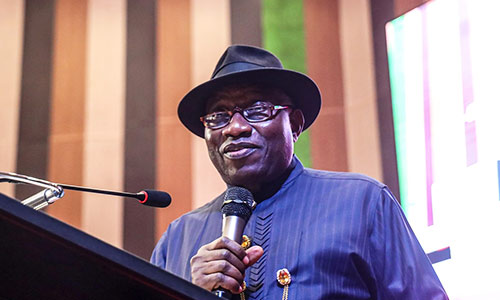
Former President Goodluck Jonathan has identified Nigeria’s poor leadership recruitment process, particularly the use of religion, language and ethnicity in selecting political leaders, as a major obstacle to the country’s progress and development.

Jonathan called for far-reaching reforms in Nigeria’s democratic system, warning that the continued recruitment of leaders based on ethnic, religious and linguistic considerations could undermine the vision and aspirations of the country’s founding fathers.
The former President spoke on Saturday, November 14, 2026, at the maiden Herbert Macaulay Colloquium, organised by the Macaulay Heritage Foundation in partnership with the Lagos State Ministry of Tourism, Arts and Culture, at the Nigerian Institute of International Affairs (NIIA), Victoria Island, Lagos.
Jonathan, who chaired the event, spoke on the theme, “Nationalism and Nation Building,” as the gathering commemorated the 162nd birthday of Nigerian nationalist Herbert Macaulay.
He recalled that Nigeria’s founding fathers had envisioned a united country where every citizen, irrespective of ethnic, religious or social background, would enjoy equal rights, dignity and opportunities.
According to him, the founding fathers worked towards establishing a nation where citizens would determine their own destiny, exercise control over their resources and deploy those resources towards national development and the welfare of the people.
However, Jonathan expressed regret that Nigeria had yet to realise those aspirations 66 years after attaining independence.
He acknowledged that the country had recorded progress in some areas but maintained that persistent challenges continued to undermine its development.
“Although the country had recorded progress in some areas, challenges such as poor leadership, institutional weaknesses, corruption, policy inconsistency, inadequate infrastructure, insecurity and dependence on raw material exports had continued to undermine national development.”
The former President maintained that the country’s leadership recruitment process remained a major concern, particularly where ethnic affiliation, religious identity and language influenced the selection of those entrusted with public responsibilities.
He consequently emphasised the need for reforms to strengthen Nigeria’s democracy and address the challenges preventing the country from achieving the aspirations of its founding fathers.
Jonathan also commended the descendants of Herbert Macaulay, particularly Chief Bode George, for organising the colloquium to commemorate the nationalist’s contributions to Nigeria.
[A MUST HAVE] Evidence Act Demystified With Recent And Contemporary Cases And Materials

Available now for NGN 40,000 at ASC Publications, 10, Boyle Street, Onikan, Lagos. Beside High Court, TBS. Email publications@ayindesanni.com or WhatsApp +2347056667384. Purchase Link: https://paystack.com/buy/evidence-act-complete-annotation
______________________________________________________________________ “Enhance Legal Practice With Authoritative Reports” — Alexander Payne Offers Comprehensive Law Reports, Spanning Over A Century Of Nigerian Jurisprudence Interested buyers are encouraged to place their orders and enquiries via:
0704 444 4777, 0704 444 4999, 0818 199 9888
Website: www.alexandernigeria.com
“A Comprehensive Guide To Evidence Law” — Releases Second Edition In Three Volumes, Covering 4,051 Cases
For enquiries and orders, contact: 08035526491 Email: jerryamadisilk@gmail.com
 Prof. Jerry Amadi’s Evidence Law, Second Edition (2026), contains 3,314 pages in three volumes, covering the Evidence Act 2011, its 2023 amendment, and 4,051 Nigerian and English cases.