Human rights lawyer and Senior Advocate of Nigeria, Femi Falana, has urged the Federal Government to seek full membership of the BRICS economic bloc, prioritise domestic refining of crude oil and adopt alternative economic policies capable of promoting national development, insisting that Nigeria has no business with poverty given its enormous resources.

Falana made the call on Tuesday, November 10, 2026, while delivering the keynote address at the sixth edition of the Frontier Discourse Annual Public Lecture Series and Awards, organised by Pacesetter Frontier Magazine at Merit House, Maitama, Abuja.
Speaking on the theme, “Barrel to Ballot: The Naturalisation of Violence, Nigeria’s Polity, and its Democratic Circus,” the senior lawyer criticised Nigeria’s reliance on economic prescriptions from international financial institutions, arguing that the country must pursue policies that encourage domestic production, protect national resources and improve the welfare of its citizens.
He noted that Nigeria became a partner country of BRICS in January 2025 but maintained that the Federal Government should go further by seeking full membership to take advantage of the economic and trade opportunities available within the bloc.
According to Falana, BRICS provides participating countries with opportunities to strengthen economic cooperation, reduce dependence on the United States dollar and conduct trade using their respective national currencies.
“It’s an organisation set up to challenge the dominance of the dollar, to challenge the West, to mould the full-fledged members so that we can take advantage and trade among ourselves in your own currencies,” he said.
The senior lawyer argued that Nigeria should explore such opportunities rather than continue relying heavily on economic arrangements that, in his view, have failed to deliver the desired development outcomes.
He also identified domestic refining of crude oil as an important step towards strengthening the economy, reducing dependence on imported petroleum products and maximising the benefits of the country’s natural resources.
Falana maintained that even within Nigeria’s existing capitalist economic framework, the government could introduce policies that would support domestic production and improve the living conditions of ordinary citizens.
“Even within the bourgeois paradigm, within the bourgeois framework, consider some of them, including refining crude oil for domestic consumption in Nigeria,” he stated.
Turning to international economic policies, Falana criticised the International Monetary Fund (IMF) and the World Bank, accusing the Bretton Woods institutions of promoting policies that have failed to deliver sustainable economic development in developing countries.
He argued that continued reliance on their prescriptions could deepen economic hardship rather than produce widespread prosperity.
“No country in the world, none, has ever been developed by implementing the policies of these Bretton Woods institutions that were set up to underdevelop the economies of third world countries,” he declared.
Falana also raised concerns over financial losses allegedly suffered by Nigeria following the suspension of its cargo tracking system, citing government reports and estimates to illustrate what he described as avoidable economic leakages.
According to him, a 2021 government report indicated that Nigeria lost approximately $32 billion during the 13 years the cargo tracking system remained suspended.
He further claimed that the country incurred an additional $10 billion in losses between 2021 and 2025.
The senior lawyer maintained that such losses demonstrated the need for effective economic policies, stronger accountability and better management of the nation’s resources.
He argued that recovering lost revenues, strengthening domestic production and reducing economic leakages could provide resources to address poverty and other pressing developmental challenges.
Falana emphasised that his proposals did not necessarily require Nigeria to abandon its existing capitalist economic system, insisting that the government could pursue policies that would benefit the wider population rather than a privileged few.
“I’m not campaigning here for the socialist reconstruction of Nigeria. That will be done elsewhere. But within your own capitalist ethos, you can run this economy in a way that will be beneficial to the entirety of the Nigerian people,” he said.
He maintained that economic growth should translate into improved living conditions for citizens, rather than being measured solely by policies or financial indicators that do not directly address public welfare.
Falana further argued that neoliberal economic policies were incompatible with the goal of achieving prosperity for the majority of Nigerians.
“There can be no prosperity when you implement neoliberal policies,” he stated.
[A MUST HAVE] Evidence Act Demystified With Recent And Contemporary Cases And Materials

Available now for NGN 40,000 at ASC Publications, 10, Boyle Street, Onikan, Lagos. Beside High Court, TBS. Email publications@ayindesanni.com or WhatsApp +2347056667384. Purchase Link: https://paystack.com/buy/evidence-act-complete-annotation
______________________________________________________________________ “Enhance Legal Practice With Authoritative Reports” — Alexander Payne Offers Comprehensive Law Reports, Spanning Over A Century Of Nigerian Jurisprudence Interested buyers are encouraged to place their orders and enquiries via:
0704 444 4777, 0704 444 4999, 0818 199 9888
Website: www.alexandernigeria.com
“A Comprehensive Guide To Evidence Law” — Releases Second Edition In Three Volumes, Covering 4,051 Cases
For enquiries and orders, contact: 08035526491 Email: jerryamadisilk@gmail.com
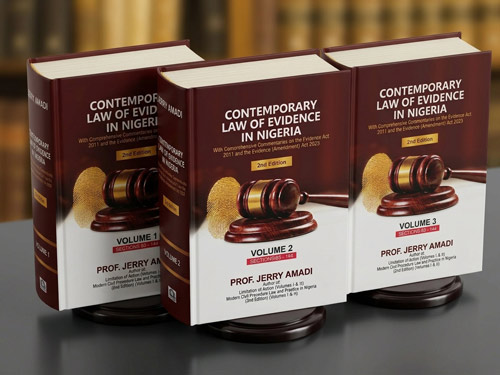 Prof. Jerry Amadi’s Evidence Law, Second Edition (2026), contains 3,314 pages in three volumes, covering the Evidence Act 2011, its 2023 amendment, and 4,051 Nigerian and English cases.