
By Festus Okoye

For Nigeria to hold a genuine election in which voters can freely express their will and the outcome reflects their choices, it must dismantle illegal roadblocks to the electoral process.
Sovereignty cannot, in law or in fact, reside with the people if they cannot confidently affirm that those in government came to power through the electorate’s free expression of will. Citizens must be able to go to the polls, cast their ballots, and celebrate the democratic process.
Eligible registered voters who face no constitutional or legal impediment must be able to exercise their franchise and leave the polling stations confident that they have fulfilled their civic duty as citizens of the Federal Republic of Nigeria. That is the essence of a genuine election. Achieving this requires establishing appropriate conditions before, during, and after an election.
These conditions must enable citizens to participate freely and with confidence in the electoral process and ensure that the outcome reflects their genuine preferences. As the supreme law of the land, the Constitution of the Federal Republic of Nigeria establishes the institutions and powers of government, including the Legislature, the Executive, and the Judiciary.
It provides the legal foundation for the country’s democracy. The Constitution affirms that Nigeria is a constitutional democracy grounded in the rule of law and due process.
Accordingly, all government institutions and authorities must discharge their functions in accordance with the Constitution and other applicable laws. This obligation extends to the electoral management body established under the constitutional framework and to political parties recognised and registered under the law.
Consequently, government institutions, political actors, and other stakeholders must dismantle any unconstitutional roadblocks erected to undermine the constitutional and electoral order. What roadblocks have anti-democratic forces erected to hijack or violate the sovereign right of Nigerian voters?
What obstacles must be removed to enable Nigeria to hold free, fair, credible, and peaceful elections in 2027?
The Constitution and Legal Framework
A genuine election does not begin and end with casting, sorting, and counting ballots, announcing results, or declaring a winner—whether the winner is chosen freely by voters or imposed by manipulation.
An election is a comprehensive process that spans the entire electoral cycle: the pre-election period, election day, and the post-election period. A credible election begins with a clear, predictable, fair, and just legal framework.
It also requires that all critical stakeholders know when an election is scheduled and trust that announced dates and statutory timelines will not be arbitrarily altered or manipulated. Legal certainty is indispensable to electoral integrity.
When rules are unclear, inconsistently applied, or altered to favour particular interests, public confidence in the process is undermined. The constitutional and legal framework must therefore provide a firm foundation for electoral competition, equal treatment, accountability, and the peaceful transfer of power.
A Credible Electoral Management Body
Voters and other key stakeholders are likely to view a weak, timid, compromised, or indecisive electoral management body as a major obstacle to credible elections.
Consequently, government institutions, political actors, and other stakeholders must dismantle any unconstitutional roadblocks erected to undermine the constitutional and electoral order.
An effective electoral management body must demonstrate integrity, competence, and independence and possess the institutional authority to command stakeholders’ respect throughout the electoral process.
An electoral management body that prioritises pleasing the appointing authority or courting public approval and social media recognition risks compromising its institutional purpose and credibility. Its legitimacy must stem from faithfully fulfilling its mandate, not from political favour or popular acclaim.
A weak or compromised electoral management body seriously obstructs credible elections. When it fails to fulfil its responsibilities, those failures must be exposed, addressed, and remedied through appropriate legal and institutional mechanisms.
Voter Disengagement
The future of democracy and the electoral process rests largely with young Nigerians, particularly those aged 18 to 34. They inherit the country’s democratic legacy and carry the torch for its future.
When young people register in large numbers and turn out to vote, they signal confidence in the electoral process and strengthen the foundations of democratic governance. When they refuse to register or stay away from polling stations, their absence raises serious questions about the health of the democratic system.
To address these perceptions, we must dismantle the barriers that prevent young people from participating in the electoral process. It may be difficult to persuade citizens to remain confident in a political system that appears unable to explain or remedy the persistence of poverty despite abundant national resources.
It may also be increasingly difficult to convince younger Nigerians to reject unconstitutional governments when democratic institutions fail to deliver tangible benefits to their lives. Nevertheless, young Nigerians can be encouraged to move beyond the symbolic politics of social media and to use their votes to pursue incremental yet meaningful changes in governance structures and practices.
Online engagement has its place, but it cannot replace participation in the electoral process. Nigerians, particularly younger citizens, must dismantle the roadblock of disengagement and actively participate in elections. Progress requires engagement, not withdrawal.
Although voting alone cannot resolve every structural problem, disengagement further weakens citizens’ ability to influence the government’s direction.
An Opaque Voter Register
A credible electoral process depends on a reliable, transparent voter register that accurately reflects eligible citizens who wish to register. An opaque, inaccurate, or poorly managed register cannot inspire confidence in the electoral system.
When eligible citizens avoid registration centres because they believe democracy has failed to improve their lives, the problem goes beyond registration. It signals a broader crisis of trust and participation that must be addressed.
The credibility of the voter register must be assessed not only by the number of registered voters but also by its accuracy, transparency, and usefulness in supporting the electoral process. Nigeria cannot credibly celebrate a growing register while ignoring persistently low voter turnout.
The challenge is therefore twofold: maintaining an accurate and transparent register and creating conditions in which citizens are willing and able to exercise their right to vote.
A Toxic Electoral Environment
Voter disengagement is often described as voter apathy.
While the term captures some reluctance to participate, it does not fully explain the range of factors behind voter withdrawal. Some citizens are willing to exercise their democratic rights but are deterred by fear.
When voters look outside their homes and see heavily armed political thugs moving through their communities, threatening residents, intimidating opponents, or disrupting public order, they may reasonably conclude that going to the polls is too dangerous.
In such circumstances, low voter turnout cannot be attributed solely to indifference. It may stem from insecurity, intimidation, and the state’s failure to ensure citizens’ safety.
Nigeria’s toxic electoral environment, coupled with the normalisation of electoral impunity as a feature of political competition, contributed to the crises that undermined the First and Second Republics. The consequences for national security and democratic stability were profound.
Successive government-appointed committees and reform initiatives have consistently identified electoral violence as a major threat to Nigeria’s democratic development and electoral integrity.
Recognising the need to confront electoral impunity, the Electoral Reform Committee (ERC), which worked in 2007–2008, recommended establishing an Electoral Offences Commission and prepared a bill to implement the proposal.
The Committee emphasised the need to address both electoral violence and its underlying causes through effective regulation of electoral actors, comprehensive enforcement of electoral laws, and the deployment of well-trained, impartial security personnel to protect the electoral process.
Similarly, the 2014 National Conference recommended establishing a Political Parties Regulation and Electoral Offences Commission (PPREOC).
The proposed commission would regulate political parties, enforce the Electoral Act, investigate and prosecute electoral offences, curb political thuggery and electoral fraud, and strengthen cooperation with other democracies to combat electoral malpractice.
The Federal Government Investigation Panel’s main report on the 2011 Election Violence and Civil Disturbances, submitted in September 2011 and commonly known as the Lemu Panel report, highlighted the severe security consequences of electoral violence.
The report recorded 943 deaths, 838 injuries, 626 arrests, and property losses estimated at ₦40,691,963,884.95. It also documented the use of weapons, including improvised explosive devices, firearms, machetes, clubs, and other dangerous weapons, in the disturbances.
Dismantling the roadblocks to credible elections therefore requires more than legal provisions on paper. It demands political will, institutional integrity, public accountability, and an electoral environment in which every eligible Nigerian can register, campaign, vote, and have their vote counted without fear.
[A MUST HAVE] Evidence Act Demystified With Recent And Contemporary Cases And Materials

Available now for NGN 40,000 at ASC Publications, 10, Boyle Street, Onikan, Lagos. Beside High Court, TBS. Email publications@ayindesanni.com or WhatsApp +2347056667384. Purchase Link: https://paystack.com/buy/evidence-act-complete-annotation
______________________________________________________________________ “Enhance Legal Practice With Authoritative Reports” — Alexander Payne Offers Comprehensive Law Reports, Spanning Over A Century Of Nigerian Jurisprudence Interested buyers are encouraged to place their orders and enquiries via:
0704 444 4777, 0704 444 4999, 0818 199 9888
Website: www.alexandernigeria.com
“A Comprehensive Guide To Evidence Law” — Releases Second Edition In Three Volumes, Covering 4,051 Cases
For enquiries and orders, contact: 08035526491 Email: jerryamadisilk@gmail.com
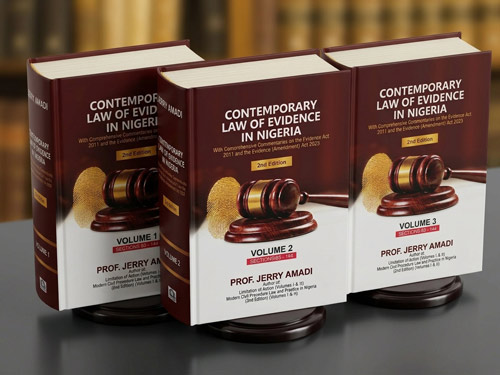 Prof. Jerry Amadi’s Evidence Law, Second Edition (2026), contains 3,314 pages in three volumes, covering the Evidence Act 2011, its 2023 amendment, and 4,051 Nigerian and English cases.