By Victor Sunday

1. Introduction
Many constitutions begin with the same three words: ‘We the people’. The American Constitution does so and so do the constitutions of Nigeria, South Africa and Kenya.[1] The words suggest that the people wrote the constitution and that they remain the final source of power. In many cases, none of these claims is fully true. The people did not write the Constitution, not all of them were counted as part of ‘the people’, and in reality, the power of ordinary citizens is far smaller than the words suggest.
These are constitutional lies even though the word is used with care. Though most makers of the constitution were not trying to cheat anyone, they were using what is called a legal fiction i.e, a statement that the law treats as true even though everyone, in some sense, knows it is not. Therefore, are such fictions harmless or even useful? And at what point does a useful fiction become a harmful lie in the grand scheme of things?
2. The Power of a Fiction
The French writer Emmanuel Sieyès[2] argued in 1789 that the nation holds constituent power, which is the power to make a constitution and that every government afterwards holds only the power the constitution gives it. Carl Schmitt later described constituent power as the political will of the people to decide the basic form of its own existence.[3] The attraction of the idea is plain. If the people made the constitution, then the constitution has a stronger claim to obedience than a law made by a king or a general.
Edmund Morgan, a historian of the founding of America, argued that popular sovereignty was itself a fiction, in the same way that the divine right of kings had been a fiction. Government, he said, requires a measure of make believe, and the fiction of the people replaced the fiction of the monarch.[4] The people who sign a declaration in the name of ‘the people’ only become a people by signing it, so the document creates the very body that it says already exists.[5]
The reason these fictions matter is legitimacy which is the belief that those who rule have a right to rule. Max Weber observed that no system of power survives on force alone and that every system works to cultivate a belief in its own right to command.[6] In a modern state, the claim that the people made and approve the constitution is one of the main ways of building that belief.
However, some fictions are useful as Plato imagined a ‘noble lie’ told to citizens so that they would accept their place in a just city.[7] A constitution does something similar but with an important difference. While Plato’s lie was meant to be believed and never questioned, a constitutional fiction is more honest when it works as a standard that citizens can use to judge their rulers.
3. Who Really Wrote the Constitution?
The American case shows how far this can be from the facts. The Constitution of 1787 was drafted by delegates who met in secret in Philadelphia and it was approved not by a national vote but by conventions in the States whose members were chosen by electorates that excluded women, enslaved people and in many places, men without property.[8] Chief Justice Marshall wrote in McCulloch v Maryland that the Constitution came from the people who had acted through those conventions.[9] Whether one accepts that explanation or not, the people’s role was real but partial.
The Nigerian case presents a starker reality as we can see that the 1999 Constitution of the Federal Republic of Nigeria opens with a preamble in which ‘We the people of the Federal Republic of Nigeria’ declare that they ‘make, enact and give to ourselves’ the Constitution.[10] In fact, the document was promulgated by the military government (a clique, preferably) of General Abdulsalami Abubakar as Decree No 24 of 1999 and took effect on 29 May 1999.[11] It was not put to a referendum, and it was not drawn up by a body chosen by the people for that purpose. It was based largely on the 1979 Constitution and on drafts from earlier processes.
Nigeria’s earlier efforts at constitution making had been somewhat more open, though none was fully popular. The 1979 Constitution came from a Constitution Drafting Committee appointed by the military government and then a Constituent Assembly. A Constituent Assembly also sat in 1988 for the Constitution of 1989 which never saw the light of the day and a National Constitutional Conference met in 1994 and 1995 under General Abacha, whose draft was never implemented. In 2014, a National Conference was convened by the Federal Government but its recommendations were not carried into law. The pattern is that Nigerians have been consulted often, but they have rarely been allowed to decide.
3.1. In Defence of the 1999 Constitution
Defenders of the 1999 Constitution might argue that a constitution can gain the consent of the people after the event as well as before it. Since 1999 Nigerians have voted in successive elections held under the Constitution, political parties have competed under its rules, citizens have taken their disputes to courts that apply it, and an elected National Assembly and elected State legislatures have amended it several times. On this view, the Constitution has been accepted through use, which is a form of ratification by practice. A long and mostly peaceful period of use is some evidence of acceptance. But it is weaker than it looks because people who have no alternative on offer cannot be said to have chosen the only one they have and continued use may reflect habit or lack of choice more than approval. The fair conclusion is that acceptance by practice reduces the harm of the original defect but does not remove it.
The same pattern appears in the content of the Constitution. Section 315(5) of the CFRN preserves a group of earlier enactments, among them the Land Use Act, and treats them as part of the Constitution for the purpose of amendment.[12] A law made under military rule thus enjoys the protection of a constitution that claims to come from the people. It is an uncomfortable sign that the ‘we’ in the preamble may have been less in control than the words imply.
4. Who Counts as the People?
History shows that the phrase ‘we the people’ has often meant only some. In the original American Constitution, enslaved persons were counted as three-fifths of a person for the purpose of representation, Congress was allowed to permit the slave trade until 1808 and States were required to return people who escaped from slavery.[13] In Dred Scott v Sandford the Supreme Court went further and held that people of African descent were not part of ‘the people’ for whom the Constitution speaks and could not be citizens.[14] Women gained a constitutional right to vote only through the Nineteenth Amendment in 1920 and Native Americans were declared citizens by statute in 1924.[15]
This part of the story has a hopeful side since the same words that once excluded became the tool for demanding inclusion. The excluded groups contended that if the Constitution was made by ‘the people’, they were part of the people and they used the promise to challenge the practice. The fiction gave them an argument that an honest statement of the original facts would not have given.
In Nigeria, the question of who ‘the people’ are is tied to the debate about inclusion and national unity. The preamble speaks of ‘one indivisible and indissoluble sovereign nation’, and section 2(1) repeats the idea.[16] Yet, Chief Obafemi Awolowo wrote in his 1947 Path to Nigerian Freedom that Nigeria was a ‘mere geographical expression’, a phrase that expressed doubt about whether the many peoples within its borders already formed a single political community.[17] Obviously, many citizens feel stronger loyalty to their ancestral communities than to the state. A constitution that declares unity as a settled fact, without asking the communities concerned, may find that the claim is hard to defend in a crisis.
5. Who Holds Real Power Today?
Section 14(2)(a) of the 1999 Constitution says that sovereignty belongs to the people of Nigeria, from whom the government derives all its powers and authority.[18] A fair test of that statement is to ask what the people can actually do. They can vote in elections and that is a real power. Beyond that, the Constitution gives them little. Section 69 allows voters to recall a Senator or a member of the House of Representatives, and section 110 does the same for State legislators,[19] but does the power extend to the President or to Governors? Selah!
More importantly, the people do not control the Constitution itself. Under section 9, an amendment must be passed by two thirds of both Houses of the National Assembly and approved by the Houses of Assembly of at least two thirds of the States.[20] At no point must the voters be asked. The same is true of the highest changes. However, in other systems the position is different. The Constitution of Ghana requires a referendum for changes to its entrenched provisions,[21] and the Constitution of Kenya requires one for amendments to certain fundamental matters, including the sovereignty of the people.[22] In Nigeria, the people are named as the authors of the Constitution but are kept out of its revision. That is the clearest sign that the claim of sovereignty is stronger on paper than in practice.
6. Does the Lie Matter in Law?
The short answer is that it has fewer than one might expect because Courts rarely ask who wrote a constitution or a law. They ask whether it is in force. Hans Kelsen taught that the validity of a legal order rests in the end on its general effectiveness, and that is how many courts have behaved.[23] Courts in Pakistan and Uganda accepted the validity of governments that took power by force once those governments had become effective, as in State v Dosso and Uganda v Commissioner of Prisons, ex parte Matovu.[24] On this view, the Nigerian Constitution is binding because it works as the supreme law, and section 1(1) says that it binds all authorities and persons whether or not the people wrote it.[25]
The preamble itself has an uncertain place as Indian courts first held that the preamble was not part of the Constitution, but the Supreme Court of India later reversed that view and treated the preamble as a key to the meaning of the whole text as seen in the re Berubari Union and Exchange of Enclaves[26] and Kesavananda Bharati v State of Kerala[27] cases respectively. This is the way a fiction becomes legally useful.
There is also a practical cost when a fiction is exposed as many Nigerians, including lawyers and commentators, describe the 1999 Constitution as a military document, and calls for a ‘people’s constitution’ recur in public debate. Such language shows that the claim in the preamble does not persuade everyone. When people stop believing a constitutional claim, they are less likely to treat the constitution as their own property to be guarded. That is the real danger of the lie of authorship. It does not make the Constitution invalid, but it can weaken the sense of ownership on which any lasting constitutional order depends.
7. Making the ‘Lie’ True
If a constitutional lie cannot be removed, it can be made true over time. Several countries show how. South Africa wrote its 1996 Constitution through a Constitutional Assembly that invited the public to make submissions, and the Constitutional Court reviewed the final text against agreed principles before it took effect.[28] Ghana’s Constitution of 1992 was approved by voters in a referendum and Kenya’s 2010 Constitution was likewise approved at a referendum.[29] In each case the people did not draft the Constitution but they were given a real chance to accept or reject it and that is a long way from a decree.
For Nigeria, several steps would make the claim in the preamble more honest. The first and most direct would be a constitutional provision requiring a referendum for new constitutions and for changes to the most basic provisions, as in Ghana and Kenya. This would need to be enacted through the existing amendment procedure in section 9.
The second would be a more open process for future constitutional review including public hearings and published reasons, so that citizens can see how their views are used. The third would be to give real force to the principle in section 14(2)(c), which states that the participation of the people in their government shall be ensured.[30]
However, it is important to note that a referendum or a new constituent assembly is not a magic cure because many African constitutions were made through processes that looked open but were controlled by those who expected to rule under them.[31] What matters is the quality of the process i.e, whether the public is given honest information, whether independent bodies run the exercise, and whether the result is binding on those who organized it. A hollow consultation would simply produce a new and more elaborate version of the old fiction.
Citizens also have a part to play. Constitutional lies survive when people do not use the language of the Constitution to demand more of those in power. The campaign known as ‘Not Too Young To Run’ persuaded the legislature to lower the minimum age for several elective offices.[32] Whatever one thinks of the result, it shows that organized citizens can use the Constitution’s own promise to change it.
8. Conclusion
‘We the people’ is one of the oldest fictions in constitutional law. It claims that the people wrote the constitution, that all of them are included, and that they remain in charge. In many countries, including Nigeria, none of these claims is fully true. The Nigerian preamble speaks for a people who did not draft the text. Yet the fiction is not worthless as it gives citizens a language in which to ventilate their grievances and a standard by which to judge those who govern. The danger lies in treating the fiction as a settled fact, because that protects the powerful from the very questions the fiction ought to invite.
Victor Sunday is a legal writer, orator, and public affairs analyst and can be reached at victorsundayonwukwe@gmail.com
References
[1] Constitution of the United States 1787, preamble; Constitution of the Federal Republic of Nigeria 1999 (as amended) (CFRN), preamble; Constitution of the Republic of South Africa 1996, preamble; Constitution of Kenya 2010, preamble.
[2] Emmanuel Joseph Sieyès, Political Writings (Michael Sonenscher ed and tr, Hackett 2003).
[3] Carl Schmitt, Constitutional Theory (Jeffrey Seitzer tr and ed, Duke University Press 2008).
[4] Edmund S Morgan, Inventing the People: The Rise of Popular Sovereignty in England and America (WW Norton 1988).
[5] Jacques Derrida, ‘Declarations of Independence’ (Tom Keenan and Tom Pepper trs) (1986) 15 New Political Science 7.
[6] Max Weber, Economy and Society (Guenther Roth and Claus Wittich eds, University of California Press 1978).
[7] Plato, The Republic bk III, 414b to 415d.
[8] Constitution of the United States 1787, art VII.
[9] McCulloch v Maryland 17 US (4 Wheat) 316, 402 to 405 (1819).
[10] CFRN, preamble.
[11] Constitution of the Federal Republic of Nigeria (Promulgation) Decree No 24 of 1999.
[12] CFRN, s 315(5).
[13] Constitution of the United States 1787, art I, s 2, cl 3; art I, s 9, cl 1; art IV, s 2, cl 3.
[14] Dred Scott v Sandford 60 US (19 How) 393 (1857).
[15] Constitution of the United States, amendments XIII, XIV and XIX; Indian Citizenship Act 1924.
[16] CFRN, preamble and s 2(1).
[17] Obafemi Awolowo, Path to Nigerian Freedom (Faber and Faber 1947) 47 to 48.
[18] CFRN, s 14(2)(a).
[19] CFRN, ss 69 and 110.
[20] CFRN, s 9(2).
[21] Constitution of the Republic of Ghana 1992, arts 1(1) and 290.
[22] Constitution of Kenya 2010, arts 1(1) and 255.
[23] Hans Kelsen, Pure Theory of Law (Max Knight tr, University of California Press 1967).
[24] State v Dosso PLD 1958 SC 533; Uganda v Commissioner of Prisons, ex parte Matovu [1966] EA 514.
[25] CFRN, s 1(1).
[26] In re Berubari Union and Exchange of Enclaves AIR 1960 SC 845.
[27] Kesavananda Bharati v State of Kerala AIR 1973 SC 1461.
[28] Ex parte Chairperson of the Constitutional Assembly: In re Certification of the Constitution of the Republic of South Africa 1996 1996 (4) SA 744 (CC).
[29] Constitution of the Republic of Ghana 1992; Constitution of Kenya 2010.
[30] CFRN, s 14(2)(c).
[31] HWO Okoth-Ogendo, ‘Constitutions without Constitutionalism: Reflections on an African Political Paradox’ in Douglas Greenberg and others (eds), Constitutionalism and Democracy: Transitions in the Contemporary World (OUP 1993) 65.
[32] CFRN, ss 65, 106, 131 and 177 (as amended).
[A MUST HAVE] Evidence Act Demystified With Recent And Contemporary Cases And Materials

Available now for NGN 40,000 at ASC Publications, 10, Boyle Street, Onikan, Lagos. Beside High Court, TBS. Email publications@ayindesanni.com or WhatsApp +2347056667384. Purchase Link: https://paystack.com/buy/evidence-act-complete-annotation
______________________________________________________________________ “Enhance Legal Practice With Authoritative Reports” — Alexander Payne Offers Comprehensive Law Reports, Spanning Over A Century Of Nigerian Jurisprudence Interested buyers are encouraged to place their orders and enquiries via:
0704 444 4777, 0704 444 4999, 0818 199 9888
Website: www.alexandernigeria.com
“A Comprehensive Guide To Evidence Law” — Releases Second Edition In Three Volumes, Covering 4,051 Cases
For enquiries and orders, contact: 08035526491 Email: jerryamadisilk@gmail.com
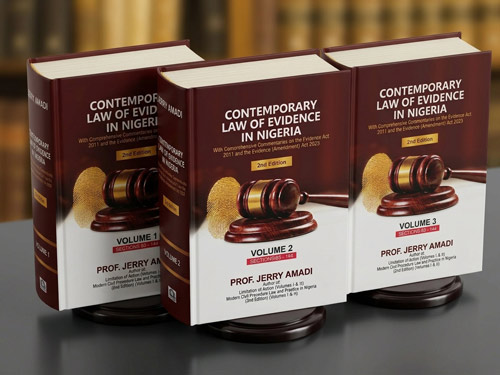 Prof. Jerry Amadi’s Evidence Law, Second Edition (2026), contains 3,314 pages in three volumes, covering the Evidence Act 2011, its 2023 amendment, and 4,051 Nigerian and English cases.