The Independent National Electoral Commission (INEC) has condemned the “rig and die” slogan being promoted by some political actors ahead of the 2027 general elections, warning that such inflammatory statements could expose innocent Nigerians to violence and undermine the credibility of the electoral process.

The Commission also warned that electoral officials, including ad hoc personnel, found to have compromised the conduct of elections would face sanctions in accordance with the law.
INEC National Commissioner and Chairman of the Information and Voter Education Committee, Mohammed Kudu Haruna, issued the warning at a media engagement forum for journalists and media executives from the South-East, South-South and South-West geopolitical zones, held in Enugu State.
Haruna expressed concern over the increasing use of threatening political language, cautioning that slogans encouraging confrontation could endanger presiding officers, ad hoc electoral staff, political party agents, election observers and ordinary voters.
He stressed that disagreements over electoral outcomes must be addressed through lawful channels, including complaints to INEC, security agencies and the courts, rather than resorting to violence or intimidation.
The National Commissioner maintained that the electoral process must be protected from inflammatory rhetoric capable of creating fear among voters and individuals assigned to election duties.
He also reaffirmed the Commission’s determination to ensure accountability, warning that any permanent or temporary electoral official found to have compromised the process would face the full weight of the law.
As part of preparations for the 2027 elections, Haruna called for stronger collaboration between INEC and media organisations to promote credible, peaceful, transparent and inclusive elections.
He described the media as an important institution in safeguarding democracy, noting that public confidence in elections depended considerably on the accuracy, fairness and professionalism of information disseminated to Nigerians.
The INEC official warned journalists against publishing misinformation, unverified election results, manipulated videos and inflammatory political narratives that could mislead voters or provoke violence.
He particularly cautioned against the premature declaration of election results and the presentation of projections or unofficial figures as authentic results released by the Commission.
“Results are declared only by the Commission through its duly appointed returning officers. Projections and unofficial figures must be clearly labelled as such,” Haruna said.
He urged journalists to verify allegations involving INEC through the Commission’s official communication channels before publication.
According to him, responsible electoral reporting requires journalists to distinguish between incidents they personally witnessed and information obtained from other sources.
He also advised media practitioners to exercise sensitivity when reporting electoral disputes, allegations of irregularities and incidents involving political parties or their supporters.
Haruna further called for inclusive election coverage that adequately reflects the interests and concerns of women, young people and persons with disabilities.
He maintained that the media should pay attention to challenges affecting the participation of these groups in the electoral process rather than concentrating exclusively on political candidates and party activities.
The National Commissioner also urged journalists to intensify public education on Permanent Voter Cards (PVCs), voter accreditation procedures, electronic transmission of election results and peaceful participation in elections.
He emphasised that adequate voter education would help citizens understand electoral procedures and reduce the circulation of misleading information about voting and result management.
Speaking on ethical and professional standards in election reporting, a resource person, Osaretin Imahheyierobo, urged journalists to familiarise themselves with the Electoral Act 2026, INEC’s election coverage guidelines and the Nigerian Broadcasting Code.
Imahheyierobo expressed concern that some journalists assigned to cover elections lacked sufficient knowledge of the legal and regulatory provisions governing electoral reporting.
He therefore called on media organisations to establish dedicated election desks, develop clear editorial guidelines and introduce effective fact-checking mechanisms ahead of the 2027 general elections.
The resource person also urged journalists to understand the Commission’s technological innovations, particularly the Bimodal Voter Accreditation System (BVAS) and the INEC Result Viewing Portal (IReV).
He explained that a proper understanding of these systems would help journalists avoid inaccurate reporting about voter accreditation, electronic transmission and the management of election results.
Imahheyierobo further cautioned journalists against compromising professional ethics in exchange for financial inducements, commonly referred to as brown envelopes.
He maintained that political candidates and their programmes should be subjected to proper scrutiny rather than having their claims, campaign promises and manifestoes repeated without critical examination.
The resource person also advocated equitable media access for political parties and candidates, stressing that voters required balanced and accurate information to make informed electoral decisions.
He warned media organisations against amplifying violent slogans and inflammatory statements capable of exposing voters, electoral officials and observers to danger.
Earlier, the Enugu State Resident Electoral Commissioner (REC), Dr. Chukwuemeka Chukwu, described the engagement as part of INEC’s efforts to strengthen its relationship with the media ahead of the 2027 elections.
Chukwu acknowledged the media’s role in voter education, shaping public opinion and holding public institutions accountable, but warned that misinformation could weaken public confidence in the electoral process.
He disclosed that the Commission had received approximately 35,000 Permanent Voter Cards for distribution across 260 wards in Enugu State.
The REC urged journalists to support public enlightenment campaigns to ensure that eligible voters were informed about the availability and collection of their PVCs.
While recognising the media’s independence and watchdog responsibilities, Chukwu called on journalists to uphold accuracy, objectivity, fairness and professionalism when reporting election-related activities.
He assured participants that INEC remained committed to conducting an acceptable, transparent, inclusive and peaceful general election in 2027.
The REC also said the Commission was open to constructive criticism and recommendations from media stakeholders, stressing that such engagement could strengthen electoral administration.
Chukwu urged journalists to educate voters about their responsibilities before, during and after elections to enable them to participate peacefully and make informed choices.
In his remarks, the Chairman of the Nigeria Union of Journalists (NUJ), Enugu State Council, Comrade Obinna Ogbuka, commended INEC for organising the media engagement but expressed concern that the initiative had not commenced earlier.
Ogbuka argued that beginning the training earlier would have enabled more journalists to benefit before the commencement of major activities in the electoral cycle.
He also raised concerns about the apparent absence of adequate budgetary provisions for journalists’ logistics during election assignments.
According to him, media practitioners require appropriate logistical support to effectively discharge their responsibilities during electoral activities.
The NUJ chairman further expressed concern over declining public confidence in INEC and urged the Commission to take deliberate steps to rebuild trust ahead of the 2027 general elections.
Other presentations at the engagement examined the legal and regulatory frameworks governing elections, relevant provisions of the Electoral Act 2026 and the rules regulating the publication and announcement of election results.
Participants commended INEC for its preparations but urged the Commission to address shortcomings observed during previous elections, particularly the technical glitches that affected electronic transmission of results during the 2023 presidential election.
The media practitioners also called on the electoral body to recognise journalists as critical stakeholders in the electoral process and ensure greater engagement with them as preparations for the 2027 general elections continue.
[A MUST HAVE] Evidence Act Demystified With Recent And Contemporary Cases And Materials

Available now for NGN 40,000 at ASC Publications, 10, Boyle Street, Onikan, Lagos. Beside High Court, TBS. Email publications@ayindesanni.com or WhatsApp +2347056667384. Purchase Link: https://paystack.com/buy/evidence-act-complete-annotation
______________________________________________________________________ “Enhance Legal Practice With Authoritative Reports” — Alexander Payne Offers Comprehensive Law Reports, Spanning Over A Century Of Nigerian Jurisprudence Interested buyers are encouraged to place their orders and enquiries via:
0704 444 4777, 0704 444 4999, 0818 199 9888
Website: www.alexandernigeria.com
“A Comprehensive Guide To Evidence Law” — Releases Second Edition In Three Volumes, Covering 4,051 Cases
For enquiries and orders, contact: 08035526491 Email: jerryamadisilk@gmail.com
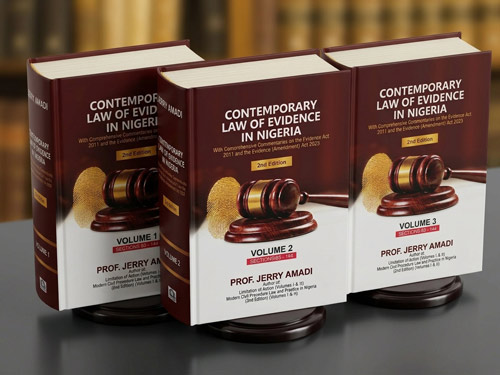 Prof. Jerry Amadi’s Evidence Law, Second Edition (2026), contains 3,314 pages in three volumes, covering the Evidence Act 2011, its 2023 amendment, and 4,051 Nigerian and English cases.