
As CJN Kekere-Ekun Warns 375 Election Tribunal Judges Against Political Pressure

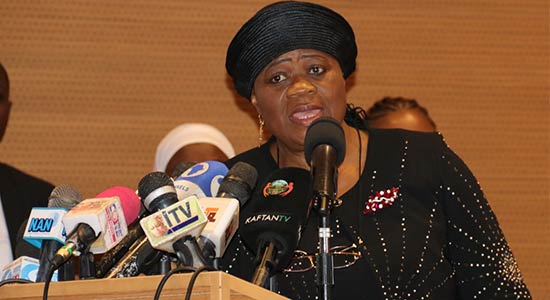
The Chief Justice of Nigeria (CJN), Justice Kudirat Kekere-Ekun, has charged newly sworn-in members of the Election Petition Tribunals for the 2027 general elections to uphold their judicial oaths, resist political interference and dispense justice without fear or favour, warning that the judiciary must remain independent and impartial in the determination of electoral disputes.
The CJN gave the charge on Monday, November 9, 2026, at the Body of Benchers Complex in Abuja, where she swore in the newly nominated tribunal members, while the President of the Court of Appeal, Justice Monica Dongban-Mensem, inaugurated 375 judges drawn from different courts and judicial institutions across the country.
The ceremony also featured the launch of the second edition of the Judicial Electoral Manual and a specialised capacity-building workshop aimed at preparing the judges for the adjudication of disputes arising from the forthcoming elections.
The preparations come ahead of the presidential and National Assembly elections scheduled for January 16, 2027, and the governorship and State Houses of Assembly elections fixed for February 6, 2027.
Addressing the judicial officers, Justice Kekere-Ekun emphasised the need for strict adherence to their oaths of office, reminding them of their constitutional responsibility to administer justice independently and in accordance with the law.
She warned them against yielding to external political pressure or allowing personal considerations and other influences to interfere with their judicial duties.
The CJN further stressed that the statutory and constitutional timelines governing election petitions must be strictly observed, insisting that there was “no room” for unnecessary trial delays or lax case management.
According to her, election petition tribunals must demonstrate the highest standards of judicial discipline and efficiency in handling disputes that may arise from the 2027 general elections.
Justice Kekere-Ekun also issued a warning to legal practitioners, political parties, media organisations and members of the public against conduct capable of undermining the independence of the judiciary or interfering with the administration of justice.
She specifically cautioned against unethical litigation practices, the abuse of ex parte applications and online media campaigns designed to prejudge pending cases or intimidate judicial officers.
The CJN maintained that the integrity of the electoral process and democratic institutions depended on the collective responsibility of all stakeholders to respect the law and the independence of the courts.
She noted that while the Independent National Electoral Commission (INEC), security agencies and the Nigerian Bar must discharge their respective statutory responsibilities conscientiously, the judiciary’s duty remained the impartial resolution of disputes strictly on the basis of applicable laws and evidence presented before the courts.
Justice Kekere-Ekun consequently urged the tribunal members to remain focused on their constitutional responsibilities and resist attempts to influence their decisions through political pressure, public commentary or other improper means.
In her remarks, the President of the Court of Appeal, Justice Monica Dongban-Mensem, described the inauguration of the 375 judges as an important institutional preparation for the judiciary’s responsibilities during the 2027 electoral process.
She disclosed that the judges were selected from different courts and judicial institutions across Nigeria, with 138 having previously served on election petition tribunals, while the remaining 237 would be undertaking the assignment for the first time.
The judges are expected to determine petitions filed by political parties and candidates dissatisfied with the outcomes of the general elections.
The exercise was conducted pursuant to Section 285(1) and (2) of the 1999 Constitution, as amended, which empowers the President of the Court of Appeal to constitute election petition tribunals to determine disputes arising from National and State Houses of Assembly elections and governorship elections.
Similarly, Section 134(3)(a) and (b) of the Electoral Act 2026 provides for the timelines within which the tribunals must be established and their registries opened.
Justice Dongban-Mensem explained that the inauguration demonstrated the judiciary’s commitment to constitutional democracy, the rule of law and the credibility of Nigeria’s electoral system.
She maintained that democratic legitimacy depended not only on credible elections but also on the existence of impartial, effective and timely judicial mechanisms for resolving electoral disputes.
“This gathering is more than a ceremonial event; it is an important institutional preparation for one of the most consequential responsibilities entrusted to the judiciary,” she said.
“The credibility of democracy depends not only on the conduct of elections but also on the existence of impartial, effective, and timely mechanisms for resolving electoral disputes.
“Through the fair determination of such disputes, the Judiciary safeguards the people’s mandate, upholds constitutional supremacy and sustains public confidence in democratic governance.”
The President of the Court of Appeal emphasised that election petition tribunals occupy an important position in Nigeria’s constitutional framework because they provide the judicial mechanism through which disagreements over electoral outcomes are resolved.
She urged the judges to approach their responsibilities with integrity, impartiality and a firm commitment to the rule of law, reminding them that their conduct and decisions would attract considerable public attention.
Justice Dongban-Mensem further stressed that the fair and timely determination of election petitions was essential to safeguarding the people’s mandate, upholding constitutional supremacy and maintaining public confidence in democratic governance.
The inauguration, launch of the second edition of the Judicial Electoral Manual and specialised training workshop form part of the judiciary’s preparations to ensure that election petition tribunals are equipped to discharge their responsibilities during the 2027 general elections.
[A MUST HAVE] Evidence Act Demystified With Recent And Contemporary Cases And Materials
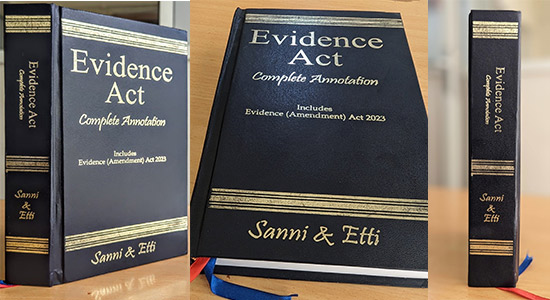
Available now for NGN 40,000 at ASC Publications, 10, Boyle Street, Onikan, Lagos. Beside High Court, TBS. Email publications@ayindesanni.com or WhatsApp +2347056667384. Purchase Link: https://paystack.com/buy/evidence-act-complete-annotation
______________________________________________________________________ “Enhance Legal Practice With Authoritative Reports” — Alexander Payne Offers Comprehensive Law Reports, Spanning Over A Century Of Nigerian Jurisprudence Interested buyers are encouraged to place their orders and enquiries via:
0704 444 4777, 0704 444 4999, 0818 199 9888
Website: www.alexandernigeria.com
“A Comprehensive Guide To Evidence Law” — Releases Second Edition In Three Volumes, Covering 4,051 Cases
For enquiries and orders, contact: 08035526491 Email: jerryamadisilk@gmail.com
 Prof. Jerry Amadi’s Evidence Law, Second Edition (2026), contains 3,314 pages in three volumes, covering the Evidence Act 2011, its 2023 amendment, and 4,051 Nigerian and English cases.