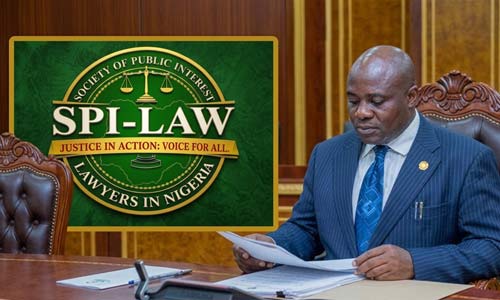
*Warns Imo AG Over NJC Directive On Justice Agugua, Threatens LPDC Petition

The Society of Public Interest Lawyers in Nigeria (SPI-LAW) has cautioned the Imo State Attorney-General and Commissioner for Justice, Hon. Paul Obinatu, against actions capable of undermining the constitutional process for appointing a substantive Chief Judge of the state, warning that proven professional misconduct could warrant disciplinary proceedings before the Legal Practitioners Disciplinary Committee (LPDC).
The group urged the Attorney-General to reconsider his reported opposition to the National Judicial Council’s (NJC) directive requesting the inclusion of Hon. Justice Ijeoma Agugua, the most senior judge of the Imo State High Court and the Acting Chief Judge, in the shortlist for appointment as substantive Chief Judge.
In a letter dated November 8, 2026, addressed to the Attorney-General and signed by its President, John Aikpokpo-Martins, SPI-LAW expressed concern over a statement reportedly made by Obinatu on November 6, challenging the NJC’s authority to request Justice Agugua’s inclusion in the appointment process.
The organisation maintained that although the Attorney-General was entitled to express legal opinions on constitutional questions, his office carried a responsibility to promote institutional cooperation, judicial independence and public confidence in the administration of justice.
“We respectfully but firmly urge you to reconsider the confrontational position attributed to your office and to facilitate a lawful, transparent and expeditious resolution of this matter,” the group stated.
Explaining the constitutional framework governing the appointment of state Chief Judges, SPI-LAW cited Section 271(1) of the 1999 Constitution, as amended, which provides that a state Chief Judge shall be appointed by the Governor on the recommendation of the NJC, subject to confirmation by the State House of Assembly.
It also referred to paragraph 6(a) of Part II of the Third Schedule to the Constitution, which assigns the State Judicial Service Commission an advisory role concerning suitable candidates, and paragraph 21(c) of Part I, which empowers the NJC to recommend candidates from the list submitted by the Commission.
According to the organisation, these provisions establish complementary constitutional responsibilities that must be exercised through cooperation rather than institutional confrontation.
“No participant should exercise its responsibility in a manner that frustrates the lawful responsibilities of the others. Equally, neither political preference nor institutional rivalry should determine access to consideration for judicial office,” SPI-LAW stated.
The group further maintained that the NJC Guidelines and Procedural Rules carry substantial legal and institutional weight in ensuring merit, integrity, consistency and transparency in judicial appointments.
While acknowledging that the guidelines cannot amend the Constitution or unlawfully enlarge the powers of the NJC, it insisted that the rules should be applied conscientiously and that disputes concerning their interpretation should be addressed through constructive engagement or the courts.
Addressing the controversy surrounding Justice Agugua’s exclusion from the shortlist, SPI-LAW clarified that seniority alone did not confer an automatic entitlement to appointment as substantive Chief Judge.
The organisation distinguished the constitutional provision governing appointment in an acting capacity under Section 271(4) from the substantive appointment process under Section 271(1).
It also cited paragraph 2.1.5 of the NJC National Judicial Policy, which recognises that comparative seniority should not prevent the appointment of deserving candidates possessing exceptional integrity and excellence.
However, the group maintained that the exclusion of the most senior serving judge, particularly one already performing the functions of Chief Judge, required an objective and defensible explanation.
“However, recognising merit does not justify disregarding seniority without a credible explanation. The exclusion of the most senior serving Judge, who is already performing the functions of Chief Judge, calls for an objective, documented and defensible assessment against the applicable criteria,” it stated.
SPI-LAW noted that the NJC’s published decision following its meeting of November 3, 2026, merely requested Justice Agugua’s inclusion in the shortlist and did not amount to her appointment as substantive Chief Judge.
It explained that her inclusion would allow her to be assessed alongside other eligible candidates without displacing the constitutional responsibilities of the State Judicial Service Commission, the NJC, the Governor or the House of Assembly.
The organisation acknowledged that the constitutional boundaries between the Commission’s shortlisting discretion and the NJC’s power to request reconsideration could legitimately be disputed.
Nevertheless, it urged the relevant authorities to facilitate Justice Agugua’s inclusion for fair assessment or present any specific legal or eligibility objection through the appropriate institutional channels.
SPI-LAW also questioned the capacity in which the Attorney-General reportedly challenged the NJC’s directive, stressing that membership of the State Judicial Service Commission did not confer unilateral authority to communicate or determine the Commission’s institutional position.
“The Commission is not a department of the Ministry of Justice, and the State Government’s position does not automatically constitute its decision,” the organisation stated.
It explained that Section 202 of the Constitution protects the Commission from external direction and control in the exercise of its specified appointment and disciplinary powers, subject to the constitutional responsibilities of the NJC.
The group therefore requested clarification on whether the Attorney-General’s statement represented a duly authorised decision of the Commission or merely the legal position of the Imo State Government.
Turning to the professional responsibilities of the Attorney-General, SPI-LAW cautioned against any conduct amounting to improper interference with the Commission’s deliberations, misrepresentation of its decisions, obstruction of the appointment process or political pressure on judicial candidates.
“Honourable Attorney-General, your office carries a particular obligation to uphold the rule of law and protect the institutions through which justice is administered. Public disagreement should be expressed with the restraint, accuracy and respect expected of the State’s chief law officer,” the letter stated.
The organisation warned that holding public office did not exempt a legal practitioner from professional accountability.
“You should take care not to expose yourself to disciplinary proceedings through conduct that is independently capable of constituting professional misconduct. Neither public office nor membership of a constitutional commission places a legal practitioner beyond professional accountability,” it stated.
SPI-LAW, however, clarified that a genuine disagreement over constitutional interpretation, expressed honestly and pursued lawfully, did not automatically constitute professional misconduct.
It equally acknowledged that an NJC administrative directive was not automatically equivalent to an order of court.
The organisation warned that if credible evidence established deliberate misrepresentation, improper interference or other conduct constituting professional misconduct, it would consider invoking the appropriate disciplinary process.
“However, should credible evidence disclose deliberate misrepresentation, improper interference, or other conduct amounting to professional misconduct under the applicable law and professional rules, this Society will consider invoking the appropriate disciplinary process, including presenting a properly supported complaint for consideration by the Legal Practitioners Disciplinary Committee (LPDC),” it stated.
SPI-LAW emphasised that any complaint would identify the alleged misconduct, the relevant professional obligations and supporting evidence while respecting the Attorney-General’s right to respond.
The organisation consequently called on Obinatu to reconsider and clarify his reported statement, promote constructive engagement between the NJC and the State Judicial Service Commission, and ensure that any objections to Justice Agugua’s consideration were based on objective criteria.
It also urged him to respect the Commission’s collective decision-making process and support the prompt resolution of any unresolved constitutional disagreement before a competent court rather than allow the appointment process to remain stalled.
The group requested a written response detailing the steps being taken to resolve the matter.
“The office of Chief Judge is a public trust. Its appointment process must command confidence through competence, integrity, fairness and fidelity to the Constitution,” SPI-LAW stated.
Copies of the letter were sent to the Secretary of the National Judicial Council and the Chairman and Secretary of the Imo State Judicial Service Commission.
[A MUST HAVE] Evidence Act Demystified With Recent And Contemporary Cases And Materials

Available now for NGN 40,000 at ASC Publications, 10, Boyle Street, Onikan, Lagos. Beside High Court, TBS. Email publications@ayindesanni.com or WhatsApp +2347056667384. Purchase Link: https://paystack.com/buy/evidence-act-complete-annotation
______________________________________________________________________ “Enhance Legal Practice With Authoritative Reports” — Alexander Payne Offers Comprehensive Law Reports, Spanning Over A Century Of Nigerian Jurisprudence Interested buyers are encouraged to place their orders and enquiries via:
0704 444 4777, 0704 444 4999, 0818 199 9888
Website: www.alexandernigeria.com