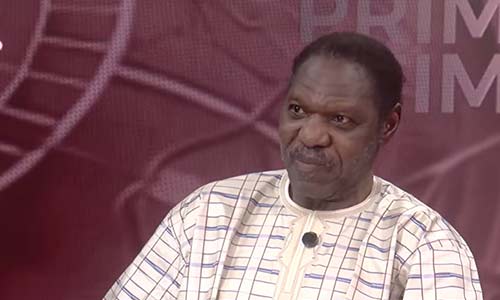
Former Senator Sola Akinyede has called on the Chief Justice of Nigeria (CJN) and the National Judicial Council (NJC) to take decisive disciplinary action against judicial officers whose conduct raises serious concerns, warning that continued reliance on appellate courts to correct questionable judgments could further undermine public confidence in the judiciary and Nigeria’s democratic system.

Akinyede, a lawyer and former senator who represented Ekiti South Senatorial District between 2007 and 2011, expressed concern over what he described as the increasing use of the judiciary by politicians to achieve political objectives, particularly in disputes involving the leadership of political parties and the eligibility of candidates for elections.
His remarks followed the judgment of Justice Peter Lifu of the Federal High Court in Abuja, which nullified the leadership of the African Democratic Congress (ADC) under former Senate President David Mark and invalidated decisions taken under its authority, including the presidential primary that produced former Vice President Atiku Abubakar as the party’s candidate for the 2027 presidential election.
The judgment has generated controversy because another judge of the Federal High Court, Justice Musa Liman, had earlier dismissed a separate challenge concerning the Mark-led leadership and directed the Independent National Electoral Commission (INEC) to recognise the party’s executive.
The ADC has rejected Justice Lifu’s judgment and initiated appellate proceedings to challenge the decision.
Speaking during a television interview, Akinyede said he was neither a member nor a supporter of the ADC but was deeply concerned about the role the judiciary appeared to be playing in political disputes.
According to him, the controversy goes beyond the fortunes of any particular political party or presidential candidate because of its implications for judicial independence, political stability and public confidence in democratic institutions.
He described himself as “very worried and disturbed” by what he considered an increasing tendency for politicians to use judicial proceedings to gain political advantages.
Akinyede recalled a Federal High Court ruling delivered in Lokoja in June 2026, which he said effectively deregistered a political party.
He also referred to another controversial ruling involving Justice Lifu, maintaining that the decisions formed part of a disturbing pattern of judicial intervention in politically sensitive matters.
According to him, appellate courts had previously criticised the conduct of judicial officers in some of the cases, including through references to judicial impertinence, judicial rascality and misconduct.
He further recalled a decision in which the Court of Appeal held that it was an abuse of judicial power for a judge to effectively sit on appeal over his own earlier judgment.
Akinyede questioned why judicial officers whose decisions attracted such criticism were not subjected to disciplinary scrutiny.
“So you have these cases going on, and they go on appeal and nothing happens,” he said.
“There are no disciplinary measures against these judicial officers.”
He maintained that overturning an erroneous judgment did not necessarily address concerns about the conduct of the judge who delivered it.
Recalling a statement he previously published on X following the Lokoja ruling, Akinyede said judicial institutions could not survive solely because superior courts possessed the power to reverse decisions.
“Judicial systems are not sustained by the corrective powers of their appellate systems, but by decency and integrity,” he stated.
“And until the CJN and the NJC enforce these standards, the Nigerian judiciary will continue on its journey of self-destruction, igniting the truncation of our democracy.”
The former lawmaker argued that judges should appreciate the broader consequences of their decisions, particularly where a ruling could affect the participation of a major political party or presidential candidate in an election.
He observed that while judges were trained in law, they were not necessarily politicians and might not fully appreciate the political implications of some of their decisions.
According to him, the ethnic and regional dimensions of Nigerian politics made the consequences of excluding a prominent candidate from an election particularly sensitive.
Akinyede noted that Atiku enjoys substantial political support in parts of northern Nigeria, particularly the North-East and North-West.
He warned that a judicial decision effectively removing the former Vice President from the presidential election could generate frustration among his supporters.
“When you take a decision effectively removing a candidate of a major political party from the presidential poll, it sends a signal,” he said.
“It’s a dangerous tendency, because you might end up having violent protests.”
The former senator suggested that there was dissatisfaction with President Bola Tinubu’s administration among sections of northern voters who had supported him during the previous election.
He argued that excluding Atiku from the presidential race could heighten that dissatisfaction and potentially trigger protests in parts of the country.
Asked whether he was issuing a warning, Akinyede replied: “Well, we hope not, but that is reality.”
He explained that the legal distinction between a trial court judgment and an appeal might not be easily understood by members of the public, particularly voters in rural communities.
According to him, many supporters would simply hear that Atiku was no longer on the ballot, without appreciating that the judgment could still be challenged before appellate courts.
He stressed that the timing of the decision was particularly troubling because of the proximity of the presidential election.
Akinyede noted that an appeal could take several months to determine, while the approaching Christmas holiday and the first week of January would further reduce the available time.
He warned that the ADC could suffer political damage even if it eventually obtained a favourable appellate judgment.
“What is going to happen is that during that short period, the ADC is going to be destabilised, and the supporters are going to be in disarray,” he said.
“People might start jumping ship.”
He suggested that the uncertainty created by the judgment could weaken the party’s ability to organise its campaign and maintain the confidence of its members and supporters.
“So it looks to me that this whole decision is a deliberate process to destabilise the opposition,” Akinyede stated.
“It looks to me as if this was deliberately done not only to embarrass but to put the ADC in disarray.”
However, he acknowledged that he did not possess evidence establishing that the judgment was deliberately procured or that the judge acted for political reasons.
He also cited a dispute involving the National Democratic Congress (NDC) in Kano State, alleging that a candidate had encountered difficulties obtaining recognition from INEC because of pending litigation.
According to him, politicians were increasingly exploiting judicial proceedings to delay political processes and secure advantages over their opponents.
“All these cases in which politicians are trying to use the judiciary to stall the process and get advantage for themselves, that is what I find worrisome,” he said.
Akinyede further observed that some supporters of the ruling All Progressives Congress (APC) appeared pleased by the judgment affecting Atiku’s candidacy.
He referred to social media reactions in which individuals were seen celebrating the decision and recalled a statement by a federal minister that the heavens would not fall if Atiku was excluded from the presidential ballot.
The former senator described those reactions as troubling but conceded that they did not establish improper interference with the judicial process.
“Although we don’t have evidence, you can sense the fact that some APC people are happy with this decision,” he said.
He acknowledged that supporters of the ADC might similarly celebrate if a court decision disqualified President Tinubu from contesting an election.
Asked whether criticism of judges whenever politically important judgments went against particular parties could itself weaken public confidence in the judiciary, Akinyede maintained that legitimate judicial accountability must be distinguished from attacks motivated solely by dissatisfaction with court outcomes.
He argued that some judgments raised concerns beyond ordinary disagreement over legal interpretation.
“There are some decisions that are so depraved that you know that something is amiss,” he stated.
He referred again to criticisms reportedly expressed by appellate courts concerning the conduct of judicial officers in earlier proceedings.
According to him, where serious concerns about judicial conduct repeatedly emerged, it would be insufficient to rely solely on an appeal to correct the outcome.
“You cannot use the appeal process to cleanse the judiciary. You have to use the disciplinary process,” Akinyede insisted.
He explained that the appellate process was designed to review judicial decisions, while the disciplinary process was intended to address misconduct and preserve professional standards.
Nevertheless, the former senator acknowledged that he could not establish whether any of the decisions he criticised were motivated by political considerations or financial inducement.
“We don’t know whether some of these decisions are driven by partisanship or by financial inducement. We don’t know,” he said.
Turning to judicial reform, Akinyede identified the composition and operation of the National Judicial Council as a major concern.
He argued that the NJC was structurally dominated by judicial officers and was consequently reluctant to impose disciplinary measures against members of the judiciary.
According to him, an institution responsible for maintaining judicial discipline must be sufficiently independent and effective to investigate allegations of misconduct without institutional bias.
He called for the reconstitution of the NJC to improve accountability and public confidence.
Akinyede acknowledged that the current Chief Justice of Nigeria had made some progress in the area of judicial discipline.
He observed that more disciplinary proceedings appeared to have been undertaken under her leadership than under some previous administrations.
However, he maintained that considerably stronger action was necessary to address the challenges confronting the judiciary.
“What I would suggest is that the Chief Justice of Nigeria and the NJC should take disciplinary actions against some of these judges, either by suspending them pending investigations, and send a signal to other judges,” he said.
He argued that decisive disciplinary intervention would demonstrate that judicial misconduct would not be tolerated.
According to him, strong action would also help restore confidence in the ability of the judiciary to act as an impartial institution.
He warned that some judicial decisions could have consequences extending beyond the parties involved in litigation and could affect national political stability.
The former senator referred to Rwanda’s history as an example of the dangers that could arise when political tensions escalated, urging Nigeria’s institutions to approach sensitive disputes with caution.
He also expressed concern over the increasing concentration of politically sensitive litigation in the Federal High Court.
According to him, the Federal High Court was originally designed to exercise specialised jurisdiction, including over commercial and other matters assigned to it by law.
He argued, however, that the court had increasingly become a preferred forum for litigants seeking decisions in disputes that ordinarily should not fall within its jurisdiction.
“In Nigeria, it has become, I’m sorry to say, almost like a market where people go where they want to get their way, where they can’t get their way in the usual High Court,” he said.
Akinyede cited the Kano Emirate litigation as an example of a dispute that, in his assessment, raised serious questions about the exercise of jurisdiction by the Federal High Court.
He maintained that chieftaincy matters were not ordinarily within the court’s jurisdiction and questioned why proceedings involving such issues could continue for months before an appellate court intervened.
According to him, the CJN and NJC needed to examine why politically sensitive disputes were repeatedly being brought before courts whose jurisdiction was questionable.
He stressed that the pattern deserved institutional scrutiny rather than merely waiting for appellate courts to correct decisions after prolonged litigation.
As part of his recommendations, Akinyede called for faster determination of politically sensitive cases to prevent litigants from using judicial proceedings to frustrate electoral activities.
He recalled an experience in a United Kingdom court approximately 20 years earlier, when he represented a relative in a legal dispute.
According to him, he requested seven days to file court processes, but the judge insisted that the documents be filed the following day or the case would be dismissed.
He explained that the documents were filed on Wednesday, the opposing bank responded on Thursday, and the court heard and dismissed the matter on Friday.
Akinyede argued that Nigeria needed a similarly efficient judicial system capable of preventing deliberate delays.
“We need to have that kind of system in Nigeria,” he said.
He suggested that where politicians instituted proceedings merely to waste time or obstruct electoral processes, courts should be able to dispose of such matters quickly.
According to him, a system that imposed strict timelines would discourage frivolous litigation and reduce opportunities for political manipulation.
The former senator also addressed the responsibility of politicians who repeatedly resorted to litigation over internal political disputes.
He acknowledged that political actors contributed substantially to the problem through their conduct.
“There’s a lot of gangsterism and impunity in Nigerian politics,” he stated.
However, he maintained that the existence of misconduct within political parties did not relieve the judiciary of its duty to enforce the law impartially.
“It is up to the judiciary to sort it out,” he said.
He argued that although politicians might continually seek ways to manipulate electoral and political processes, the courts were expected to serve as independent arbiters.
Akinyede expressed concern that the judiciary appeared increasingly vulnerable to political pressure and manipulation.
Reflecting on his experience in politics, he said the judiciary had not appeared as compromised when he contested elections as he believed it was today.
According to him, political litigation in earlier years was more commonly associated with disputes arising after elections.
He argued that politicians had increasingly turned to the courts before elections to influence party leadership, candidate selection and political participation.
“The politicians use the judiciary to achieve their purpose for political benefit, and the judiciary appears to be a willing tool,” he stated.
The former senator also criticised what he described as the growing influence of money and questionable conduct in Nigerian politics.
According to him, politicians willing to spend large sums of money and disregard established procedures often enjoyed advantages during party primaries.
“The more dodgy you are, the more likely you’ll be acceptable in Nigerian politics,” he said.
He maintained that the judiciary must remain independent enough to protect political competition from such practices.
Akinyede argued that strengthening judicial integrity would be more effective than attempting to eliminate political misconduct solely through appeals to politicians.
He said the judiciary should be capable of protecting the democratic process from unlawful actions, regardless of which political party or candidate stood to benefit.
Asked whether he had engaged in similar political practices during his own Senate election, Akinyede denied doing so.
He jokingly remarked that if he had adopted such tactics, he might have secured a second term.
The former lawmaker described the election through which he entered the Senate as relatively free and fair.
He recalled attempting to return to the National Assembly in 2014 but alleged that political manoeuvres involving the then Governor of Ekiti State frustrated his ambition.
According to him, the internal problems affecting the Peoples Democratic Party (PDP) at the time reflected a growing culture in which party tickets were allegedly influenced by financial considerations and political interests.
He criticised the party’s National Working Committee during that period, describing it as a “national wrecking committee.”
Akinyede maintained that those internal problems contributed to the eventual weakening of the PDP.
He disclosed that he had not joined another political party since leaving the PDP, although he expressed a favourable personal assessment of former Anambra State Governor Peter Obi.
Nevertheless, he maintained that the central issue in Nigerian politics should be the quality of governance rather than allegiance to particular political personalities.
“The most important thing is good governance,” he said.
Reflecting on his earlier advocacy for a state of emergency on corruption while serving in the Senate, Akinyede argued that the fight against corruption depended heavily on the quality of political leadership.
According to him, electing leaders committed to accountability was essential to tackling corruption.
He maintained that even with the right political leadership, judicial integrity would remain indispensable because anti-corruption laws could not be effectively enforced where the courts lacked independence.
“If you don’t elect the right person, corruption will not be tackled,” he said.
He stressed that the judiciary was central to the survival of democratic government and the protection of public institutions.
“The judiciary is very key, because by the time the judiciary is compromised, the country is finished,” Akinyede warned.
He concluded by reiterating his call for stronger intervention by the Chief Justice of Nigeria and the National Judicial Council.
While acknowledging what he considered improvements in disciplinary efforts under the present CJN, Akinyede insisted that the judiciary required more far-reaching reforms to restore confidence in the administration of justice.
According to him, the long-term solution lies not simply in correcting questionable judgments on appeal but in ensuring that judicial officers are held accountable for proven misconduct through credible and effective disciplinary procedures.
[A MUST HAVE] Evidence Act Demystified With Recent And Contemporary Cases And Materials

Available now for NGN 40,000 at ASC Publications, 10, Boyle Street, Onikan, Lagos. Beside High Court, TBS. Email publications@ayindesanni.com or WhatsApp +2347056667384. Purchase Link: https://paystack.com/buy/evidence-act-complete-annotation
______________________________________________________________________ “Enhance Legal Practice With Authoritative Reports” — Alexander Payne Offers Comprehensive Law Reports, Spanning Over A Century Of Nigerian Jurisprudence Interested buyers are encouraged to place their orders and enquiries via:
0704 444 4777, 0704 444 4999, 0818 199 9888
Website: www.alexandernigeria.com