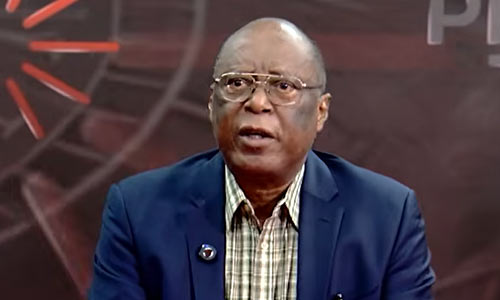
*Says “We Have Two Judgments Upholding David Mark’s Leadership”

The National Legal Adviser of the African Democratic Congress (ADC) and former Governor of Edo State, Professor Oserheimen Osunbor, has rejected the Federal High Court judgment nullifying the party’s leadership under former Senate President David Mark and the presidential nomination of Atiku Abubakar, insisting that the decision will not stand.
Osunbor accused the ruling All Progressives Congress (APC) of attempting to use judicial proceedings to weaken the opposition, frustrate Atiku’s presidential campaign and prevent Nigerians from freely choosing their leaders in the January 2027 general elections.
He also raised allegations concerning the reassignment of the leadership suit to Justice Peter Lifu of the Federal High Court, Abuja, questioning why the case was transferred from another judge despite objections by the ADC.
Speaking separately on Arise Television and Channels Television’s Politics Today on Thursday, November 5, 2026, the former governor said the party would appeal the judgment, seek a stay of execution and formally notify the Independent National Electoral Commission (INEC) of the legal steps being taken.
He maintained that Atiku remained the party’s presidential candidate and that the ADC would continue its nationwide campaign despite the ruling.
“Our presidential candidate, former vice president, His Excellency Atiku Abubakar, has been offering hope for Nigerians; real hope, not deceptive hope,” Osunbor stated.
He described the judgment as a politically motivated response to the large turnout at the ADC’s presidential campaign flag-off in Sokoto State on Wednesday.
According to him, the ruling party was unsettled by the growing public support for Atiku and had resorted to legal and psychological measures to discourage opposition supporters.
Osunbor alleged that the judgment was intended to distract Nigerians from the ADC’s campaign message and dampen the morale of party members.
He described it as a “panic response” to the crowd that attended the Sokoto rally, maintaining that the APC was “rattled beyond comprehension.”
The senior lawyer said the judgment had not disrupted the campaign, which moved from Sokoto to Kebbi State on Thursday.
He urged ADC members and supporters not to lose confidence in the party’s presidential ambition.
According to him, the campaign would continue because Nigerians were seeking relief from the economic hardship confronting the country.
Osunbor said Atiku had presented proposals to address the cost of living, including a commitment to reintroduce petroleum subsidies, whose removal he blamed for much of the hardship experienced by Nigerians.
He insisted that the party’s political opponents would not succeed in frustrating the presidential campaign through court proceedings.
Addressing the legal implications of Justice Lifu’s judgment, Osunbor said he believed Atiku still had a valid presidential ticket despite the court’s decision.
Asked directly whether the former Vice-President remained the ADC’s lawful candidate, he responded, “I believe he does.”
He based his position on what he described as two previous decisions of the Federal High Court recognising the leadership of the ADC under David Mark.
According to him, one of the decisions was delivered by a Federal High Court sitting in Lafia, while the other arose from a suit instituted by a member of the House of Representatives, Leke Abejide, before Justice Musa Liman of the Federal High Court, Abuja.
Osunbor maintained that Justice Liman had dismissed the challenge to the Mark-led National Working Committee after considering the issues raised in that proceeding.
He said the earlier judgment upheld the validity of the party’s leadership arrangement and remained relevant to the dispute.
The former governor argued that Justice Lifu, being a judge of the same Federal High Court, lacked the authority to overturn or disregard a subsisting decision of a court of coordinate jurisdiction.
He maintained that the proper course for anyone dissatisfied with Justice Liman’s decision was to challenge it before the Court of Appeal rather than continue pursuing similar reliefs before another judge of the Federal High Court.
Osunbor acknowledged that the parties and legal issues in separate cases might differ but argued that courts must also consider the central principle determined in earlier proceedings.
“No two cases are exactly the same. What you look for is the central principle behind the case,” he said.
According to him, both the Abejide case and the suit instituted by Nafiu Bala Gombe questioned the legitimacy of the David Mark-led leadership.
He expressed concern about conflicting decisions involving the same political party, arguing that such developments could undermine public confidence in the judiciary.
Osunbor also recalled that the Supreme Court had previously warned against conflicting judgments by courts of coordinate jurisdiction.
He maintained that the appellate courts would ultimately determine the validity of the latest judgment.
Reconstructing the history of the litigation, Osunbor explained that Gombe, a former Deputy National Chairman of the ADC, instituted the leadership suit on September 2, 2025.
According to him, the action was initially assigned to Justice Emeka Nwite of the Federal High Court, Abuja.
He said Gombe sought an interim order recognising him as the party’s authentic national chairman following the resignation of former ADC National Chairman Ralph Nwosu.
Osunbor explained that Justice Nwite initially directed the defendants to show cause why the interim relief sought by Gombe should not be granted.
He alleged that the enrolled order subsequently described the judge as having refused the application, creating a procedural issue that contributed to the case reaching the appellate courts.
According to Osunbor, the ADC challenged the matter before the Court of Appeal, which held that the appeal was incompetent because no substantive decision had been delivered and the required leave had not been obtained.
He said the Court of Appeal nevertheless directed the parties to maintain the status quo ante bellum, an order later challenged at the Supreme Court.
The Supreme Court subsequently set aside the status quo directive and ordered that the substantive proceedings before the Federal High Court be determined expeditiously.
Osunbor maintained that the Supreme Court’s decision also addressed the restrictions affecting the ADC’s access to INEC’s political party portal.
Following the apex court’s intervention, the case returned to the Federal High Court for hearing on its merits.
However, the former governor alleged that Gombe subsequently requested that the case be reassigned from Justice Nwite.
According to him, Gombe complained to the Chief Judge of the Federal High Court, Justice John Tsoho, about repeated adjournments.
Osunbor disputed that complaint, alleging that approximately five adjournments had occurred at Gombe’s own instance.
He said the ADC became concerned when information circulated suggesting that the claimant’s camp was searching for a judge who would be more favourable to its case.
The former governor disclosed that the party’s National Publicity Secretary had raised concerns about the alleged judge-shopping on May 7, while the ADC also wrote to the Chief Judge opposing the proposed reassignment.
He maintained that the party wanted Justice Nwite to conclude the proceedings, particularly because the case had already been before him.
Osunbor said the explanation given for the reassignment was that Justice Nwite’s name appeared on a list of judges being considered for elevation to the Court of Appeal.
He questioned that reason, arguing that Justice Nwite and other judges whose names appeared on the list, including Justice Omotosho, were still hearing cases at the Federal High Court.
According to him, the continued hearing of cases by those judges raised questions about why the ADC leadership dispute could not remain before Justice Nwite.
The matter was eventually reassigned to Justice Lifu, who commenced proceedings afresh.
Osunbor alleged that the reassignment reinforced the concerns earlier expressed by the party.
He described Justice Lifu as the judge who “appeared now to be the friendly judge that we heard they were shopping for.”
The former governor maintained that the proceedings might have been concluded earlier if Justice Nwite had been allowed to continue hearing the case.
He further disclosed that the ADC applied for Justice Lifu to recuse himself, citing concerns about previous judicial decisions involving the judge.
According to Osunbor, the party referred to an earlier Court of Appeal judgment in which Justice Lifu’s conduct was criticised in strong terms, including references to “judicial rascality,” “judicial disobedience” and “judicial impertinence.”
He said Justice Lifu rejected the applications seeking his withdrawal from the case.
Osunbor also alleged that Gombe amended his originating summons for a third time to introduce questions concerning the party’s presidential primaries.
According to him, the primaries were not part of the original dispute when the suit was instituted in September 2025.
He questioned the circumstances under which the court proceeded to determine issues affecting Atiku’s nomination.
The former governor also challenged Gombe’s claim that he was entitled to take over the ADC leadership following Nwosu’s resignation.
He maintained that Gombe had voluntarily resigned alongside other members of the party’s former leadership.
According to Osunbor, the transition that produced the Mark-led caretaker structure followed extensive consultations, negotiations and due diligence involving members of the ADC and the coalition.
He explained that the previous National Executive Committee and National Working Committee members agreed to resign, after which the new leadership structure emerged.
“All of them agreed collectively… Nafiu Gombe resigned, the same resignation that Ralph Nwosu resigned,” he stated.
Osunbor said the party possessed a copy of Gombe’s resignation letter.
He drew attention to an unusual spelling of the word chairman in the document, explaining that it appeared as “C-H-I-A-R-M.”
The former governor said Gombe subsequently alleged that the resignation letter was forged but maintained that the burden of proving that allegation rested on the person making it.
“He who alleges must prove. Who forged it?” Osunbor asked.
He said the issue was raised during proceedings before Justice Lifu but maintained that the court rejected the argument advanced by the ADC.
The former governor further alleged that Gombe’s continued litigation was being encouraged by external political interests.
“If he wasn’t being sponsored by the ruling party… he may not even have gone to court at all because he resigned,” Osunbor stated.
He accused unnamed political actors of employing backroom tactics and attempting to use judicial institutions to achieve political objectives.
Osunbor also alleged that he received information suggesting that Gombe had assured some members of the original ADC leadership that he would ultimately be declared national chairman.
According to him, approximately two people separately informed him about the confidence displayed by Gombe’s camp before the judgment.
He claimed that Gombe had contacted individuals who previously belonged to the original ADC but had joined the Mark-led leadership, encouraging them to return to his faction.
Quoting the alleged message, Osunbor said Gombe told them: “Why don’t you come back and join me? I’ve been assured that I will be declared chairman.”
The former governor described the information as deeply worrying, alleging that Gombe enjoyed backing from individuals connected with the state.
These allegations concerning sponsorship, judicial influence and assurances of victory were made by Osunbor and were not established by the judgment itself.
He also referred to other legal disputes involving the ADC, including matters he identified as the Danomma case and litigation associated with Dumebi Kachikwu.
Osunbor alleged that the cumulative effect of those proceedings was an attempt to prevent the ADC from fielding candidates in the 2027 elections.
He maintained that the APC was deploying various political and legal strategies to weaken opposition parties.
According to him, similar methods had been employed against the Peoples Democratic Party and the Labour Party.
He also alleged that a government minister had openly boasted about using the judiciary to weaken political opponents, although he did not identify that minister in the remarks provided.
Asked whether he was accusing Justice Lifu of being an APC member, Osunbor declined to make that specific allegation.
“I don’t know if he’s a member, but he’s been giving judgments,” he said.
He referred to previous public concerns expressed by retired Supreme Court Justice Amina Augie about judges who might secretly align themselves with politicians.
Osunbor also cited comments attributed to Professor Chidi Odinkalu suggesting that the outcomes of certain proceedings before Justice Lifu had become predictable.
“A judge shouldn’t become so predictable,” he stated.
He alleged that judgments involving the APC or the government before the judge frequently produced outcomes favourable to the ruling party.
When asked why Justice Lifu was not among judicial officers recently sanctioned by the National Judicial Council, Osunbor responded that he was not a member of the Council.
“I’m not in the NJC,” he said.
Beyond the ADC dispute, Osunbor expressed concern about what he described as a deteriorating democratic environment in Nigeria.
He accused the ruling party of using political pressure, court cases and psychological tactics to discourage opposition participation.
The former governor drew comparisons with political developments in other countries, including Brazil, the United States and Tanzania.
He specifically referred to the administration of Tanzanian President Samia Suluhu Hassan, alleging that methods used to suppress political opposition elsewhere were being replicated in Nigeria.
According to him, those methods included arresting opposition figures, using courts to disqualify candidates and pursuing the deregistration of political parties.
Osunbor alleged that a Deputy Director-General of the ADC Presidential Campaign Council had been incarcerated.
He also criticised the economic hardship facing Nigerians, accusing political actors of exploiting poverty to influence elections.
According to him, some politicians believed they could secure votes by offering financially distressed Nigerians small amounts of money.
He maintained that poverty was being deliberately “weaponised,” with political actors allegedly believing that ₦5,000 could influence voters’ decisions.
The former governor urged Nigerians to resist political manipulation and remain committed to their democratic rights.
He also disclosed that he had represented the ADC National Chairman at an engagement involving representatives of the United Nations, the Economic Community of West African States and the European Union.
According to him, representatives of the international organisations expressed concerns about developments surrounding Nigeria’s forthcoming elections, although they were generally cautious about public comments.
He said international observers were concerned about the signals emerging from the country’s political environment.
Osunbor argued that the traditional doctrine of non-interference in the internal affairs of sovereign states had evolved over time.
He referred to the International Criminal Court and the experiences of former political leaders, including Laurent Gbagbo and Charles Taylor, while discussing international accountability.
He nevertheless placed the responsibility for protecting Nigeria’s democracy primarily on the country’s institutions and citizens.
On the next legal steps, Osunbor said the ADC would obtain the certified true copy of Justice Lifu’s judgment before finalising its grounds of appeal.
“I have not seen the certified true copy,” he stated.
He explained that the party intended to file an appeal, apply for a stay of execution and notify INEC of the pending proceedings.
Osunbor maintained that the commission should consider both the earlier judgments recognising the Mark-led leadership and the latest decision nullifying it.
“INEC is aware of the two judgments,” he said.
He argued that the commission should not simply select one judgment while disregarding the others.
“I don’t think [INEC] has the liberty to pick and choose which one to obey and which one not to obey,” he stated.
The former governor expressed the view that once the ADC filed its appeal and the appeal was entered, INEC should refrain from implementing the judgment pending further judicial determination.
He maintained that the earlier judgment delivered by Justice Liman continued to provide legal support for the party’s leadership and campaign activities.
However, the filing of an appeal does not automatically operate as a stay of execution in every case. Whether INEC must suspend implementation of the judgment would depend on the applicable legal rules and any orders made by the relevant appellate court.
Osunbor nevertheless expressed confidence that the Court of Appeal would overturn Justice Lifu’s decision.
He said the party’s legal team would act promptly and pursue available judicial remedies.
Asked whether the ADC had an alternative arrangement if its appeal failed, the former governor described the question as hypothetical.
He explained that the judgment had only been delivered that morning and that the party’s leadership would have to meet before considering any further course of action.
“The plan B was to rely on the judiciary,” he stated.
Osunbor, however, warned that a loss of public confidence in judicial institutions could have serious consequences for national stability.
He suggested that citizens who believed they could no longer obtain lawful remedies might become frustrated with the justice system.
The programme’s host observed that such a development could threaten the stability of society.
Osunbor responded: “Hopefully we won’t get to that stage.”
He also recalled his earlier political career, including his election to the Senate in 1999 and his service as the first Chairman of the Senate Committee on INEC and Electoral Matters.
The former governor criticised the present National Assembly, accusing lawmakers of failing to exercise sufficient independence and oversight over the executive.
He questioned the quality of electoral legislation and criticised what he regarded as inadequate legislative scrutiny of government activities.
Osunbor also expressed concern about allegations of inflated appropriation bills and the weakening of parliamentary oversight.
He contrasted the current legislative environment with his experience in the National Assembly, arguing that democratic institutions should operate independently rather than serve the interests of those in power.
The former governor further recalled Nigeria’s experience under military rule, referring to the political uncertainty that preceded the emergence of General Sani Abacha’s administration.
He warned against allowing disputes within democratic institutions to create conditions that could threaten constitutional government.
“God forbid that what happened with Abacha does not happen again,” he stated.
Asked whether the legal dispute could be conclusively determined before the presidential election scheduled for January 16, 2027, Osunbor expressed concern about the limited time available.
“Things are getting from bad to worse, and I fear for my country,” he said.
He warned that the exclusion of Atiku from the presidential ballot could generate serious political consequences, given the expectations of his supporters and the importance of allowing Nigerians to choose among competing candidates.
According to him, Nigerians would ultimately have to decide whether they wanted to retain control over the process of choosing their leaders.
“If Atiku is not on the ballot,” he warned, “only God knows.”
He added that Nigerians would have to determine “whether they want to be enslaved or whether they want to be the determinants of who rules them.”
Despite the concerns raised, Osunbor maintained that the ADC would continue to pursue the dispute through the courts.
He expressed confidence that the higher courts would examine the relevant issues and correct what he considered an erroneous judgment.
The former governor reiterated that Atiku’s presidential campaign would continue and urged supporters not to be discouraged by the decision.
“He will. The people are behind him,” Osunbor said when asked whether Atiku could overcome the legal and political challenges.
He maintained that the party would rely on the judiciary to protect its rights and resolve the conflicting legal positions concerning its national leadership.
For Osunbor, the controversy extends beyond the personal ambition of Atiku or the leadership of David Mark, raising broader concerns about the independence of judicial institutions, the rights of political parties and the credibility of the 2027 general elections.
[A MUST HAVE] Evidence Act Demystified With Recent And Contemporary Cases And Materials

Available now for NGN 40,000 at ASC Publications, 10, Boyle Street, Onikan, Lagos. Beside High Court, TBS. Email publications@ayindesanni.com or WhatsApp +2347056667384. Purchase Link: https://paystack.com/buy/evidence-act-complete-annotation
______________________________________________________________________ “Enhance Legal Practice With Authoritative Reports” — Alexander Payne Offers Comprehensive Law Reports, Spanning Over A Century Of Nigerian Jurisprudence Interested buyers are encouraged to place their orders and enquiries via:
0704 444 4777, 0704 444 4999, 0818 199 9888
Website: www.alexandernigeria.com