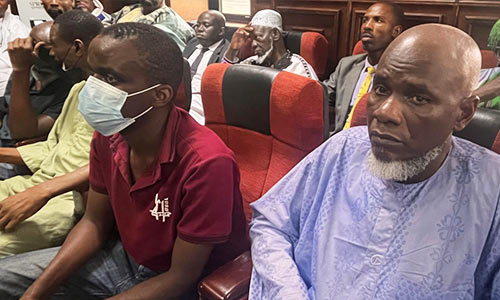
The Federal High Court in Abuja has admitted written statements and video recordings tendered by the Federal Government against six persons standing trial over an alleged plot to overthrow the administration of President Bola Tinubu.

Justice Joyce Abdulmalik, delivering a ruling on Thursday, November 5, 2026, rejected the defendants’ allegations that their extrajudicial statements were obtained through coercion and torture, holding that they had failed to establish that the statements were made involuntarily.
The court consequently admitted the statements obtained by a Special Investigation Panel and military police investigators, alongside video recordings of the defendants’ interrogations, as evidence in the ongoing trial.
The six defendants are retired Major General Mohammed Ibrahim Gana; retired Naval Captain Erasmus Ochegobia Victor; serving Police Inspector Ahmed Ibrahim; Zekeri Umoru; Bukar Kashim Goni; and a Zaria-based Islamic cleric, Sheikh Abdulkadir Sani.
They are standing trial on a 13-count charge marked FHC/ABJ/CR/206/2026, filed by the Office of the Attorney-General of the Federation over allegations bordering on treason, terrorism, failure to disclose security intelligence and money laundering connected with alleged terrorist activities.
The Federal Government accused the defendants of participating in or having knowledge of a conspiracy to overthrow the democratically elected government of President Tinubu.
The defendants, however, pleaded not guilty to the charges when they were arraigned on April 22, 2026, and were remanded in the custody of the State Security Service (SSS) pending the determination of the case.
During the trial, the prosecution sought to tender written statements and audio-visual recordings allegedly obtained from the defendants during investigations into the suspected coup plot.
Defence lawyers objected to the admissibility of the materials, arguing that their clients did not make the statements voluntarily.
They alleged that the statements were obtained under coercion and that the interrogation procedures violated provisions of the Administration of Criminal Justice Act, 2015.
The defence also maintained that the defendants were denied access to legal representation during interrogation and questioned alleged discrepancies between their recorded interviews and written statements.
The prosecution opposed the objections and urged the court to admit the materials, insisting that the statements had been obtained in accordance with the law.
Following the objections, Justice Abdulmalik ordered a trial-within-trial to determine whether the statements were voluntarily made before deciding on their admissibility in the substantive criminal proceedings.
The issue arose while the fourth prosecution witness was giving evidence concerning the investigation and the materials obtained from the defendants.
During the trial-within-trial, the prosecution presented evidence to support its position that the defendants had been informed of their rights and were not subjected to threats or intimidation.
The defence challenged that account, maintaining that the circumstances surrounding the interrogations rendered the statements inadmissible.
Delivering her ruling, Justice Abdulmalik held that the defendants had failed to substantiate their allegations of coercion.
The judge described their claims of making the statements under duress as an afterthought and rejected their allegations of torture.
Consequently, the court admitted the written statements and video recordings as part of the evidence to be considered in determining the charges.
The admissibility ruling followed earlier proceedings in which recordings of interviews conducted with some of the defendants were played in open court.
One of the recordings featured the fourth defendant, Zekeri Umoru, an employee of Julius Berger Nigeria Plc who worked in the Maintenance Department at the Presidential Villa, Abuja.
During proceedings on May 20, 2026, Umoru was shown in a video recording discussing an alleged plan to interrupt the electricity supply to the Presidential Villa as part of the suspected coup operation.
According to his recorded account, discussions had taken place about switching off the electricity supply to facilitate access to the presidential complex.
Umoru said he warned that such an action would immediately attract investigations and could lead to the detention of workers on duty at the time.
He also alleged that Colonel Mohammed Alhassan Ma’aji, identified by investigators as a suspected mastermind of the plot, offered him money through the third defendant, Inspector Ahmed Ibrahim, to recruit between 18 and 19 persons working within the Presidential Villa.
According to Umoru, the persons targeted for recruitment included soldiers, SSS personnel and employees of Julius Berger.
He further alleged that Ma’aji wanted access to the Presidential Villa and had indicated that he could obtain entry “with force”, even if the proposed recruits refused to cooperate.
The statements formed part of the prosecution’s evidence concerning the alleged arrangements made by persons suspected of involvement in the plot.
Another recording involved the sixth defendant, Sheikh Abdulkadir Sani, a Zaria-based Islamic cleric.
In the video played before the court, the cleric said he had been informed about the alleged plan and was approached to offer prayers intended to prevent information about the plot from becoming public.
He maintained that he warned those involved that the plan would fail and that their activities would eventually be exposed.
His account was presented as part of the investigative material relied upon by the prosecution in establishing the alleged roles of the defendants.
However, the statements contained in the recordings remain evidence for the court’s consideration and do not, by themselves, establish the defendants’ guilt.
The Federal Government alleged in its charge that the defendants, sometime in September 2025, conspired with other persons to levy war against the Nigerian state with the intention of overawing President Tinubu.
The prosecution maintained that the alleged conduct constituted an offence punishable under Section 37(2) of the Criminal Code.
It further alleged that the defendants had prior knowledge of a planned treasonable act involving Colonel Ma’aji and others but failed to disclose the information to the appropriate authorities.
According to the prosecution, the defendants were under an obligation to report the alleged plan to the President or a peace officer and take reasonable steps to prevent the commission of the offence.
The charge accused them of failing to use reasonable efforts to prevent the alleged treasonable act despite their purported knowledge of the conspiracy.
Other counts concerned alleged terrorism-related offences under the Terrorism (Prevention and Prohibition) Act, 2022, including conspiracy to commit an act of terrorism in Nigeria.
The prosecution also included allegations of money laundering connected with the suspected activities.
Former Bayelsa State Governor and former Minister of State for Petroleum Resources, Timipre Sylva, was also mentioned in the charge filed by the Office of the Attorney-General of the Federation.
The prosecution described Sylva as being at large in connection with the alleged plot.
The allegations against him, like those against the six defendants, remain subject to proof through the appropriate judicial process.
Earlier in the proceedings, the Federal High Court granted the prosecution permission to conceal the identities of witnesses drawn from the Nigerian Army because of the security-sensitive nature of the case.
The court also received evidence from three bank officials who tendered financial documents, including correspondence associated with investigations conducted by the Economic and Financial Crimes Commission (EFCC).
Those documents formed part of the prosecution’s attempt to establish the alleged financial transactions and activities connected with the suspected plot.
The proceedings have involved challenges to documentary evidence, witness protection measures and the circumstances in which investigators obtained statements from the accused persons.
The latest reported ruling concerns the admissibility of the defendants’ written and recorded statements following objections raised by their lawyers.
It does not amount to a finding that the defendants committed treason, terrorism or any of the other offences charged.
The prosecution must still establish its case in accordance with the applicable law, while the defendants remain entitled to challenge the evidence and present their defence.
Following the ruling, Justice Abdulmalik fixed December 7 and 10, 2026, for continuation of hearing.
[A MUST HAVE] Evidence Act Demystified With Recent And Contemporary Cases And Materials

Available now for NGN 40,000 at ASC Publications, 10, Boyle Street, Onikan, Lagos. Beside High Court, TBS. Email publications@ayindesanni.com or WhatsApp +2347056667384. Purchase Link: https://paystack.com/buy/evidence-act-complete-annotation
______________________________________________________________________ “Enhance Legal Practice With Authoritative Reports” — Alexander Payne Offers Comprehensive Law Reports, Spanning Over A Century Of Nigerian Jurisprudence Interested buyers are encouraged to place their orders and enquiries via:
0704 444 4777, 0704 444 4999, 0818 199 9888
Website: www.alexandernigeria.com