

By O. H. Omokide

Introduction
The relationship between a bank and its customer is, in the main, contractual. The customer deposits funds, and the bank undertakes to honour the customer’s valid mandates. The Supreme Court has long held that a bank which holds sufficient funds and refuses to honour a customer’s cheque is in breach of contract: Allied Bank (Nig) Ltd v Akubueze (1997) 6 NWLR (Pt 509) 374 (SC).
For many account holders, a restriction arrives without warning. It could come in the form of a failed transfer, a Post-No-Debit (“PND”) flag, or an instruction to visit the branch. It is widely assumed that a bank may impose such a restriction whenever it deems fit. That assumption is wrong. This article examines what a bank account restriction is, the sources of lawful authority for it, when it is unlawful, the recent and, at times, divergent decisions of the courts, and the remedies open to an aggrieved customer.
2. The Nature of an Account Restriction
A restriction on an account prevents a customer from dealing with funds standing to their credit. It may affect savings, current, corporate and digital banking accounts alike. Restrictions commonly follow allegations of fraud, suspected money laundering, terrorism financing, criminal investigations, regulatory directives or court orders.
The governing principle is that a bank cannot restrict an account at will. In Fidelity Bank Plc v Bayuja Ventures Ltd & Anor (2011) LCN/5020(CA), the Court of Appeal held that a bank has no right to freeze a customer’s account without a court order and that fraud, being a criminal allegation, must be proved beyond reasonable doubt. The Court has since reaffirmed this position in UBA Plc v Antai (2018) LPELR-49786(CA) and Diamond Bank Plc v Unaka & Ors (2019) LPELR-50350(CA), the latter confirming that a bank has no power, of its own motion, to deny a customer access to funds, save in limited cases, such as notice of the customer’s death. A bank’s authority to restrict an account must, therefore, derive from one of three sources: the account contract (together with the regulatory instruments that govern it), a court order, or an express statutory power.
3. Sources of Lawful Authority
3.1 The Account Contract and CBN Instruments
A bank may restrict an account on the customer’s own instruction or under a lawful term of the account-opening mandate, for example, in cases of suspected fraud, incomplete KYC or breach of terms. The Central Bank of Nigeria (CBN) Circular on the Establishment of Industry Fraud Desks (11 June 2015) and Regulation 10(3) of the CBN Regulation on Instant (Inter-Bank) Electronic Funds Transfer Services (2018) further authorise a PND on receipt of a fraud complaint. On this footing, the Ekiti Division of the Court of Appeal, in Kuda Microfinance Bank Ltd v Blessing (2024) LPELR-80643(CA), upheld a PND placed on an account that had received an erroneous credit of ₦5 million, holding that the bank’s terms and conditions and the CBN instruments justified the restriction without a court order. See also Ipinloju v EFCC & Ors (2024) LPELR-61914(CA). Other CBN-driven restrictions include those for missing or outdated KYC, BVN or NIN data, breaches of tier limits and dormancy.
3.2 Court Orders
A court may restrain an account by a garnishee order under the Sheriffs and Civil Process Act (an order nisi made absolute) to satisfy a judgment debt; by an interim injunction or Mareva-type order to prevent the dissipation of assets pending trial; or by an ex parte order in fraud or asset recovery proceedings.
3.3 Statutory Powers
(a) Economic and Financial Crimes Commission (Establishment) Act 2004, Section 34.
Where the EFCC suspects that an account holds proceeds of an offence, the Chairman or an authorised officer may apply ex parte to the court for an order freezing it. The Court of Appeal has consistently held that a court order is a condition precedent to the exercise of this power and that the Commission cannot freeze an account by its own directive to a bank: GTB Plc v Adedamola (2019) 5 NWLR (Pt 1664) 30, 43 (per Abubakar JCA); Olagunju v EFCC (2019) LPELR-48461(CA). The power is not a licence for indefinite restraint; it must be tied to a live investigation and supported by judicial authority within a reasonable time.
(b) Money Laundering (Prevention and Prohibition) Act 2022.
The Act makes banks gatekeepers; they must identify customers, monitor transactions and report suspicious or large transactions to the Nigerian Financial Intelligence Unit (NFIU). Section 7(6) also authorises a temporary stop order on an account or transaction suspected of involvement in an unlawful act for not more than 72 hours; continued restraint requires an application to the Federal High Court under Section 7(8).
In EFCC v AG Benue State & Ors (2022) LPELR-58696(CA) and its companion appeal, UBA Plc v AG Benue State & Ors (2022) LPELR-58695(CA), the Makurdi Division recognised the 72-hour power but held that a court order is required to extend it, having regard to Section 44(2)(k) of the Constitution. The 72-hour window was also considered in UBA Plc v Eje & Ors (2022) LPELR-57973(CA) and NPG Properties & Construction Works Ltd v Zenith Bank Plc (2023) 15 NWLR (Pt 1908) 423, which confirms that, after its expiry, the EFCC must obtain a court order for any further restriction.
(c) Terrorism (Prevention and Prohibition) Act 2022.
The Act provides for the freezing of funds and assets linked to terrorism or its financing, including targeted financial sanctions against designated persons and entities. Banks must act promptly on such designations and orders.
4. When Is a Restriction Unlawful?
Legality turns on the source of authority, the circumstances that triggered the restriction, its scope and the procedure followed. An account restriction may be unlawful in the following circumstances:
- Failure to Obtain the Requisite Court Order: Where an EFCC or Police directive is issued without the requisite court order.
- Continuation Beyond a 72-Hour Stop Order: Where a restriction continues beyond 72 hours without further judicial authority (EFCC v AG Benue State & Ors (2022) LPELR-58696(CA)).
- Cessation of the Legal Basis for the Restriction: Where the legal grounds upon which the account was initially frozen have ceased to exist, yet the restriction is maintained without any independent and subsisting legal justification.
- An Order Made by a Court Without Jurisdiction: Where the court purporting to authorise the freezing of an account lacks the requisite jurisdiction to grant the order in question (Abhulimen v Zenith Bank).
- A Bare Petition, Telephone Call or Letter: Where the restriction is based solely on a petition, telephone call or letter from the Police or a private party.
- A Unilateral Freeze: Where the restriction has no contractual, regulatory or statutory justification.
5. Court Orders, Jurisdiction and Conflicting Authority
Scope of the Order:
A bank must give effect to an order according to its terms, scope and duration, and must not construe it more widely than its wording permits. In FBN Plc & Anor v DKN Investment Ltd & Anor (2025) LPELR-80878(CA), the Benin Division held that an order merely granting access to a customer’s account records did not authorise a freeze and that the Police could not rely on it to impose a restriction the court had not granted. The Court restated that no person or institution may restrict a customer’s account without a court order, citing, among others, Arogundade v Skye Bank (2020) LPELR-52304(CA).
Jurisdiction:
Section 251(1)(d) of the Constitution places banker-customer disputes within the concurrent jurisdiction of the Federal High Court and the State High Courts. See NDIC v Okem Enterprises Ltd & Anor (2004) LPELR-1999(SC).
In Abhulimen v Zenith Bank Plc & Anor (FCT/HC/CV/2194/2024, 16 July 2025), Zenith Bank placed a PND on a law firm’s Abuja account on the strength of an ex parte order obtained by the Nigeria Police Force from a Chief Magistrate Court in Mararaba, Nasarawa State. The FCT High Court held that the Magistrate Court lacked both substantive and territorial jurisdiction, faulted the bank for failing to notify its customer, and awarded ₦60 million in general damages and ₦25 million in costs against the bank and the Police, jointly and severally, together with a published apology. In September 2026, the Court of Appeal (Abuja Division, CA/ABJ/CV/1335/2025) dismissed the bank’s appeal and affirmed all the reliefs granted.
Compliance with Orders and Its Limits:
Abhulimen sits uneasily with the settled principle that a court order binds until it is set aside, however irregular it may appear: Akinyemi v Soyanwo & Anor (2006) LPELR-363(SC); Ngere v Okuruket XIV (2014) 11 NWLR (Pt 1417) 147 (SC).
That principle has been applied to banks in IBWA v Kennedy Trans (Nig) Ltd (1993) 7 NWLR (Pt 304) 238 (CA) and GTB Plc v Chijioke & Anor (2024) LPELR-81087(CA), where a bank was held not to have acted wrongly in complying with a Magistrate Court’s PND order because it was not for the bank to determine that court’s jurisdiction.
One possible reconciliation is the patent defect. In Access Bank Plc v Agbasiere (2022) LPELR-58489(CA), a bank was held to have acted wrongly in restricting an account on an order purportedly issued by a court that did not exist, against a non-juristic entity. Until the point is settled at the apex level, banks should scrutinise every order on its face and notify the customer promptly.
Directives from Law Enforcement Agencies:
In NPG Event, Gardens & Parks Ltd v Zenith Bank Plc (2026) 7 CLRN, the Court of Appeal considered a six-month PND imposed on an EFCC directive without a court order. It held that a bank cannot feign ignorance of the need to verify that such a directive is backed by a court order and that a bank which complies without doing so may be held jointly and severally liable with the agency for the resulting violation of the customer’s fundamental rights.
The Court added that the pendency of an investigation does not, without more, suspend a person’s right to use and enjoy their property, and awarded ₦5 million in general damages.
6. Remedies
The appropriate remedy depends on how and why the restriction was imposed.
Written Complaint:
The customer should first request, in writing, the legal or regulatory basis relied on. This also creates a record for later proceedings.
Civil Action:
Where the restriction lacks a lawful basis, outlasts its authority or exceeds it, the customer may sue in the Federal High Court or a State High Court (see NDIC v Okem) for a declaration that the restriction is unlawful, an order lifting it, an injunction against further interference and damages.
Damages are neither automatic nor uniform: Abhulimen attracted ₦85 million, inclusive of costs; in NPG Event, the Court of Appeal awarded ₦5 million against a claim of ₦100 million; and in Kuda, the restriction was justified, and no damages arose.
Fundamental Rights Proceedings:
An application under the Fundamental Rights (Enforcement Procedure) Rules 2009 is viable where the facts disclose a genuine infringement of rights under Sections 34 and 44 of the Constitution, as in NPG Event, where the restriction followed an agency directive.
The procedure carries risks, however. In UBA Plc v Asime (2025) LPELR-82099(CA), the Court of Appeal set aside a fundamental rights judgment against a bank (which had included ₦30 million in damages), holding the action incompetent because its gravamen was a breach of the banker-customer contract rather than an infringement of a Chapter IV right.
A customer should, therefore, identify the specific right infringed, plead the facts accordingly and select the procedure that fits the true cause of action.
7. Practical Takeaways
- An EFCC or Police directive to freeze an account must be backed by a court order. The only exception is the 72-hour stop order under Section 7(6) of the Money Laundering (Prevention and Prohibition) Act 2022.
- A restriction that continues beyond 72 hours without a court order is unlawful and may be challenged (EFCC v AG Benue State; NPG Properties).
- A bank may restrict an account without a court order only where the customer’s contract or a CBN instrument clearly permits it (Kuda), and then only temporarily and with notice to the customer.
- A bank must verify any order it is asked to enforce, including its scope, the issuing court’s jurisdiction and any patent defect. A bank that merely obeys an agency directive may be held jointly liable with that agency (NPG Event; Abhulimen).
- Customers should seek the basis of the restriction in writing, review their account terms and choose the appropriate procedure, whether an ordinary civil action or a fundamental rights application, based on the facts (Asime).
8. Conclusion
The freezing of bank accounts in Nigeria is governed by a combination of statutes, regulatory instruments, court orders and contracts. A restriction is lawful only where it rests on a recognised legal basis, is imposed within the limits of the authority relied on, and is maintained no longer than the law permits.
Where a bank or law enforcement agency restricts an account without such justification, or without the court order the law requires, the restriction is unlawful and exposes the bank and, in appropriate cases, the agency to liability.
The recent appellate decisions confirm that compliance with an agency directive is not a safe harbour for banks and that customers have effective remedies against banks for unlawful restrictions on their accounts.
[A MUST HAVE] Evidence Act Demystified With Recent And Contemporary Cases And Materials
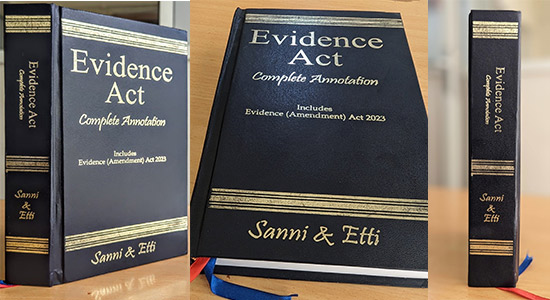
Available now for NGN 40,000 at ASC Publications, 10, Boyle Street, Onikan, Lagos. Beside High Court, TBS. Email publications@ayindesanni.com or WhatsApp +2347056667384. Purchase Link: https://paystack.com/buy/evidence-act-complete-annotation
______________________________________________________________________ “Enhance Legal Practice With Authoritative Reports” — Alexander Payne Offers Comprehensive Law Reports, Spanning Over A Century Of Nigerian Jurisprudence Interested buyers are encouraged to place their orders and enquiries via:
0704 444 4777, 0704 444 4999, 0818 199 9888
Website: www.alexandernigeria.com