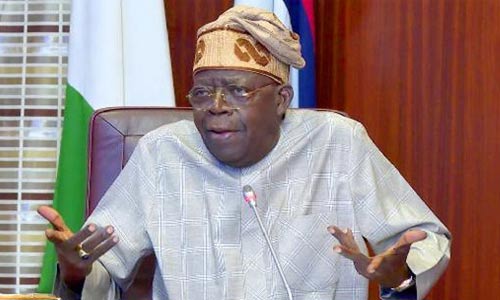
President Bola Tinubu has withdrawn his earlier request to the National Assembly to approve the processing of external loans worth $20.5 billion and €1.05 billion under the 2026–2027 Supplementary External Borrowing Plan.

The president has instead requested approval for a new external borrowing plan of $7.7 billion to finance the 2026 budget deficit partly.
The new request, which seeks approval for $7,707,404,882.49, was in a letter read by Senate President Godswill Akpabio during plenary on Wednesday.
According to Mr Tinubu, the proposed borrowing is equivalent to N10.9 trillion, calculated at an exchange rate of $1 to N1,400, and is intended to finance the N20.2 trillion budget deficit partly.
The president said the new borrowing plan would finance critical projects across various sectors, including infrastructure, defence, agriculture, healthcare, power and education.
He said the projects were designed to stabilise and strengthen the macroeconomic reforms and gains his administration has recorded in recent years.
The new request provides more details about the proposed borrowing, including the sources of funds and the conditions under which they would be raised.
Mr Tinubu said the proposed external borrowing would be sourced through several options, with emphasis on Eurobonds, which he described as relatively faster to conclude and capable of raising larger amounts at a lower cost.
He said the government would pursue all available options simultaneously, taking into account their costs, benefits to the country and the time required to access the funds.
“The plan is to raise the new external borrowings of USD 7.7 billion. I wish to note that all the options will be pursued simultaneously considering the cost and relative benefits to the country and the time required to access the funds,” the letter said.
The president added that the focus would be on Eurobond issuance because of the speed of completing such transactions.
“In view of this, emphasis will be on the issuance of Eurobonds, which is typically faster to conclude. Additionally, a larger amount can be raised through Eurobonds at a relatively lower cost in respect to the terms and conditions of the Eurobond,” he said.
Mr Tinubu explained that because the borrowing would be market-related, the final terms and conditions, interest rates and repayment periods could only be determined at the time of pricing.
He said the request was in line with Sections 21(1) and 27(1) of the Debt Management Office (Establishment, etc.) Act, 2003, and the borrowing plan approved by the National Assembly in the 2026 budget.
According to the president, the 2026 Appropriation Act approved N29.2 trillion in new borrowing to partly finance the budget deficit of about N31.4 trillion.
The approved borrowing comprises N18.4 trillion in domestic borrowing and N10.79 trillion in external borrowing.
The proposed $7.7 billion facility is intended to finance part of the external borrowing component.
“The total new borrowings of N29.2 trillion were further subdivided into new domestic borrowing of N18.4 trillion and new external borrowings of N10.79 trillion. The latter is the subject of this request,” the letter said.
The president said the new external borrowing was required to implement programmes and projects contained in the 2026 Appropriation Act.
After reading the letter, Mr Akpabio referred the request to the Senate Committees on Local and Foreign Debts and Appropriations for further scrutiny.
He directed the committees to report back as soon as practicable.
Last Tuesday, Mr Akpabio read an earlier executive communication in which Mr Tinubu sought the National Assembly’s approval to process external loans worth $20,517,755,901 and €1,045,083,643 under the 2026–2027 Supplementary External Borrowing Plan.
The president said the proposed loans would finance critical projects across various sectors, including infrastructure, agriculture, healthcare, education, water supply, security and employment generation, as well as financial management reforms.
The latest request comes about five months after the National Assembly approved a $516.3 million loan from Deutsche Bank AG to finance the construction of the Sokoto–Badagry Superhighway, a flagship infrastructure project under the Tinubu administration’s Renewed Hope Agenda.
The loan has a nine-year tenure, including a grace period of up to three years, with an interest rate capped at the Chicago Mercantile Exchange’s Secured Overnight Financing Rate (SOFR) plus 5.3 per cent annually.
The facility is backed by insurance from the Islamic Corporation for the Insurance of Investment and Export Credit, the insurance arm of the Islamic Development Bank.
In March, the National Assembly also approved a $6 billion external borrowing plan for the federal government.
Of that amount, $5 billion was to be sourced from First Abu Dhabi Bank to support the national budget, while a $1 billion export finance facility from the United Kingdom, arranged by Citibank, was earmarked for the rehabilitation of Tin Can Island Port and the Lagos Port Complex.
The latest borrowing request comes amid concerns about Nigeria’s rising public debt and the growing cost of servicing government obligations.
Nigeria’s debt burden has increased in recent years as the federal government has relied on domestic and external borrowing to finance budget deficits and infrastructure projects.
Although the country’s debt-to-GDP ratio has generally been considered moderate compared with that of some peer economies, analysts have raised concerns about the government’s limited revenue base and its capacity to meet debt obligations.
A substantial share of government revenue goes to debt servicing, limiting funds available for infrastructure, public services, and other development priorities.
The International Monetary Fund and the World Bank have repeatedly urged Nigeria to strengthen revenue mobilisation, improve tax collection and ensure that borrowed funds support productive investments capable of generating economic returns.
The federal government has maintained that external borrowing is necessary to address the country’s infrastructure deficit, finance development projects and meet its budgetary obligations.
Officials have also argued that borrowing on favourable terms can help manage financing costs and support economic growth.
[A MUST HAVE] Evidence Act Demystified With Recent And Contemporary Cases And Materials

Available now for NGN 40,000 at ASC Publications, 10, Boyle Street, Onikan, Lagos. Beside High Court, TBS. Email publications@ayindesanni.com or WhatsApp +2347056667384. Purchase Link: https://paystack.com/buy/evidence-act-complete-annotation
______________________________________________________________________ “Enhance Legal Practice With Authoritative Reports” — Alexander Payne Offers Comprehensive Law Reports, Spanning Over A Century Of Nigerian Jurisprudence Interested buyers are encouraged to place their orders and enquiries via:
0704 444 4777, 0704 444 4999, 0818 199 9888
Website: www.alexandernigeria.com