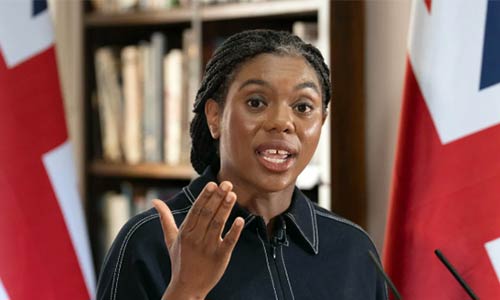
Leader of the United Kingdom’s Conservative Party, Kemi Badenoch, has opposed calls for Britain to formally apologise for its role in the transatlantic slave trade, arguing that such an apology could become a pathway to demands for financial reparations.

Badenoch described slavery as an evil in which people from different continents and regions participated and called for what she described as an honest account of the entire history, including the involvement of African kingdoms, rulers and merchants in capturing and selling enslaved people.
Her intervention comes as British Prime Minister Andy Burnham considers making a formal apology for Britain’s role in the transatlantic slave trade ahead of the Commonwealth Heads of Government Meeting in Antigua and Barbuda. Burnham has, however, ruled out direct financial reparations.
Badenoch argued that Britain should acknowledge its historical involvement without selectively presenting parts of the history, pointing also to the country’s later role in abolishing the transatlantic slave trade.
“If Caribbean countries are asking Britain for a formal apology for Britain’s role in the transatlantic slave trade, will they also be asking the same of the descendants of African kingdoms, rulers and merchants who captured, sold and profited from the trade?” she asked.
The Conservative leader said an apology would amount to a “navel-gazing distraction” and warned that campaigners could use it as leverage to press Britain for financial compensation.
She maintained that the Commonwealth should concentrate more on its future and cooperation among member states rather than remain consumed by historical grievances.
“The Commonwealth should be looking forward, not endlessly backwards,” Badenoch said.
She also questioned whether British prime ministers should continue attending future Commonwealth summits if demands for slave trade reparations become a dominant feature of the meetings.
Badenoch said Britain should not make financial payments to compensate for the slave trade, arguing that present-day taxpayers should not be required to bear financial responsibility for events that occurred generations ago.
“What I’m worried about is that this CHOGM summit is yet another opportunity for people to start asking Britain for money because of the slave trade,” she said.
She added that she did not believe Burnham needed to apologise because such a move could become “a lever to wedge open the door to ask for cash.”
Badenoch also cited comments by former Prime Minister Tony Blair nearly two decades ago expressing Britain’s deep sorrow and regret over its role in the slave trade, arguing that another formal apology was unnecessary.
Burnham has taken a different position, saying Britain should confront both sides of its history: its participation in the trafficking and enslavement of Africans and its later role in abolishing the trade.
The Prime Minister has said he is open to a formal apology and believes an honest conversation about the legacy of slavery is appropriate.
He has nevertheless rejected direct financial compensation, saying people living in Britain today should not be personally liable for historical wrongs committed under different laws centuries ago.
Instead of cash reparations, Burnham has proposed working with other wealthy countries and investors to help poorer Commonwealth nations restructure their debts over longer periods and at lower interest rates.
He has enlisted former Prime Minister Gordon Brown to assist with the initiative.
Caribbean nations have cautiously welcomed Burnham’s willingness to consider an apology but maintained that an apology without some form of repair would be incomplete.
The Caribbean Community, CARICOM, has continued to seek a broader reparatory justice programme, including investment in education and healthcare, debt cancellation, development initiatives, repatriation and monetary compensation.
British Chancellor of the Exchequer John Healey has also backed discussions about a possible apology while opposing financial reparations.
Healey said it would be unfair to impose financial liability on present-day British citizens for events in which they personally played no part.
He stressed that considering an apology did not mean the government had accepted the case for monetary compensation.
[A MUST HAVE] Evidence Act Demystified With Recent And Contemporary Cases And Materials

Available now for NGN 40,000 at ASC Publications, 10, Boyle Street, Onikan, Lagos. Beside High Court, TBS. Email publications@ayindesanni.com or WhatsApp +2347056667384. Purchase Link: https://paystack.com/buy/evidence-act-complete-annotation
______________________________________________________________________ “Enhance Legal Practice With Authoritative Reports” — Alexander Payne Offers Comprehensive Law Reports, Spanning Over A Century Of Nigerian Jurisprudence Interested buyers are encouraged to place their orders and enquiries via:
0704 444 4777, 0704 444 4999, 0818 199 9888
Website: www.alexandernigeria.com