A United States federal court has dismissed a lawsuit filed by President Donald Trump’s administration seeking to prevent the certification of Alaska’s Senate election results if incumbent Republican Senator Dan Sullivan loses to Democratic candidate Mary Peltola in the November 3, 2026, midterm elections.

The United States District Court for the District of Alaska, presided over by Judge Sharon L. Gleason, ruled on Sunday, November 1, that the Department of Justice (DOJ) lacked the requisite legal standing to maintain the action because it failed to demonstrate how the court could provide an effective remedy for the alleged electoral irregularity.
In a 20-page decision, the judge also found that the relief sought by the federal government was impracticable, particularly because early voting had commenced and ballots already cast could not be separated for investigation without compromising voters’ constitutional and statutory protections.
The dispute arose from the presence of two candidates bearing the name Dan Sullivan on Alaska’s Senate election ballot.
Apart from the incumbent Republican senator, Dan S. Sullivan, another candidate, Daniel J. Sullivan Jr., a retired schoolteacher from Petersburg, is also contesting the election.
The Trump administration alleged that the similarity between their names could confuse voters intending to support the Republican incumbent, potentially diverting votes to the other candidate and benefiting Peltola.
The Department of Justice consequently instituted proceedings on October 22, seeking to prevent Alaska’s electoral authorities from certifying a result that could have been affected by the alleged confusion.
Under the government’s proposed arrangement, certification would be delayed if the incumbent senator lost by a margin smaller than the number of votes received by the other candidate bearing his name.
The federal authorities wanted an investigation to determine whether votes cast for Daniel J. Sullivan Jr. were actually intended for the incumbent Republican senator.
The administration argued that the second candidate’s participation could undermine the integrity of the electoral process and unfairly influence the outcome of the contest.
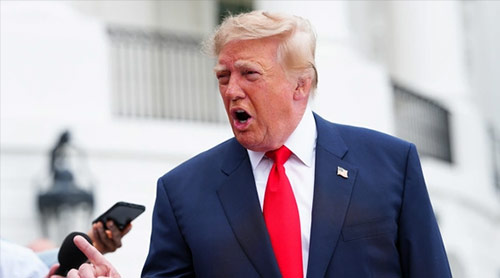
President Trump, who publicly stated that he had personally directed the legal action, accused political opponents of attempting to manipulate the election by introducing a candidate with a name similar to that of the incumbent senator.
The allegations included claims that individuals associated with Peltola had encouraged the second Sullivan to enter the race in an attempt to confuse voters and weaken the Republican candidate’s electoral support.
However, Peltola denied deliberately recruiting the candidate for that purpose.
Daniel J. Sullivan Jr. also maintained that his candidacy was legitimate and rejected suggestions that he entered the race solely to mislead voters.
The controversy had previously resulted in separate proceedings before Alaska’s state courts after election authorities attempted to remove the second Sullivan from the ballot.
The matter eventually reached the Alaska Supreme Court, which upheld his eligibility to participate in the election.
Despite that decision, the Justice Department pursued the federal lawsuit, seeking to establish a mechanism for investigating possible voter confusion before the final election result could be certified.
In dismissing the action, Judge Gleason held that the federal government had failed to satisfy the redressability requirement for legal standing under Article III of the United States Constitution.
Under the constitutional requirement, a party seeking relief from a federal court must demonstrate, among other things, that the alleged injury is likely to be remedied by the judicial order requested.
The judge found that the government had not identified a workable procedure through which ballots cast for the second Sullivan could be investigated to establish the voters’ intentions while preserving ballot secrecy.
She observed that many voters had already cast their ballots and that identifying or segregating such votes for further investigation would create serious practical and legal difficulties.
The court consequently held that the requested intervention could not provide an appropriate judicial remedy.
Judge Gleason further warned that introducing new electoral procedures shortly before polling day could create additional uncertainty and discourage participation.
The court reasoned that ordering a post-election investigation into ballots cast for a particular candidate could itself cause voter confusion, contrary to the stated objective of the government’s lawsuit.
The judge also considered the constitutional responsibility of states to administer elections and the need to avoid last-minute judicial interference with established voting arrangements.
She maintained that the proposed procedure had not been adequately explained and that its implementation could conflict with the legal protections surrounding the secrecy of individual ballots.
The court therefore dismissed the Justice Department’s action without determining that the allegations of deliberate voter confusion had been established.
The ruling represents a setback for the Trump administration’s attempt to intervene in the certification of the Alaska Senate election, a contest attracting national attention because of its implications for the balance of power in the United States Congress.
Alaska is among the states where Democrats are seeking to gain seats currently held by Republicans as both major parties contest control of the Senate.
The state’s ranked-choice voting system allows voters to rank candidates in order of preference.
Under the system, if no candidate secures the required majority of first-choice votes, the candidate with the fewest votes is eliminated and those ballots are redistributed according to voters’ next preferences.
The process continues until a candidate obtains a majority of the remaining votes.
The inclusion of two candidates with similar names therefore became a central issue in the dispute, with the Justice Department arguing that voters could mistakenly rank the wrong Sullivan.
However, the court’s ruling means that the federal government has not obtained an order stopping Alaska’s electoral authorities from proceeding with the certification process under the applicable state laws.
The decision also reinforces the legal principle that allegations of electoral irregularities must be accompanied by a legally cognisable injury and a remedy that a federal court has the jurisdiction and practical ability to grant.
The judge’s findings did not amount to a final factual determination that no voter could be confused by the names on the ballot or that every allegation surrounding the second Sullivan’s candidacy was false.
Rather, the dismissal rested on the government’s failure to establish a proper legal basis for the specific judicial intervention it requested.
Following the ruling, the Justice Department indicated that it would challenge the decision through the appellate process.
The controversy has also generated broader debate about federal involvement in state election administration, the protection of ballot secrecy and the limits of judicial intervention immediately before an election.
With voting scheduled for Tuesday, November 3, the dismissal leaves Alaska’s existing electoral arrangements in place unless a higher court subsequently orders otherwise.
[A MUST HAVE] Evidence Act Demystified With Recent And Contemporary Cases And Materials

Available now for NGN 40,000 at ASC Publications, 10, Boyle Street, Onikan, Lagos. Beside High Court, TBS. Email publications@ayindesanni.com or WhatsApp +2347056667384. Purchase Link: https://paystack.com/buy/evidence-act-complete-annotation
______________________________________________________________________ “Enhance Legal Practice With Authoritative Reports” — Alexander Payne Offers Comprehensive Law Reports, Spanning Over A Century Of Nigerian Jurisprudence Interested buyers are encouraged to place their orders and enquiries via:
0704 444 4777, 0704 444 4999, 0818 199 9888
Website: www.alexandernigeria.com