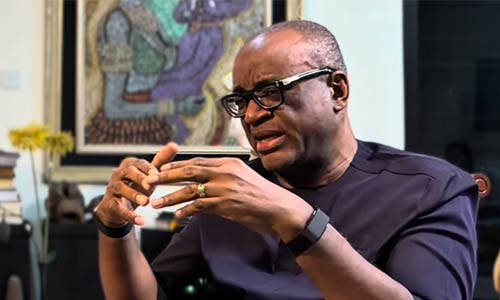
A former President of the Nigerian Bar Association has told Professor Pat Utomi that the deepest problem in Nigerian law is not corruption but uncertainty, and that a country which rewrites its electoral statute before every election cannot expect its courts to look consistent.

Augustine Oyarekhua Alegeh, SAN, CON, FCIArb, the 27th President of the Association, was speaking in a televised conversation on law, institutions and the condition of the country.
The interviewer opened by saying that the most consistent finding about how countries succeed is that strong institutions build great nations, that the ultimate institutions are the rule of law and property rights, and that in Nigeria there is a sense that the rule of law does not quite hold, that might is right, and that a person in power who dislikes your face can abrogate your property rights.
Mr. Alegeh began with the military era.
“You said we’re a country that was under military rule for several years. [We] still had judges who were committed enough to their oath of office that they would make decisions striking down the provisions or even military decrees, [in] those days.”
“And then things have evolved to a stage where there’s a lot of uncertainty about the law, and in real terms the foundation of law is the certainty of law.”
“Law ought to be precise, which is why you can say nobody is above the law. Because if there are two infractions of the same law, we [expect] to have the same outcome.”
“But when the law no longer has the blindfold on the statue [of Justice], it becomes a challenge.”
“Nobody can say clearly how we got here, but I know that the judiciary, the legal profession, and the lawyers, judges, we can do more. We could have done more to ensure that we have a country that we can say upholds always the principles of law.”
“One of the great challenges we have in our legal jurisprudence today is the frequency with which our laws are being changed.”
“We never had an election with the same electoral act. So you find out that the jurisprudence and the decisions of the last electoral act, you are going to have a different [outcome].”
“And if the people say, ‘Ah, but last year the judiciary held this way,’ and this year they are holding this way, it already adds to the distrust that people have for the judiciary.”
“Assuming what the judiciary did was even right in both cases, but you are applying two different laws, so the outcome becomes different. It then becomes again the general impression that, ‘Oh, this one was done this way because of this. This one was done this way because of this.'”
He gave an example.
“We understand that the legislature [has] the right to amend the electoral act at all times. But you start to wonder how, with our history and with the [cases] we have seen. Bayelsa State: they [won] the election. He was to be sworn in. And it turned out that his deputy had some educational challenges. And he lost his governorship because of that.”
“And now the new electoral act says you can’t challenge qualification. So if tomorrow somebody else is in that situation and a decision is pronounced, is it not the same Supreme Court that pronounced [the earlier one]? So you see the point I’m making.”
“When there’s frequent change of law, it leads, even if I’m not defending the judiciary, even if they are following the law, because [of the] frequent change, people are wondering, ah, you held this one this season, you are holding this the next season.”
And he put the question he says the country must answer.
“We need to keep asking ourselves, why do we keep changing our laws? And to whose benefit? When laws are being made to benefit certain persons, the laws will hardly be good laws.”
“So you ask, if the constitution says that to be a governor you must have this qualification, and then they say no, that is no longer a ground for challenging. But it was a ground last time.”
Professor Utomi put it to him that the Bar Association, as a civil society body, might have been expected to be at the forefront of alerting society to the dangers of that kind of law making, and that when Justice Onnoghen was removed as Chief Justice, the comparison with Pakistan was unavoidable.
“When it happened in Pakistan, similarly, all the lawyers of Pakistan with their wigs and everything went on the streets. And the government had to reverse that. Is there any constraint to the bar acting like a guardian of [the] social conscience?”
Mr. Alegeh’s answer was blunt.
“The Nigerian [people] and the Pakistanis are two different peoples. And the way we react here and the way they react in Pakistan [is] totally different.”
“Pakistan currently, they have increased [the] fuel price. And people have decided from all over Pakistan to march into the capital and they are actually marching. We’ve had fuel crisis here. Prices are 1,600 today for a litre of fuel. But no whimpering from anybody.”
“So why do we expect the bar association to be different from the whole community? We are the bar association, the lawyers are part of the community. And the general concept in Nigeria is, let me find a way to survive.”
Then he made the harder point.
“Look at the [Onnoghen] case, where they brought a charge before the Code of Conduct Tribunal. And then if lawyers went on strike, the question people will ask [is], when they took Mr. A or this civil servant to that same court, why did lawyers not go on strike?”
“So lawyers are only going on strike [for their own]. So you see, it looks like they’re not doing enough. But you look at the circumstances.”
On law making, he described an advocacy effort that came to nothing.
“I know that we have a very robust legislative advocacy group. But when you put the ideas forward, and what comes out is different, then [you] have a problem.”
“The bar association years ago had a conference to review the decisions of all election petition tribunals, with a view to seeing how can you harmonise. There was one time where they said pre-trial must be by letter, must be by motion, and cases were being struck out. One court is saying by motion.”
“So by the time you finish harmonising all of this, you still have to take it to the legislature. We are saying, this is what we can discern from the pattern in these last elections. [These are] the amendments that can be made. We need to attend to this issue, attend to that issue.”
“But that does not concern them. That is not what they want. So the law is not being made to see how the system can work better, but to see how we can make it serve particular interests better.”
Professor Utomi said he had spoken several times at events of the Association’s Section on Public Interest and Development Law, and found it striking that lawyers there are strident against the judiciary, and asked whether the socialisation of those who move from the Bar to the Bench is fractured.
Mr. Alegeh answered with two stories.
“Without mentioning names, I had a visitor years ago, two very good friends who were very critical of the [administration]. And just on an evening like this, the [administration] announced one as a minister. And the other one was very happy. He drafted a speech of rejection for his friend. He got to his friend’s house and there was a celebration.”
“The lawyer who has been in the forefront fighting for judiciary reform, fighting for [access] to the bench. We had this case years ago where the whole bar fought for a very brilliant lawyer to be elevated to the bench. And eventually [he] got elevated. In his first week in office, he committed a lawyer for contempt of court.”
“So they say you never know your real friend unless you try [him] with power or cash. And in this case, the power of the judiciary at times.”
“And we have people who have gone to the judiciary and who have stayed true to themselves. We have those who we have tried to encourage to go to [the] judiciary [who say] I don’t think I can go there.”
On appointments:
“I’ve always said personally the [whole] system of appointment of judges, the whole infrastructure around it needs to be revamped. It has worked, but the dynamism and the changes of societies today mean that you need to revamp it one way or the other. And if you do that, you’ll find that there’ll be improvement in the judiciary.”
He compared Nigeria with its neighbours and then with the United States.
“If you look at our neighbouring countries, Ghana, Cameroon, a lot are not different. But there’s been concerted effort and you can see they’re making progress. Our progress should be far ahead of them.”
“[They] look at technology. Nigeria, we have people who are technology savvy, who are far ahead in terms of financial services. But our judges are still using the longhand.”
“Imagine that [Judge Lance Ito] who did the O. J. Simpson trial had recorders who were recording for him. And in that whole trial, every morning by the time they came to court, they had their transcripts. And [you] ask, how long ago was that? And in 2026, a judge in Nigeria is using his pen to [record] evidence.”
Then he explained why he raised it, and the reason is not efficiency.
“If, for example, [we did] what they’ve done with technology, there’s a trial going on and transcripts are there for everybody. You can apply and you get a copy. And everybody sees the evidence that has been led. It makes it more difficult at the end of the trial process for the judge to give [a judgment at odds with it].”
“So you see, I’m bringing in technology to see that there are things that enable the inefficiency of the system. There are things that we can do to address them. So it has to be a whole concerted effort.”
“The judiciary, I’ll say, has several, [a] majority [of] good people. The bar also. I’ve met several lawyers in your house. If they’re not men of upright character, you will not [have] them in your house. But then ask, why is the entire system still being seen as corrupt?”
“It’s difficult, but I think currently, I know that there are still efforts ongoing to make some changes in the constitution, some changes in [the] Legal Practitioners Act, and relevant laws, to see how we can get the system better.”
“But until the final outcome of what the legislature gives you, you see it, you don’t really know what it’s like. In the last Electoral Act now, there are still several things that we had in [the previous] Electoral Act. It’s gone away. It’s gone somewhere.”
Professor Utomi interjected that the legislature, “especially this 10th Assembly, has been considered a disaster for Nigeria”, before turning to elections.
Professor Utomi said rulings on elections have been the biggest source of the diminishing of the judiciary, and recounted a conversation in a rural area a few days earlier.
“People say to you, ‘This kind [of] judiciary we have, where you have [an] election and number four suddenly becomes the winner. Is there any logic in this your higher judiciary [and how it] functions?'”
He said he was referring to the judgment that made Hope Uzodinma governor of Imo State, and asked whether the profession is not concerned by the loss of standing, recalling that to be called a lawyer in the 1950s drew admiration.
“Personally, I don’t think anybody who’s in the legal community does not pray, hope and look forward to the days of yore when, [at the] mention of a judge, everybody trembled.”
“You look forward and work towards it, but it has to be continuous effort. And like I keep saying, lawyers cannot operate or act different from the society.”
He then turned the interview round and put a question to his interviewer.
“At the last election we had so many people who won tickets under the Labour Party. And by now 90 per cent of them have gone. So in this new dispensation you guys are getting into, how are you going to deal with that challenge? Which is just like you are saying: [a] very active lawyer fighting for rule of law, he gets there. So these same people you say let them make a change, instead of them to change, they have joined [them].”
Professor Utomi answered at length. He said a small group dissatisfied with both main parties had begun talking about a third way; that the nature of the Nigerian electoral process is that one needs what people call “structure”, a word he finds irritating; and that outcomes turn on it because, in his words, “just about every election in Nigeria has been rigged, manipulated”, so that without people on the ground results can be changed.
“The entrepreneurs of power get together, they have cash, and so they create a PDP and they create whatever party. And they own it. It’s a special purpose vehicle for that time, to capture power [in] the state.”
He said the best available alternative structure was the labour movement, with workers everywhere in the country, and that he engaged its leadership. He said that on his birthday, 6 February 2022, the then President of the Nigeria Labour Congress, Ayuba Wabba, gave a speech saying it was time to collaborate, and that negotiations followed to find a vehicle among the political parties through which the structure of the labour movement could become the structure of the campaign.
“One of your colleagues, Femi Falana, [SAN], stepped into the meetings and said, ‘Look, why don’t we take the Labour Party back? It had gone rogue, more or less. Some people had hijacked it. Why don’t we take it back?’ And that he would get a court order that would make that happen. And he went and he got something. And that’s how the Labour Party became its platform.”
“The time between when all of this came together and the extraordinary campaign that really unfolded was so short that all kinds of scoundrels were just jumping on board to get a vehicle that [they] saw was moving fast. There was no time to sort.”
“Because as I keep saying, the biggest problem in Nigeria is that we don’t have a political party. Nigerian SPVs to power are not political parties. We know what a political party is. We know the process of socialisation of people who come in. We don’t [have] ideology.”
Asked by Mr. Alegeh whether the same people would jump in again in the next cycle, he said some would, but perhaps fewer, and that if victory came through a proper election “the right people at the top will make it difficult for those kinds of characters.”
Mr. Alegeh replied:
“It’s like you said, people do not join parties in Nigeria because of ideology. They join because it’s just [an] SPV. To get there. Because if it’s ideology, then you don’t have that fear.”
Professor Utomi illustrated the contrast with an American anecdote about a senator who left the Republican Party to sit as an independent and thereby flipped control of the Senate, and about lunching the next day at a Republican club in Washington where jokes were made, before his companion, seeing the senator walking alone near Union Station, said: “Look at this useless man. If this [were] in Nigeria, I’ll just go and beat him.”
(Two details in that anecdote require correction. See the verification note.)
Mr. Alegeh closed on the structural lock.
“On the side of the law, we always hope and pray [it] can get better, because we know that our democracy will be stronger and better if the law upholds its end. But there are difficulties, human. There are difficulties, institutional.”
“We just all have, as a country, to keep working to get better. Because we have no other country but Nigeria, so we can’t say we’re going to run away from here. We have to make it work here.”
“The fact that you dig a dry well doesn’t mean you [stop]. Drill and drill and drill. So we just keep trying.”
“At the end of the day, there must be commonality between those who want the law to move forward and those who are entrusted with the duty of making the changes to the law. When there’s a divergence there, you’re just hitting your head on the wall.”
“And some of the problems we are facing [are that] those who are entrusted with changing the law are those whose position [depends on] the situation in the system. Like you will say, ‘Look, why do we have so many senators? Can’t we make it part-time? Who’s going to change that?’ The same guys who are taking advantage of all this system.”
Professor Utomi closed by invoking Douglass North, author of Institutions, Institutional Change and Economic Performance and a Nobel laureate in economics, who he said reminds us that institutions evolve from what may look like people seeking their self-interest, until everyone agrees it is not working. He urged attention to states that have collapsed, naming Sudan and Somalia.
[A MUST HAVE] Evidence Act Demystified With Recent And Contemporary Cases And Materials

Available now for NGN 40,000 at ASC Publications, 10, Boyle Street, Onikan, Lagos. Beside High Court, TBS. Email publications@ayindesanni.com or WhatsApp +2347056667384. Purchase Link: https://paystack.com/buy/evidence-act-complete-annotation
______________________________________________________________________ “Enhance Legal Practice With Authoritative Reports” — Alexander Payne Offers Comprehensive Law Reports, Spanning Over A Century Of Nigerian Jurisprudence Interested buyers are encouraged to place their orders and enquiries via:
0704 444 4777, 0704 444 4999, 0818 199 9888
Website: www.alexandernigeria.com
Interested buyers are encouraged to place their orders and enquiries via:
0704 444 4777, 0704 444 4999, 0818 199 9888
Website: www.alexandernigeria.com