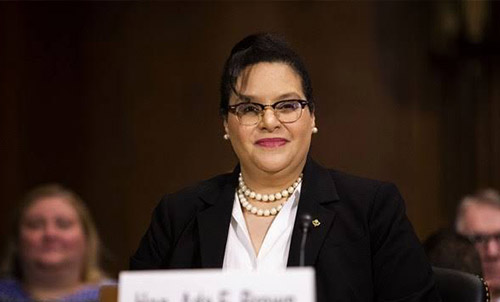
A United States federal judge, Ada Brown of the Northern District of Texas, is facing judicial misconduct proceedings after a committee of judicial investigators reportedly concluded that she had “abandoned her post as a federal judge” and recommended that her docket be temporarily taken away from her.

Bloomberg Law, in a report published on October 17, 2026, said the findings were contained in internal court documents shared with the publication. The proceedings concern allegations including mishandling of cases, hostile treatment of fellow judges and court employees, delays in issuing decisions and refusal to cooperate fully with an ongoing judicial investigation.
According to the report, Brown, a U.S. District Judge sitting in Dallas, is the subject of two judicial misconduct complaints. One was filed by an attorney who had appeared before her, while another was identified by Chief Judge Jennifer Walker Elrod of the U.S. Court of Appeals for the Fifth Circuit.
The investigating committee reportedly found what it described as a “reasonable basis” to believe that a mental condition may currently be interfering with Brown’s ability to discharge the responsibilities of her office. That remains a finding made for purposes of the judicial disciplinary process and is not an independent medical diagnosis established publicly.
The committee cited several factors for its conclusion, including allegations that Brown had declined to manage parts of her docket, recused herself from more than 40 cases since June 1, sometimes without explanation or with reasons investigators considered unusual, sent numerous emails described by investigators as troubling, declined meetings with senior judges over her docket and allegedly made inappropriate racial remarks concerning judges or court employees.
Bloomberg Law reported that the committee also concluded that Brown had effectively stopped performing much of her judicial work, describing the situation as an abandonment of her post.
According to the documents, Brown had issued almost no orders since August 10 in what was described as a protest over a recusal letter that had not been entered on the docket of a case subsequently reassigned to another judge.
Investigators reportedly asked Brown when she intended to return fully to work but said she did not provide an answer.
The committee consequently recommended that cases assigned to her be temporarily removed and directed her to undergo an independent psychiatric evaluation by October 21.
Brown, however, is declining to participate further in the Fifth Circuit Judicial Council proceedings, according to an email she reportedly sent early Saturday to investigators and court personnel.
The misconduct proceedings are being handled within the Fifth Circuit’s judicial disciplinary framework. The Fifth Circuit publicly maintains a judicial conduct process for complaints alleging misconduct or disability by federal judges.
The attorney complaint against Brown centres partly on allegations that she made inappropriate racial statements concerning the lawyer during court proceedings.
Brown denied misconduct in a written response reviewed by Bloomberg Law, although she reportedly acknowledged that the way she communicated with the lawyer could have been handled more carefully.
She also rejected suggestions that she was suffering from a mental condition affecting her work.
Brown said she would not want anyone appearing before her to believe that she held racial bias and referred to her own Black, White and Native American heritage.
She is the first Black woman to serve as a federal district judge in the Northern District of Texas and has Native American ancestry through her family.
The second complaint, identified by Chief Judge Elrod, reportedly alleges probable cause to believe that Brown treated judges and judicial employees in what the complaint described as a “demonstrably egregious and hostile manner.”
It also alleges that she created a hostile working environment, repeatedly delayed decisions, abandoned her docket and failed to cooperate with aspects of the investigation into the attorney’s complaint.
According to the internal documents cited by Bloomberg Law, Brown had twice indicated that she would resign from the federal bench but later withdrew those decisions.
Elrod, however, stressed in an October 1 order that the identification of a misconduct complaint did not amount to a determination that the allegations were true.
“The court is dedicated to ensuring a fair and impartial proceeding,” she said, according to the report, adding that Brown would be afforded due process and that opening or identifying a complaint did not reflect any conclusion on its merits.
The investigating judges had also asked Brown to attend a meeting on September 21 and answer written questions concerning the allegations.
Brown did not attend, reportedly explaining that she had been advised by counsel to give testimony only under oath because of what she described as a parallel investigation.
According to the documents, she did not identify the separate investigation to which she was referring.
Chief Judge Reed O’Connor of the Northern District of Texas subsequently transferred cases away from Brown on October 5, and she is no longer included in the court’s current case-assignment arrangement, Bloomberg Law reported.
Brown, born in Oklahoma City in 1974, graduated from Spelman College in 1996 and Emory University School of Law in 1999. She previously worked as an assistant district attorney in Dallas and served as a Texas state judge before President Donald Trump nominated her to the federal bench in 2019.
The allegations remain the subject of an ongoing judicial misconduct process. No final disciplinary determination establishing the claims against Brown has yet been reported, and the judicial council proceedings are separate from ordinary appellate review of decisions she has made from the bench.
[A MUST HAVE] Evidence Act Demystified With Recent And Contemporary Cases And Materials

Available now for NGN 40,000 at ASC Publications, 10, Boyle Street, Onikan, Lagos. Beside High Court, TBS. Email publications@ayindesanni.com or WhatsApp +2347056667384. Purchase Link: https://paystack.com/buy/evidence-act-complete-annotation
______________________________________________________________________ “Enhance Legal Practice With Authoritative Reports” — Alexander Payne Offers Comprehensive Law Reports, Spanning Over A Century Of Nigerian Jurisprudence Interested buyers are encouraged to place their orders and enquiries via:
0704 444 4777, 0704 444 4999, 0818 199 9888
Website: www.alexandernigeria.com
Interested buyers are encouraged to place their orders and enquiries via:
0704 444 4777, 0704 444 4999, 0818 199 9888
Website: www.alexandernigeria.com