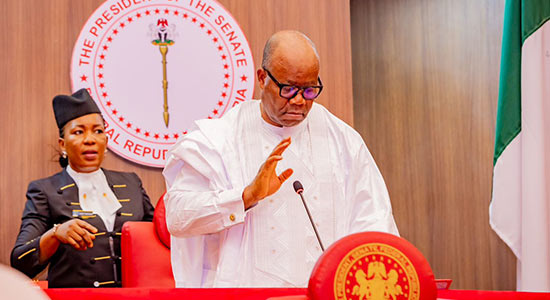
Senate President Godswill Akpabio has received public backing from members of the 10th Senate for his return as presiding officer of the 11th National Assembly in 2027, following declarations by Senate Chief Whip, Senator Tahir Monguno, and Senator Cyril Fasuyi that there would be no vacancy in the office of the Senate President.

The development occurred during plenary on Thursday, October 15, 2026, when the lawmakers openly supported Akpabio’s continued leadership and extended their declarations to the Deputy Senate President and other principal officers of the Senate.
The expressions of support came amid political discussions about the leadership of the next National Assembly and public controversy surrounding Akpabio’s remarks during the Senate’s consideration of the Suicide Prevention Bill 2026.
Monguno, who represents Borno North Senatorial District, expressed confidence that a majority of serving senators would secure re-election in 2027 and retain the existing leadership structure.
“Insha Allah, by the grace of God, the majority of us are going to make it back to the Senate, and this seat is hereby declared: there is no vacancy,” Monguno said.
He extended the declaration to the office of the Deputy Senate President and other principal officers, insisting that the current leadership should continue in the next Assembly.
Senator Cyril Fasuyi, representing Ekiti North Senatorial District, supported Monguno’s position and declared that Akpabio should retain the Senate presidency when the 11th National Assembly is inaugurated.
“I hereby support the motion ably moved by Senator Monguno that the seat of the Senate President in the 11th Assembly is not open to any contest. It is already occupied by Senator Godswill Obot Akpabio,” Fasuyi declared.
Following the statements, Akpabio sought the views of other senators on the proposed continuation of his leadership.
He called on lawmakers supporting the position to respond with an affirmative voice vote, drawing an audible chorus of “aye” from the chamber.
When he invited opposing voices, no audible response was recorded.
“I think that settles it,” Akpabio remarked.
Although the exchange demonstrated support for Akpabio among lawmakers present, it did not constitute a formal election or legally determine the leadership of the 11th Senate.
Under the constitutional framework governing the National Assembly, the Senate President is elected by members of the Senate from among themselves. Consequently, the eventual leadership of the 11th Senate will depend on the composition of the chamber after the 2027 general elections and the election of its presiding officers.
The development comes amid political discussions about possible contenders for the Senate presidency in 2027, including reports linking Imo State Governor Hope Uzodimma to the position. Such political speculation does not alter the constitutional procedure for electing the Senate President.
Meanwhile, Akpabio used Thursday’s plenary to caution Nigerians, particularly political commentators and television analysts, against taking statements made during legislative debates out of context.
His intervention followed criticism of comments attributed to him during Tuesday’s consideration of the Suicide Prevention Bill 2026, sponsored by Senator Asuquo Ekpenyong, representing Cross River South Senatorial District.
The bill, which passed second reading, seeks to establish a legal framework for suicide prevention, decriminalise attempted suicide and provide medical, psychological and rehabilitative support for survivors.
During the earlier debate, Akpabio had expressed opposition to removing criminal penalties for attempted suicide, arguing that the law should continue to discourage the act.
His position generated public criticism, particularly over whether people who survive suicide attempts should face prosecution and imprisonment or receive appropriate medical and psychological care.
The debate also raised questions about the relationship between the proposed legislation and existing Nigerian criminal laws.
Section 327 of the Criminal Code and Section 231 of the Penal Code contain provisions criminalising attempted suicide, while proponents of the proposed reforms argue that a health-focused response would better address mental distress and the circumstances associated with suicide attempts.
Senator Ekpenyong, in presenting the proposed legislation, had argued that Nigeria needed to reconcile existing criminal provisions with the treatment-oriented approach reflected in the National Mental Health Act.
However, Akpabio maintained that his comments during the debate should be understood within the broader context of legislative deliberations, where lawmakers are entitled to express differing opinions before arriving at a collective decision.
“When we discuss here, we discuss for and against, and in the course of our discussions, whatever we say should not anger anybody outside this chamber, because at the end, what matters is our final decision,” he said.
He explained that disagreements among senators were part of the lawmaking process and should not automatically be interpreted as personal hostility or evidence of prejudice.
“We want to make the best laws, so we are bound to oppose each other, and we are also bound to support each other,” Akpabio added.
The Senate President also addressed criticism surrounding comments about suicide bombers and religious beliefs, rejecting attempts to associate terrorism with Islam or Christianity.
“Terrorists are not Muslims. Terrorists are not Christians. Terrorists are human beings who believe in taking their lives and the lives of others,” he declared.
Akpabio argued that the teachings of Islam prohibit suicide and unlawful killing, stressing that violent acts committed by extremists should not be presented as representing the beliefs of an entire religious community.
He explained that his earlier reference to claims about suicide bombers expecting rewards in paradise was intended to challenge extremist interpretations rather than disparage Muslims.
The Senate President maintained that religious teachings should not be manipulated to justify violence or the killing of innocent people.
He further argued that discussions about suicide legislation must distinguish between individuals experiencing mental health challenges and those who deliberately kill others through suicide attacks.
“You have to distinguish between suicide committed by people who are mentally disturbed and suicide intentionally committed by people who are physically sound,” Akpabio said.
He insisted that lawmakers must consider different circumstances when debating legislation intended to address suicide prevention, criminal responsibility and public safety.
Akpabio also urged television panellists and political commentators to exercise restraint when interpreting legislative proceedings, warning against presenting individual contributions as the final position of the Senate.
“No matter the discussion, please take the final decision of the Senate into consideration. Don’t go and sit down in panels and try to do politically motivated discussions,” he said.
The Senate President subsequently defended his personal record of maintaining relationships across religious lines, citing his support for Muslim and Christian pilgrims during his tenure as Governor of Akwa Ibom State.
He disclosed that he had sponsored approximately 5,800 Muslims on pilgrimage to Mecca and more than 10,000 Christians to Rome and Jerusalem.
Akpabio said his support for religious activities across both faiths demonstrated his longstanding commitment to religious coexistence and respect for people of different beliefs.
He also referred to his relationship with Muslim members of his personal staff, explaining that he had worked closely with individuals from different religious backgrounds for many years.
“My ADC for 19 years is a Muslim. I don’t recognise him as a Muslim. I recognise him as a brother,” he stated.
According to him, more than 65 per cent of his staff members are Muslims, a circumstance he cited while rejecting allegations that his earlier comments were intended to ridicule Islam.
“There’s no way I will talk down on the Muslim religion,” Akpabio said.
He maintained that his remarks during the legislative debate had been misunderstood and urged Nigerians to examine the full context of parliamentary discussions before drawing conclusions.
Akpabio also stressed that the Senate remained committed to considering legislation capable of addressing social problems while taking into account competing legal, moral and public policy considerations.
The Suicide Prevention Bill 2026 remains under legislative consideration following its passage through second reading, meaning that the Senate has not yet reached a final legislative decision on the proposed decriminalisation of attempted suicide.
The Thursday plenary therefore brought together two separate developments: the public expression of support for Akpabio’s continued leadership of the Senate after 2027 and his response to criticism over the proposed reform of Nigeria’s laws on attempted suicide.
While the lawmakers’ declarations indicate support for Akpabio among members of the current Senate, the constitutional process for selecting the presiding officers of the 11th National Assembly remains unaffected.
[A MUST HAVE] Evidence Act Demystified With Recent And Contemporary Cases And Materials

Available now for NGN 40,000 at ASC Publications, 10, Boyle Street, Onikan, Lagos. Beside High Court, TBS. Email publications@ayindesanni.com or WhatsApp +2347056667384. Purchase Link: https://paystack.com/buy/evidence-act-complete-annotation
______________________________________________________________________ “Enhance Legal Practice With Authoritative Reports” — Alexander Payne Offers Comprehensive Law Reports, Spanning Over A Century Of Nigerian Jurisprudence Interested buyers are encouraged to place their orders and enquiries via:
0704 444 4777, 0704 444 4999, 0818 199 9888
Website: www.alexandernigeria.com
Interested buyers are encouraged to place their orders and enquiries via:
0704 444 4777, 0704 444 4999, 0818 199 9888
Website: www.alexandernigeria.com