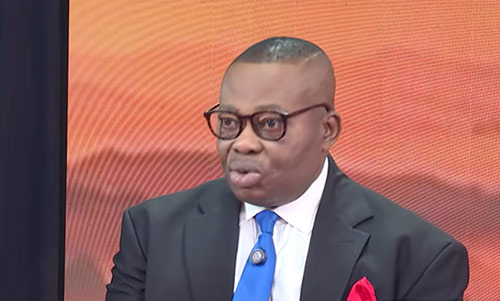
Dr. M. O. Ubani, SAN, has written that he would not object to paying a Danish rate of tax in Nigeria if the Nigerian government delivered a Danish quality of life, and that the question which matters in the Nigerian tax debate is not the rate but the return.

Writing after the International Bar Association Annual Conference in Copenhagen, and after travel in Scandinavia, he sets out what he saw, what it cost the Danish taxpayer, and what he concludes from the comparison.
“Having seen what a well-organised society can offer, I have reached a personal conclusion: I would not mind paying higher taxes in Nigeria if I could see government using the money to deliver the quality of life I experienced in Denmark.”
He begins with transport and the ordinary texture of the city.
“Copenhagen’s transport system immediately caught my attention. Bicycles are an integral part of everyday life, supported by dedicated cycling infrastructure and safer roads. The metro is reliable, easy to navigate and well integrated with other forms of transportation. The city is clean, orderly and secure, while public spaces are properly maintained.”
And then the comparison that does the work in the essay.
“For a Nigerian accustomed to poor roads, unreliable electricity, inadequate public transportation and limited access to essential services, these may appear extraordinary achievements. Yet, in Denmark, they are largely part of the ordinary expectations of daily life.”
From that he draws a proposition about how a country should be measured.
“A country’s greatness should not be measured solely by the wealth of its few citizens or the abundance of its natural resources. It should also be measured by the quality of the environment in which its people live, the services available to them and the dignity with which they conduct their daily affairs.”
He records the Danish tax position and the reaction he expects from Nigerian readers.
“During my stay, I learnt more about Denmark’s relatively high-tax system. Depending on income and applicable taxes, some taxpayers can face marginal tax rates around or above 50 per cent. To many Nigerians, particularly those already struggling with economic hardship, such a rate may appear excessive. But the more important question is this: What does the citizen receive in return?”
He is careful not to present Denmark as faultless.
“Denmark provides publicly funded education, broad access to healthcare, social protection and well-maintained public infrastructure. Its system is not without challenges. Waiting lists, public expenditure debates and disagreements over policy exist there too. Nevertheless, the connection between taxation and public services is much more visible than what many Nigerians experience at home.”
The conclusion he draws is a proposition about consent.
“Taxation becomes easier to accept when citizens can identify tangible benefits from public expenditure. People are more likely to trust and support a government when they can see their taxes translated into better schools, functioning hospitals, dependable transportation, safer roads and a cleaner environment. Conversely, when government demands more from citizens without delivering corresponding public value, taxation becomes a source of frustration and distrust.”
“The issue, therefore, is not merely how much tax a government collects. It is what the government does with the money collected.”
He draws the limits of his own argument expressly.
“Let me be clear. I am not suggesting that Nigeria should suddenly impose a 50 or 60 per cent tax rate on its citizens. Such a proposal would be irresponsible without considering our income levels, poverty rates, cost of living, large informal economy and the government’s capacity to provide essential services.”
“Neither should we assume that a tax system that works in Denmark will automatically work in Nigeria.”
And he says the Nordic countries cannot be transplanted.
“The experiences of Denmark, Sweden, Norway and other Nordic countries are not models Nigeria can simply copy and paste. Their achievements reflect decades of institution-building, economic development, public administration, social trust and responsible management of public resources.”
What he is advocating is stated as a change of premise.
“Taxation should not be regarded primarily as an instrument for extracting money from citizens. It should be a means of financing public prosperity, expanding opportunities and improving lives.”
And a condition precedent.
“Before asking Nigerians to pay more, government must demonstrate that public funds are managed transparently, waste is reduced, corruption is confronted and public expenditure produces measurable results. The Nigerian taxpayer must be able to ask not only how much money has been collected, but also what that money has accomplished.”
He sets out five questions he says should trouble every serious Nigerian, and particularly those entrusted with political power and the management of public resources.
“Why should a country blessed with oil and gas continue to struggle with reliable electricity?”
“Why should parents make enormous sacrifices to educate their children, only for them to graduate into unemployment and uncertainty?”
“Why should access to quality healthcare depend so heavily on personal wealth?”
“Why should roads remain sources of danger, hardship and economic loss?”
“Why should persons with disabilities continue to encounter avoidable barriers when accessing public buildings and essential services?”
His programme is set out in six paragraphs covering streets, transport, power, health, education and the standard against which all of it should be judged: “properly maintained roads, functioning streetlights, safe pedestrian walkways, attractive public spaces and effective waste management”; cities “designed for people, not merely vehicles”; electricity “consistently available” so that “businesses can operate without excessive dependence on generators”; healthcare “accessible without impoverishing citizens”, with functioning primary healthcare centres and properly equipped public hospitals; and for every child “access to quality basic education, qualified teachers, safe classrooms, libraries, laboratories and digital resources”, with university education “affordable and accessible”.
“These are not impossible aspirations. They are public policy objectives that require deliberate planning, sustained investment, institutional discipline and accountable leadership.”
He notes that he has travelled across all the continents, listing Australia, the United States, the United Kingdom, Mexico, Italy, Singapore, the United Arab Emirates and South Africa, and that the Scandinavian countries nonetheless left the strongest impression, because of “the consistency of quality in everyday life”.
His central takeaway: “institutions, public policy and leadership matter enormously. Natural resources alone cannot guarantee prosperity.”
He asks whether Nigeria can achieve it and answers that it can, with “dedicated, intentional and accountable leadership”, which for him should be “grounded in godly principles: integrity, justice, compassion, stewardship and a sense of responsibility to those who have entrusted public power to it.”
“The challenge is not simply to collect more revenue. It is to build a country in which public revenue produces public prosperity.”
He closes by acknowledging that many Nigerians will disagree, that “reasonable people can hold different views about the appropriate rates, priorities and pace of reform”, and by putting the question to the reader: “Would you be more willing to pay taxes if you could see your money reflected in good roads, reliable electricity, quality education, accessible healthcare, efficient public transportation and a government that accounts for every naira?”
“As God will help us, we must also help ourselves.”
[A MUST HAVE] Evidence Act Demystified With Recent And Contemporary Cases And Materials

Available now for NGN 40,000 at ASC Publications, 10, Boyle Street, Onikan, Lagos. Beside High Court, TBS. Email publications@ayindesanni.com or WhatsApp +2347056667384. Purchase Link: https://paystack.com/buy/evidence-act-complete-annotation
______________________________________________________________________ “Enhance Legal Practice With Authoritative Reports” — Alexander Payne Offers Comprehensive Law Reports, Spanning Over A Century Of Nigerian Jurisprudence Interested buyers are encouraged to place their orders and enquiries via:
0704 444 4777, 0704 444 4999, 0818 199 9888
Website: www.alexandernigeria.com
Interested buyers are encouraged to place their orders and enquiries via:
0704 444 4777, 0704 444 4999, 0818 199 9888
Website: www.alexandernigeria.com