President Bola Ahmed Tinubu has called for a comprehensive overhaul of Nigeria’s criminal justice system to close procedural loopholes and prosecution weaknesses that politically exposed persons and organised criminal networks exploit to evade justice.

The President particularly challenged judicial officers to scrutinise existing laws, review outdated judicial precedents, and strengthen case management procedures to prevent influential suspects from exploiting legal technicalities to frustrate criminal trials.
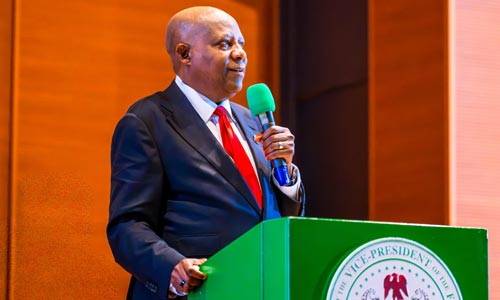
Tinubu, speaking on Tuesday at the eighth annual Economic and Financial Crimes Commission (EFCC) and National Judicial Institute (NJI) Capacity Building Workshop for Judges and Justices in Abuja, maintained that the fight against corruption could not succeed without an independent, progressive, and reform-minded judiciary.
Represented by Vice President Kashim Shettima, the President warned that financial and economic crimes posed a serious threat to Nigeria’s survival, stressing that the executive alone could not defeat corruption.
He urged judicial officers to rise above procedural technicalities that undermine the administration of justice and ensure that the courts remain effective instruments for protecting the public interest.
According to a statement issued by his Senior Special Assistant on Media and Communications, Office of the Vice President, Stanley Nkwocha, Tinubu said, “Probe prosecution strategies, dismantle outdated precedents, and seal procedural gaps that politically exposed persons and organised crime actors exploit to delay or frustrate trial.”
The President said the judiciary must recognise its critical responsibility to protect society from corruption, warning that excessive reliance on legal technicalities could undermine public confidence in the justice system.
“We must no longer permit legal pyrotechnics and procedural pedantry to shelter criminality. The Bench is not merely a mechanical arbiter of rules, but an active guardian of moral order and social equity.
“Law is, by design, an instrument of social engineering; it must invariably prioritise the public good over narrow, selfish interests shielded by technical manoeuvres. Our courts must embody the spirit, and not just the arid letter, of the law,” he declared.
Tinubu dismissed the notion that the anti-corruption campaign was exclusively an executive responsibility, arguing that corruption undermined every arm of government and adversely affected ordinary Nigerians.
He maintained that meaningful progress in uprooting corruption requires a judiciary committed to institutional independence, progressive reforms, and effective administration of justice.
The President also expressed concern about the growing sophistication of financial crimes, particularly those facilitated by emerging technologies, including artificial intelligence, blockchain and cryptocurrency platforms.
He described the workshop, themed “Investigation and Prosecution of Economic and Financial Crimes in a Digital Age,” as timely, noting that technological advances had significantly transformed the nature, scale and complexity of financial crimes.
“My Lords, we confront a rapidly shifting criminal landscape. Technology has amplified the audacity and reach of illicit actors, ushering in sophisticated crimes driven by destructive ingenuity.
“The rise of blockchain technology and artificial intelligence has introduced unprecedented layers of complexity to traditional illicit activities.
“Because these modern crimes constantly mutate, law enforcement and judicial authorities must continuously build capacity to adapt and respond effectively,” he said.
Tinubu said Nigeria’s investigative, prosecutorial, and judicial institutions must continuously update their strategies to respond to emerging threats and avoid becoming ineffective as technology advances.
He commended the EFCC for its recent operations against cryptocurrency-related fraud and for recovering substantial digital assets linked to financial crimes.
According to him, the commission had recovered billions of naira in cryptocurrency investment-related fraud cases, demonstrating its determination to confront emerging forms of economic crime.
Providing details of the agency’s operations, the President said the EFCC secured the forfeiture of Bitcoin valued at $22,417.91, digital assets amounting to 1,001,301.87 USDT, and $5.6 million linked to the CBEX investment scheme in 2025.
He added that 192 foreigners arrested in connection with cyber-terrorism and cryptocurrency fraud were successfully prosecuted and subsequently deported.
“We are already on the right trajectory. The EFCC’s recent momentum in tackling cryptocurrency fraud and its commendable strides in recovering virtual assets are highly reassuring,” Tinubu said.
While acknowledging the commission’s progress, he stressed that the judiciary must complement law enforcement efforts by rapidly improving its technical capacity to handle increasingly complex financial crime cases.
He commended the Chief Justice of Nigeria, Justice Kudirat Kekere-Ekun, for ongoing judicial reforms and pledged the Federal Government’s support for initiatives to strengthen justice delivery in the digital age.
Earlier, the Chief Justice of Nigeria, Justice Kekere-Ekun, said the growing sophistication of technology-driven financial crimes demanded improved judicial knowledge, disciplined case management and stronger institutional collaboration.
She noted that technological developments have fundamentally changed how courts obtain, preserve, and present digital evidence, making continuous capacity development imperative for judicial officers.
The CJN said sustained judicial education and training initiatives were already producing positive results, particularly in improved case management and justice delivery.
She described the collaboration between the EFCC and NJI as an important platform for addressing challenges confronting the criminal justice system.
Also speaking, Chairman of the Senate Committee on Anti-Corruption and Financial Crimes, Senator Emmanuel Udende, expressed concern over the increasing sophistication of financial crimes, particularly those involving politically exposed persons.
Udende said such cases presented significant challenges to timely prosecution and justice delivery, assuring that the National Assembly would continue supporting anti-corruption efforts through proactive legislation.
The Attorney-General of the Federation and Minister of Justice, Prince Lateef Fagbemi, represented by the Director of Public Prosecution, Rotimi Oyedepo, stressed the importance of stronger collaboration among institutions responsible for investigating, prosecuting and adjudicating financial crimes.
He maintained that no single arm of government could effectively combat corruption on its own and urged judges, lawyers, and prosecutors to use the workshop to improve their professional competence.
In his welcome remarks, the Administrator of the National Judicial Institute, Justice Babatunde Adejumo, said the partnership between the NJI and EFCC had become an integral component of efforts to strengthen the capacity of judicial officers to address emerging financial crimes.
He described the Vice President’s participation as evidence of the Tinubu administration’s commitment to strengthening the country’s anti-corruption institutions.
EFCC Chairman Ola Olukoyede described the workshop as a national imperative, saying it had become an important feature of both institutions’ annual programmes.
He said the commission recorded unprecedented convictions and financial recoveries over the past three years, while maintaining its commitment to transparency and accountability in managing recovered assets.
Olukoyede, however, expressed concern that rapid advances in digital technology were increasingly outpacing existing legal frameworks and prosecution procedures.
He called for ongoing reforms and capacity development to ensure Nigeria’s justice system can respond effectively to the changing dynamics of corruption and financial crimes.
[A MUST HAVE] Evidence Act Demystified With Recent And Contemporary Cases And Materials

Available now for NGN 40,000 at ASC Publications, 10, Boyle Street, Onikan, Lagos. Beside High Court, TBS. Email publications@ayindesanni.com or WhatsApp +2347056667384. Purchase Link: https://paystack.com/buy/evidence-act-complete-annotation
______________________________________________________________________ “Enhance Legal Practice With Authoritative Reports” — Alexander Payne Offers Comprehensive Law Reports, Spanning Over A Century Of Nigerian Jurisprudence Interested buyers are encouraged to place their orders and enquiries via:
0704 444 4777, 0704 444 4999, 0818 199 9888
Website: www.alexandernigeria.com
Interested buyers are encouraged to place their orders and enquiries via:
0704 444 4777, 0704 444 4999, 0818 199 9888
Website: www.alexandernigeria.com