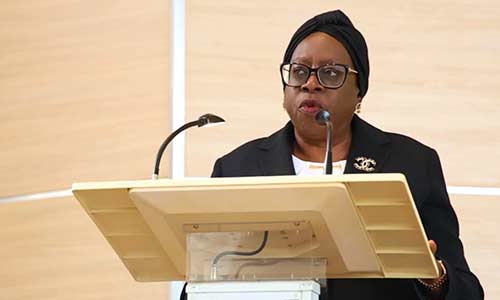
The Chief Justice of Nigeria, Justice Kudirat Kekere-Ekun, has warned lawyers against using criticism of judgments and judicial proceedings to launch personal attacks on judges, misrepresent court proceedings or mobilise public pressure against the judiciary.

She also cautioned against forum shopping and parallel proceedings capable of producing conflicting orders, saying lawyers must not allow the judicial process to be manipulated for partisan or strategic purposes.
Justice Kekere-Ekun spoke in Abuja on Wednesday, October 7, 2026, during the commissioning of the National Industrial Court of Nigeria’s headquarters building and a special court session marking the commencement of its 2026/2027 legal year.
Describing legal practitioners as indispensable partners in the administration of justice, the CJN urged restraint and accuracy in their public commentary.
“The right to criticise a judgment or judicial process does not extend to personal attacks on judges, deliberate misrepresentation of proceedings or attempts to bring pressure to bear on the court through public opinion.
“Where there are genuine concerns about judicial conduct, the appropriate institutional channels remain available and should be used,” she said.
Her remarks also addressed the responsibilities of judges and lawyers ahead of the next electoral season, particularly in politically sensitive litigation.
The CJN noted that some judges of the National Industrial Court could be assigned to election petition tribunals under the applicable constitutional and legal framework. She said such assignments would require heightened impartiality, restraint and detachment because of the intense public attention surrounding electoral disputes.
“As we approach another electoral season, these responsibilities assume even greater importance. Some of your Lordships may, in accordance with the applicable constitutional and legal framework, be called upon to serve as members of the election petition tribunals.
“In that capacity, your Lordships will be called upon to decide politically sensitive disputes which attract considerable public attention. The nature of such assignments therefore demands an even greater degree of impartiality, restraint and detachment,” she said.
Justice Kekere-Ekun reminded judges that their conduct, both within and outside the courtroom, would be closely scrutinised.
“Whether sitting in this court or performing a tribunal assignment, you must remain conscious that your conduct will be closely scrutinised.
“You must ensure that nothing in your associations, public engagements or other conduct creates a reasonable perception of political alignment or predisposition.”
Turning to the conduct of counsel, she said the integrity of politically sensitive litigation depended equally on the professional judgment exercised by lawyers.
“Counsel, too, has a responsibility to protect the integrity of the judicial process. Politically sensitive litigation requires particularly careful professional judgment.
“The temptation to pursue proceedings in different courts or divisions in the hope of obtaining a more favourable outcome must be resisted,” she said.
She warned that forum shopping and overlapping proceedings could damage public confidence and expose the judiciary to avoidable embarrassment through conflicting orders.
“The Bar must never become an instrument through which the judicial process is manipulated for partisan or strategic purposes. The proper forum is determined by law, not by the perceived likelihood of success before a particular judge or court.”
While commending the leadership of the National Industrial Court for its achievements, the CJN reminded judicial officers that the privilege of holding office carried profound responsibilities.
She said the authority of the courts flowed from the Constitution and the law, while public confidence had to be earned through the daily conduct of judicial officers.
According to her, how judges conduct proceedings, listen to parties, treat lawyers and court staff, and explain their decisions matters as much to public trust as the outcome of a case.
She urged the court’s judges to approach their work with diligence, patience and intellectual discipline, stressing that heavy workloads could not justify poor treatment of those seeking justice.
“The volume of cases before a court can be demanding, but pressure must never become an excuse for impatience, discourtesy or inadequate attention to the matters placed before the court.
“Every case represents real people, real businesses, real livelihoods and, sometimes, circumstances of considerable personal hardship.
“The parties may not always obtain the outcome they seek, but they are entitled to know that their cases have been heard carefully, fairly and impartially,” she said.
In his address, the President of the National Industrial Court, Justice Benedict Kanyip, described the court as a bastion of labour justice and an institution entrusted with protecting workplace rights and enforcing obligations according to law.
He said impartiality remained central to its responsibilities, adding that judicial independence was essential to the effective resolution of labour disputes.
“As an institution for labour justice, we are expected to remain impartial in all circumstances. For this reason, judicial independence, which applies to all courts, remains fundamental to the effective dispensation of labour justice,” he said.
Justice Kanyip added that independence came with enormous responsibility and assured participants of the court’s commitment to its mandate.
Reviewing its performance during the outgoing legal year, he disclosed that the court disposed of 2,236 cases across its judicial divisions over the preceding 12 months, helping to reduce its historical backlog.
He credited the judges’ dedication despite the volume of matters before them and said case disposal had improved compared with previous years.
However, the NICN President expressed concern that lawyers and litigants were making limited use of the court’s Alternative Dispute Resolution mechanisms, despite measures introduced to reduce delays.
He disclosed that only 31 cases were referred to ADR during the outgoing legal year. Of these, 11 were resolved, seven were at an advanced stage, while 13 remained unsettled and had been returned to the referring judges for litigation.
The Attorney-General of the Federation and Minister of Justice, Lateef Fagbemi, SAN, also commended the court’s achievements and called for further measures to ensure timely justice.
Represented by the Acting Director of Civil Appeals at the Federal Ministry of Justice, Tijani Gazali, SAN, Fagbemi said delays in employment disputes could have serious consequences for both workers and employers.
“In employment disputes, as with any other dispute, delay can have particularly serious consequences.
“A worker whose employment has been terminated may face prolonged uncertainty about livelihood, while an employer may also be left with uncertainty affecting business decisions and investment,” he said.
The AGF stressed that technology alone would not eliminate delays without improvements in personnel, case management and professional cooperation.
“Timely dispensation of justice is truly an essential part of effective justice. The technological systems developed by the court provide an important foundation for greater efficiency, but they must be complemented by effective case management, adequate personnel, professional discipline and cooperation between the Bench and the Bar.”
[A MUST HAVE] Evidence Act Demystified With Recent And Contemporary Cases And Materials

Available now for NGN 40,000 at ASC Publications, 10, Boyle Street, Onikan, Lagos. Beside High Court, TBS. Email publications@ayindesanni.com or WhatsApp +2347056667384. Purchase Link: https://paystack.com/buy/evidence-act-complete-annotation
______________________________________________________________________ “Enhance Legal Practice With Authoritative Reports” — Alexander Payne Offers Comprehensive Law Reports, Spanning Over A Century Of Nigerian Jurisprudence Interested buyers are encouraged to place their orders and enquiries via:
0704 444 4777, 0704 444 4999, 0818 199 9888
Website: www.alexandernigeria.com
Interested buyers are encouraged to place their orders and enquiries via:
0704 444 4777, 0704 444 4999, 0818 199 9888
Website: www.alexandernigeria.com