*Says “NBA-SPIDEL Will Continue To Draw Attention To The Urgent Need To Prevent Avoidable Deaths In Custody”

The Chair of the Nigerian Bar Association Section on Public Interest and Development Law (NBA-SPIDEL), Associate Professor Uju Agomoh, has said the Section will continue to press for the prevention of avoidable deaths in custody and for detention facilities in Nigeria to be operated in accordance with the law.
“The NBA-SPIDEL will continue to draw attention to the urgent need to prevent avoidable deaths and abuses in places of detention, and to ensure that detention facilities operate in accordance with Nigerian law and internationally recognised human rights standards,” she said.
She placed the Section behind a statement issued by the leadership of the Nigerian Bar Association on deaths in an official detention facility.
“This is aligning ourselves to the very, very strong and very impressive statement that had been made under the leadership of the President of the Nigerian Bar Association in response to the unfortunate deaths of thirty-seven persons in the NSCDC detention facility in Minna,” she said.
Agomoh linked the Section’s work on detention to the wider condition of the country’s institutions.
“Democracy, as you all will agree with us, cannot survive on elections alone, but elections are very critical,” she said. “It requires strong institutions. It requires respect for the rule of law.”
She said lawyers must speak up on issues affecting society and protect the public interest.
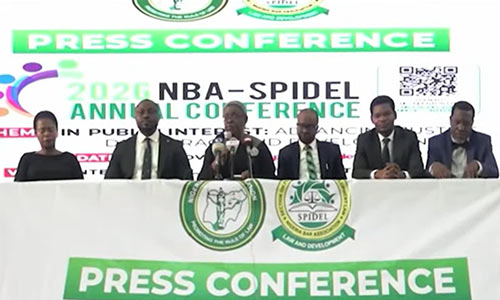
Agomoh was speaking at a press conference in Abuja on Monday, 5 October 2026, to announce the Section’s 2026 Annual Conference.
The four-day conference is scheduled for 10 to 13 November at the International Conference Centre, Umuahia, Abia State, under the theme “In Public Interest: Advancing Justice, Democracy and Development.” The Abia State Government is co-hosting.
The Section intends to bring together lawyers, judges, policymakers, civil society actors, academics and other stakeholders, and organisers say the gathering is expected to attract more than 2,000 participants. Early-bird registration, originally due to close at the end of September, has been extended to 14 October following interest from prospective delegates.
Agomoh said the choice of theme reflects the Section’s view that the legal profession cannot separate itself from the conditions under which Nigerians encounter the state, the courts, the police, correctional institutions and other public authorities.
“Law must serve the public interest,” she said, stressing that justice must be accessible, democratic institutions protected and development anchored in the rule of law.
She was explicit that the meeting is not intended to end in speeches.
“We are not gathering in Umuahia merely to discuss problems,” she said. “We are gathering to identify solutions, responsibilities and pathways for action.”
The conference agenda covers access to justice, public-interest litigation, constitutionalism, human rights, administration of justice, non-custodial measures, oversight of detention facilities, deaths in custody, policing and community safety, corruption, terrorism financing, legal aid, inclusion and the future of public-interest law in Nigeria.
Agomoh said the conference would examine structural barriers to justice, including delays in the courts, inadequate legal representation, weaknesses in justice-sector institutions and the particular difficulties faced by vulnerable and marginalised Nigerians.
The Section is also expected to examine the continued use of non-custodial measures and the oversight of detention facilities, with particular attention to preventing avoidable deaths and abuses in custody.
For most Nigerians, the Section’s case runs, access to justice is determined long before a case reaches a courtroom.
It depends on whether an arrested person gets a lawyer, how long an accused person remains in custody before trial, whether a family can afford legal representation, whether a court order is obeyed, whether a detention facility provides basic medical care, and whether vulnerable citizens have the means to challenge abuses by public authorities.
Congestion, prolonged pre-trial detention and inadequate access to legal representation have remained persistent concerns in the criminal justice system.
NBA-SPIDEL has increasingly tied its public-interest advocacy to conditions inside the justice and correctional systems.
In 2025, the Section worked with the Nigerian Correctional Service on an intervention at the Medium Security Custodial Centre in Uyo, which included a solar-powered borehole and lighting for the clinic, while also collecting data on inmates without legal representation.
In July, the Section inaugurated new statutory committees and task teams covering public-interest litigation, research and policy, detention monitoring, legal aid implementation, advocacy and law reform. Its Research and Policy Committee, chaired by Mr. Folarin Aluko, SAN, was given a mandate to produce evidence-based research, policy briefs and law-reform proposals.
The Section’s engagement in September with the President of the Nigerian Bar Association, Mrs. Oyinkansola Badejo-Okusanya, SAN, highlighted its wider agenda.
At that meeting, the President backed the Section’s focus on detention, disability rights, children in conflict with the law and the treatment of lawyers by the police, and urged the Bar to translate concern over rights abuses into practical reforms.
She is expected to attend the Umuahia conference with members of her executive committee. The Section has pledged to work with the national leadership as part of a broader “One NBA” approach, in what is the first Bar year under Badejo-Okusanya, the Association’s first elected female President.
Part of the agenda addresses the intersection between national security and individual rights.
The Section plans to examine corruption and illicit financial flows, including terrorism financing, while considering how enforcement mechanisms can be strengthened without sacrificing due process and human rights.
The state must have effective powers to protect national security and public resources, but those powers are themselves subject to constitutional limits. For the Section, the task is to ensure that the pursuit of security and accountability does not become a justification for weakening the safeguards that make criminal justice legitimate.
Agomoh argued that development cannot be measured solely by economic growth, and that institutions, accountable government, access to justice and the rule of law determine whether citizens actually benefit from it.
Questions about infrastructure, public spending, environmental protection, land, public services and economic opportunity increasingly produce legal disputes, because the distribution of public resources is inseparable from questions of rights and accountability.
Abia State’s decision to co-host provides a local backdrop. The state’s Attorney-General and Commissioner for Justice, Mr. Ikechukwu Uwanna, SAN, earlier told the Local Organising Committee that 17 new court buildings were under construction, and pointed to proposed amendments to the state’s Administration of Criminal Justice Law and to a proposed Restorative Justice Law.
Agomoh placed young lawyers, women lawyers and lawyers with disabilities within the conference agenda, saying the intention is to ensure that young lawyers are not merely recipients of the profession’s traditions but participants in determining its future.
The conference will include mentoring, leadership development and professional networking alongside sessions on public-interest advocacy and national development, and will address the participation of women lawyers, lawyers with disabilities and other groups often under-represented in justice-sector decision-making.
Agomoh’s invitation was deliberately wider than the Bar. She called on lawyers, members of the judiciary, policymakers, government institutions, civil society organisations, academics, development partners, journalists, young professionals and other Nigerians concerned about justice, democracy and development to participate.
[A MUST HAVE] Evidence Act Demystified With Recent And Contemporary Cases And Materials

Available now for NGN 40,000 at ASC Publications, 10, Boyle Street, Onikan, Lagos. Beside High Court, TBS. Email publications@ayindesanni.com or WhatsApp +2347056667384. Purchase Link: https://paystack.com/buy/evidence-act-complete-annotation
______________________________________________________________________ “Enhance Legal Practice With Authoritative Reports” — Alexander Payne Offers Comprehensive Law Reports, Spanning Over A Century Of Nigerian Jurisprudence Interested buyers are encouraged to place their orders and enquiries via:
0704 444 4777, 0704 444 4999, 0818 199 9888
Website: www.alexandernigeria.com
Interested buyers are encouraged to place their orders and enquiries via:
0704 444 4777, 0704 444 4999, 0818 199 9888
Website: www.alexandernigeria.com