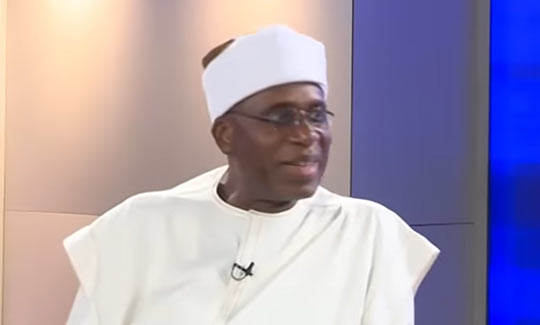
The vice presidential candidate of the African Democratic Congress (ADC), Mr. Rotimi Amaechi, has said those boasting that the 2027 general elections are already decided in their favour have never won an election without writing results, alleging that the exercise will be conducted in a manner that prevents voters from voting.

Amaechi, a former Governor of Rivers State and former Minister of Transportation, spoke on Channels Television’s Politics Today on Thursday, in his first major broadcast interview since emerging as running mate to former Vice President Atiku Abubakar on the ADC ticket.
Asked about claims by political actors in Rivers State that no candidate outside what has been described as a rainbow coalition can win the state, Amaechi declined to engage the individuals involved but answered the claim directly.
“I’ve warned you several times. Don’t bring me talking to people that ” he said, before adding: “Don’t make me talk to people who were my subordinates.”
He went on: “Now those who are bragging to have to win Rivers State, they should show you one day they have won a state by votes other than writing results. That’s why this election will be a very funny election. Let us wait now.”
Pressed on whether the ADC had a chance in Rivers State, he returned to the same point.
“Those who brag about winning election should show you one day that they have won election without writing result. They call, they take INEC, they take police, they take army. Don’t worry. Why don’t you wait? Why are you in a hurry?”
Asked whether he was saying he would defeat them this time, he declined to put it that way.
“I didn’t say that. I just simply say that what you know what they do when they say those things. It means that people will not be allowed to vote.”
He also asked for the conversation to be conducted with deference, saying: “Please, please respect me because I’m not your mate. I’m older. I was governor.”
The most concrete undertaking of the interview came in response to the presidential claim that relief had begun to reach ordinary Nigerians.
Amaechi said he would test the claim himself at a filling station the following morning.
“I will go tomorrow morning to a petrol station to buy fuel myself so I can see, because my staff go — maybe that’s why you don’t know,” he said. “I will go. If fuel has come down to 600 I will campaign for the President.”
He repeated the pledge and extended it. “If fuel comes down tomorrow to 600 I will campaign for the President tomorrow. If you doubt, come with your camera in the morning to the house and I will go to the station and I will buy fuel. If it has come down to this, I will withdraw as a vice presidential candidate and campaign for the President.”
Earlier, challenging the claim that transport costs had fallen from 1 October, he said: “You have a car, you’re a big man. Ask one of your staff that goes by transport how much it costs to move from Nyanya to Abuja. Has anything come down? Has any price come down? Has anything changed?”
Amaechi responded to the allegation by the Special Adviser to the President on Information and Strategy, Mr. Bayo Onanuga, that critics of the President’s Independence Day broadcast had prepared their responses before the address was delivered.
“But we waited for him to finish his broadcast. First, it’s disrespectful for us to speak before him. So he spoke and we sat down with young men who can listen to him and write out his speech and we discussed it,” he said.
“Don’t forget we already have our solutions in place. So we don’t need to wait for the President to react to our solutions. But then the Vice President had to respond to what he had said. So how are we magicians?”
Asked directly whether the response was premeditated, he said: “No, no, no. It was immediately after.”
On Onanuga personally, he declined to trade words, citing age and custom. “I won’t respond to him now because in my tradition I should be calling him da,” he said, explaining that the word denotes an elder. “Well, I wouldn’t be insulting. But you see the problem with such elders is that if they come out to a public space in my village and mess themselves up, sometimes the young ones would help them.”
On the office of presidential spokesman, he said: “Speaking for the President is for me an honourable task to do in our profession. Globally speaking, once you are given that position if I become a president for instance and I’m a liar, you join me to tell Nigerians lies.”
Asked whether he was saying the President was lying, he replied: “Of course I think he’s lying.”
On the 66th independence anniversary, Amaechi said the celebration had little content for ordinary citizens.
“When we were in university we used to call it flag, flag and anthem independence,” he said. “It means that beyond going to the stadium with a flag and national anthem, what are you benefiting? The government, the people benefiting from this, so-called independence, is the rich. The poor continues to suffer, and it is worse in Tinubu’s government. I doubt that even the rich is benefiting. It’s a cult group of persons that are just taking away all the things that belong to Nigerians. So when you say things are changing, I want to see how I feel it in my pocket.”
He criticised the change of the national anthem, saying the reported cost would have been better spent. “It’s ridiculous that the President wakes up and what bothers him is national anthem. They say they spent about 12 billion to change the national anthem. If you look at it, I can tell you it would have built like hundreds of healthcare centres. So instead of wasting time and wasting money, spend that money building healthcare centres in several locations.”
The programme’s anchor noted that he could not confirm the figure, and Amaechi said he could not confirm it either.
Asked whether the Atiku-Amaechi ticket had published a manifesto, Amaechi said the document belonged to the party rather than the candidates.
“We have, but I don’t have it here with me,” he said, before correcting the premise: “Atiku has no manifesto. The party has a manifesto. What you can say is what the ticket will do when it gets to government. What you can refer to as a blueprint, and we’ve been addressing it.”
Asked whether that meant the ticket would run on the ADC agenda, he said: “Of course, the ADC manifesto has nearly everything we want to deal with.”
He said the only gap was on the mechanics of subsidy. “Now the manifesto of the party deals with petroleum. The only thing it may not have dealt with is how subsidy removal is to be implemented. So the ticket said, okay, our party manifesto deals with the issue of subsidy removal and how to handle it.”
Amaechi said there were three principal issues requiring immediate attention, all of them connected to corruption, and then listed four.
“First education. Or first economy. Or all of them need to take first position — security, economy and education. They are all tied together, and if you don’t deal with them then the country is heading nowhere.”
Asked to name the three things Nigerians could take away from the ticket, he said petroleum and petroleum subsidy came first, followed by insecurity, then the economy, with education fourth.
“Petroleum, energy, is key to economic development, key to whatever you want to do in the country,” he said. “The crisis you have today is the energy crisis.”
Amaechi said the removal of the petrol subsidy had been undertaken without accounting for its consequences.
“When the President came and said the economists advised him, but he was courageous enough to remove the subsidy, he didn’t realise that there would be spiral inflation. So you remove the subsidy — transport cost goes high, rent goes high, food cost goes high, everything goes high. Now he didn’t think about the poor. He said, okay, I increase their salaries from 30,000 to 70,000. Clap for yourself. What goes next? Taxes.”
He said electricity tariff banding already amounted to a withdrawal of subsidy. “Band A, Band B, Band C on its own is a removal of subsidy. But by next year they’re going to remove subsidy on electricity.”
Told that the minister had denied any such plan, he replied: “Just because of election, they have changed their mind. They have changed what they are saying.”
He added: “Right now, if you have removed subsidy, you have devalued naira, you want to remove subsidy on electricity — you want more persons to die. Every day, not less than 10 persons in a week fall into poverty in Nigeria.”
Asked how a production subsidy would operate and who would pay for it, Amaechi set out a mechanism based on domestic pricing of crude oil.
“Going by the ADC manifesto, I will reintroduce subsidy, but not the type of subsidy that was removed. We will deal with production subsidy, which means no more importation of oil,” he said.
“So what does that do? It creates jobs, because as you buy imported fuel you are creating jobs elsewhere. But here, the moment you encourage people to build their own refinery, modular or big refinery, whatever it is, you are creating jobs even in building those refineries. In refining the products locally you’re also creating jobs.”
He explained the pricing differential with an illustration.
“If the price of crude is say 15,000 naira for instance, if you call Dangote and modular refinery owners and say, okay, I sell to you crude no longer at the international market cost, I sell to you at what I will refer to as domestic price — if it’s by law, I get the National Assembly to pass that law, or to repeal the law they had passed earlier, to say domestic crude will be sold at domestic price. So if it’s 15,000 naira for instance, I won’t sell to Dangote and the modular refineries at 15,000. I will sell at 10. The 5,000 naira difference is the subsidy.”
On supply, he said Nigeria produced more crude than the Dangote refinery required. “Dangote needs 700,000 barrels per day to produce. That’s the capacity of the refinery, between 650,000 and 700,000. Nigeria produces roughly 1.5 million or thereabout, 1.2, sometimes 1.3, roughly an average of 1.2 to 1.3 million barrels per day. That means we are producing crude more than what Dangote needs.”
Asked about the shortfall, he identified forward sales of crude as part of the problem, and when it was put to him that between 40 and 50 per cent of production belongs to the international oil companies, he said: “The one that affects Nigeria is the one we use. We will not take from them. The one that affects Nigeria is the one that will be part of the subsidy. Then every other person who is an investor will keep his own.”
He also disputed official consumption figures. “If you audit consumption of fuel, you do go below 700,000. The reason why there’s an increase in that is that if the price is cheap here, some will try to smuggle.”
He said that even on the official consumption figure the plan would hold. “Let’s also assume that it’s even correct, the volume the Nigerian economy consumes. We will also not only fund Dangote refinery by way of subsidy. There are other modular refineries existing in Nigeria that will also benefit and produce for the economy. Not only that, new persons will establish modular refineries once they see the profit coming out of that. All that is why I say it will not be a one-day thing. It will be a gradual process, but before the end of a year you will see how much improvement there will be in the economy.”
Asked how quickly the price of food, fuel and transport could fall under an Atiku-Amaechi administration, he set a timeline.
“I say to Nigerians, give us one year. If you don’t begin to feel the change, I am to leave,” he said. “It doesn’t take one year for the President to say I reintroduce production subsidy.”
The anchor pointed out that the removal of subsidy followed from the Petroleum Industry Act, and that there had been no provision for subsidy in the budget.
Amaechi answered by asking whether the law had since been repealed, and on being told it had not, said: “So this has not been repealed. Subsidy has been removed according to President Tinubu. How do we intend to introduce production subsidy? The same thing we could have done — by either repealing the law or going for an amendment, because it’s about the lives of Nigerians.”
Asked whether the route would be legal, he said: “Whatever it takes to bring back production subsidy. All you need to know is that we must bring back production subsidy. We don’t want Nigerians to continue to die.”
He added that the administration would place a bill before the National Assembly immediately on assuming office if the existing law stood in the way.
Amaechi said the protection of life was the single obligation on which a presidency stands or falls.
“I’m a very emotional person. I hate to see my friends die, or my mother like she died the last time, or my brothers or my children,” he said. “So if government allows its citizens to be dying — I said in the AIT interview, there’s only one responsibility that keeps a president in office: protection of lives and property. When you are not able to protect lives and property, it’s an impeachable offence. I was in the parliament.”
A substantial portion of the interview was given to an exchange over corruption, in which Amaechi was repeatedly asked about his own record and the record of the administration he served.
Asked whether corruption was worse than under the Buhari administration, he said: “Well, if you compare the two, you think there was no corruption in Buhari’s period?” He then drew a distinction. “No, that’s not as bad as this. In fact, there’s no corruption here. They just taking the thing home. You know the difference? The difference is that when you’re corrupt, you hide it. This is not hiding it.”
Told that he had been a strong ally of the former President, he objected to the characterisation of his role. “I was minister of transport. Please correct yourself.”
On the chieftaincy title conferred on him in Daura, he gave an account of seeking the former President’s view before accepting it. “When the emissaries came, I said look, I need to clear from the President, I don’t want titles, I don’t like titles. And so I thanked them. I said, read, the Emir, I’m grateful that this title was given to me and I wear it like a badge. But can I talk to the President? He said okay. So I went to the President… His answer was no. I said okay, then I don’t have to accept. He said, no, no, you must accept.” He added: “I love the title. I accept the title. I’m grateful to the Emir. I’m grateful to the Daura people. So don’t put the title at issue.”
Asked directly whether he was corrupt, he answered in the negative and invited proof. “Have you asked yourself why they find it difficult to arrest me? And I’ve been in politics since 1987,” he said. “I’m not an accountant. I read English, I read literature. I don’t know how to keep money.”
Pressed again, he said: “I’ve said several times. Even when I was being interviewed and she asked, are you corrupt, I said no, and I’m waiting for the person that will prove that I was corrupt.” Asked whether he could still say so, he replied: “I will say it one again and again. I will not go near corruption. I will not get close to corruption.”
Asked for his own definition, he said: “In every form.” Offered kickbacks as an example, he said: “Kickbacks, one. Nobody can even approach me.”
He said he found the line of questioning objectionable and asked that it be directed elsewhere. “Deal with the issue of corruption in this government. Why haven’t you asked those you even interview from this government whether they are corrupt or not? Why do you look at somebody who has served in government how many years ago and ask him if he’s corrupt, when the thieves are there facing you and you’re clapping for them?”
He said he appeared on such programmes out of necessity. “The only reason why I come for most of your interviews is because I don’t have a choice. I need to sell our message. If not, I shouldn’t be speaking to you, because you’re not putting these questions across to those people you go to interview.”
Asked whether there were no thieves among those he now works with in the ADC, he answered with an account of how he raises his children, saying he keeps them away from public funds, publicity and government, and that they demand explanations from him. “Anything you can’t explain to us, then there’s trouble.”
Asked whether the money the World Bank had referred to was stolen, he was careful with the word. “I don’t know. I’m using the word World Bank used — missing,” he said, citing a figure of 34.6 trillion naira and adding that the institution was asking how it was spent. “So if they say it’s missing, for government to say it’s not missing, say how I spent it.”
He also said, of party movements: “The criminals in other parties have moved to APC, because once you’re in APC you get more money. You don’t go to EFCC, you don’t go to jail.”
Amaechi challenged the administration to name a completed project.
“By this time in Buhari’s first tenure, we had completed Kaduna-Abuja rail. Tell them to show one they’ve completed. I started the Kano-Kaduna rail. They’ve not completed it. Now, by the time I awarded it, I said build the terminal. Now they’ve completed the terminal. They show it as what we did. We paid for it. We already asked them to proceed, but they’re showing it off. They should name one project they have completed, including television house like Channels.”
He referred to the Lagos-Calabar Coastal Highway, putting its cost at 33 trillion naira, about 16 billion dollars, and said he had driven three to four hours from a village in Nasarawa State to the studio on a road constructed under the previous administration.
Asked whether he considered the government a failure, he said: “I don’t think — I know that the government is a failure.”
Amaechi said the education figures were the clearest measure of decline.
“There are 92 million Nigerians who are illiterate, who are not able to read nor are they able to write. What are we going to do about them? Nigeria under Tinubu has moved from 12 million out-of-school children under Buhari to 20 million out-of-school children. Eight million people have fallen into poverty,” he said, adding that the consequence was a larger pool of recruits for banditry and crime.
On the naira’s stability, he said: “The reason why the dollar has stabilised is because the dollar was devalued and so nobody’s able to pay school fees.”
Told that inflation had fallen over three quarters and that the economy had grown, Amaechi said the inflation figure had been rebased, and declined to argue the statistics.
“So let me not talk about economics. Let’s talk about reality. Okay, inflation has fallen. He said there is economic growth. I support that. I support. How many people are able to feed? How many children are in school? How many parents are able to afford school fees? How many bandits have repented and come out to say, no, the economy has improved, I now have employment? How many people have been employed?”
He added: “My friend, economics is simple. What is in my pocket? What I can feed on? How much I can provide for myself?”
He said the National Bureau of Statistics had reported spending of 200 billion naira on imported drugs in a single quarter, and that 40 per cent of finished goods were imported.
Asked why he disagreed with the President, Amaechi said: “Because policies are killing people. I’ve lost my mother.”
He said the cost of medication had become unmanageable. “By the time he came, it was difficult to buy drugs for my mother.”
The exchange that followed, in which the anchor questioned whether a policy could be held responsible for the death and whether the responsibility for her care was not his own, became tense, with Amaechi saying: “I did the best I could.”
He returned to the general point. “So many persons whose parents have died, who themselves are about to die.”
He also gave his assessment of the choice before voters. “The people have not two choices, one choice to make — the choice to be alive,” he said. “If you vote for Tinubu — first, before you even talk about the country, before you talk about the North, before you talk about the South or East or West or religion, you must learn that the first thing is that you must be alive.”
He said the proceeds of subsidy removal had not been accounted for. “The essence of the President removing subsidy is to better the lives of Nigerians. Where is the money? I want to feel it. Everybody wants to feel it. Nobody hates Tinubu. I love Tinubu. He knows.”
On wages, he gave an illustration from his wife’s business. “I have staff in her shop and they’re asking for salary increase. You know why they’re asking for salary increase? Transport from where they live — the 70,000 naira you pay them in a month as their income, transport alone takes 65,000. What about house rent? The landlord has increased his rent by 300 per cent. I have somebody call me up in Lagos and tell me they’ve increased mine by 100 per cent. So government increases your salary to 70,000, introduces taxes that take away over 60 to 70 per cent. Is the money in your pocket?”
Asked whether free education formed part of the programme, Amaechi said he personally favoured it but doubted the resources existed.
“I wish I could. I’m one person who thinks that there should be free education all over the country,” he said, adding that it would extend “up to university level, but I doubt that we have the resources to do that.”
“I’m not the President, so I will only support the President, coupled with the fact that before you can recover all the resources that have been looted, before you can have money to run — there are too many things to focus on now that free education will be a distraction. Would you encourage education? Yes. Would you make it accessible and affordable? Yes. So it may not completely be free, but affordable, within the reach of the poor. Because if you don’t have an educated community then you have a crime-infested community.”
He pointed to his own record. “But I did that in Rivers State. Free education up to secondary school, then university I gave scholarship. And when I say free education, it was not just to go and announce free education. I paid school fees on behalf of every child.”
On the Nigerian Education Loan Fund, he said the scheme would be reviewed. “It will be reviewed. It’s a law, so if we review it and it’s positive we’ll go ahead with it.”
He questioned its logic. “The removal of subsidy caused both private and government institutions to increase school fees. So because you removed subsidy you then give them a loan. It’s a loan to go to school, not enough to pay their school fees and keep them in school, but at least it’s a loan which they will pay in future.”
Told that repayment begins two years after national service, he said: “That’s even worse, because by then they won’t have employment. So why not remove the thing that increased school fees? Why not make something that will make education affordable?”
He said the focus would be accessibility and affordability: “Primary schools in literally every village. Secondary school within the location everybody can access. And then school fees that people can afford.”
Asked what a fair exchange rate would be, Amaechi declined to name a figure and said the question belonged to economists.
“That you require to ask the President. We need to sit down with economists,” he said. “We’re not a president who said the economists advised him not to remove subsidy but he had courage. We’re not very courageous. We are courageous to the extent that the people should not suffer. So the President will sit with economists, his economic adviser, and whatever they tell us we implement, to ensure that we come out with a fair exchange rate.”
Asked how far an ADC government would go on insecurity, Amaechi described the approach he said he adopted as governor, beginning with the economy.
“When I reviewed the economic situation in Rivers State, I knew that because the economy was breeding poverty, it also bred criminals,” he said, recalling a statement he had made in office: “If government is unable to create a legal economic environment for Nigerians, Nigerians in Rivers State will create an illegal economy for themselves.”
He said the response was employment and social infrastructure. “The legal economy is you create jobs, you put salaries in people’s pockets. Government has failed here. So if government has failed, what happens? You breed criminals who then go out to kill people, to rob people, to kidnap people — and that is a criminal economy.”
He listed the measures taken: the Songhai farms and the training of farmers; the construction of primary schools in every village, each employing about 50 workers a day; new primary healthcare centres; and the employment of more than 400 doctors across about 350 health centres. He said women were encouraged to use the health centres for delivery and went home with 10,000 naira after each attendance, and that a mother and child hospital was built which the succeeding administration did not maintain.
Asked whether he would advise the use of mercenaries, he rejected the suggestion outright.
“No, no, no. The Nigerian Army is capable of fighting this war — training and equipment,” he said. “All we did was allow us train our soldiers, our policemen outside. So we took policemen to Israel. They were trained in Israel, about 300 of them. We came back, we built a police college to retrain the policemen around us. So the policemen in Rivers State were different from policemen outside, because they were well trained by then.”
Amaechi said the decisive variable in curbing corruption was the conduct of the President himself, and illustrated it with what he described as a joke.
In his telling, a newly inaugurated President is visited by the head of the national oil company, who offers him 200 million dollars saved in anticipation of his victory. The President accepts, the news leaks, and within a fortnight he replaces the official with his own appointee because he considers the sum too small. “Then corruption will start. That’s when you see an inflated figure of consumption of Nigerian fuel.”
He said the opposite signal produces the opposite result. “Once they know that the head brooks no nonsense, every other person will fall in line. Once a new president comes in place, if he’s not a noted criminal, if he’s not one noted to be a corrupt person, Nigerians will wait and watch him.”
He added: “The President doesn’t need to say anything. Once he keeps his hands like this and sees a thief, he puts him in prison — judiciary, take him to court, the court finds him guilty, puts him in prison. Every other person will fall in line.”
Responding to a suggestion that his analysis of the crude supply position was disputed by the government, Amaechi rested on length of service.
“The President has been in government for some time, but he has not been in government as long as I have been. He has been a governor, he has been a senator for 20 months, senator, eight years governor, and then the next thing is president. I have been a speaker for eight years, I’ve been a governor for eight years — that’s 16, more than the President, with all respect to him. I’ve been a minister for another nearly eight years. So for 23 years I’ve been in government, and I have passed through government at the state and the federal, so I can discuss some of these issues more than the President before he became president.”
[A MUST HAVE] Evidence Act Demystified With Recent And Contemporary Cases And Materials

Available now for NGN 40,000 at ASC Publications, 10, Boyle Street, Onikan, Lagos. Beside High Court, TBS. Email publications@ayindesanni.com or WhatsApp +2347056667384. Purchase Link: https://paystack.com/buy/evidence-act-complete-annotation
______________________________________________________________________ “Enhance Legal Practice With Authoritative Reports” — Alexander Payne Offers Comprehensive Law Reports, Spanning Over A Century Of Nigerian Jurisprudence Interested buyers are encouraged to place their orders and enquiries via:
0704 444 4777, 0704 444 4999, 0818 199 9888
Website: www.alexandernigeria.com
Interested buyers are encouraged to place their orders and enquiries via:
0704 444 4777, 0704 444 4999, 0818 199 9888
Website: www.alexandernigeria.com