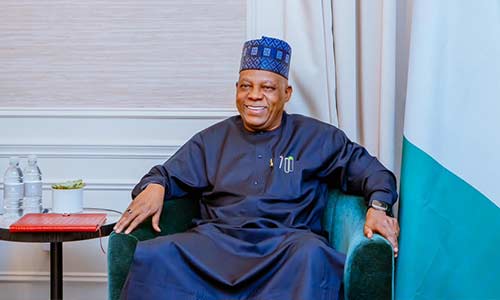
Nigeria is set to renew its longstanding demand for a permanent seat on the United Nations Security Council as Vice President Kashim Shettima leads the country’s diplomatic engagements at the 81st United Nations General Assembly in New York, with reform of global political and financial institutions expected to feature prominently in Nigeria’s agenda.
Shettima, who is representing President Bola Tinubu, is scheduled to deliver Nigeria’s national statement on Thursday, September 24, during the General Debate, where he is expected to press the country’s case for stronger African representation in global decision-making and a system that gives developing countries greater influence.
Ahead of the engagements, Minister of Foreign Affairs, Ambassador Bianca Odumegwu-Ojukwu, and Nigeria’s Permanent Representative to the United Nations, Ambassador Jimoh Ibrahim, briefed the Vice President on the country’s priorities, scheduled meetings and commitments at the high-level gathering.
According to Stanley Nkwocha, Senior Special Assistant to the President on Media and Communications in the Office of the Vice President, Nigeria intends to build on positions it advanced at previous UN meetings and deepen its campaign for reforms capable of making international institutions more representative, equitable and responsive to developing countries.
Nkwocha said Shettima would use the various platforms available during the General Assembly to present Tinubu’s positions across several areas, including Nigeria’s campaign for permanent representation on the Security Council. Nigeria’s participation, he said, would also involve strategic engagements with key international stakeholders.
The fresh push follows the position Shettima presented at the 80th UN General Assembly in 2025 when, speaking on behalf of Tinubu, he declared that Nigeria should be granted a permanent seat on the Security Council as part of a broader restructuring of the United Nations.
At the time, Shettima argued that the composition of the UN’s most powerful decision-making body no longer sufficiently reflected contemporary demographic, economic and geopolitical realities.
He pointed to Nigeria’s population, its role in regional peace and security and its history of participation in international peacekeeping as part of the government’s case for permanent representation.
Nigeria’s advocacy also fits within the broader African position on Security Council reform.
Under the Ezulwini Consensus and the Sirte Declaration, African states have consistently demanded at least two permanent seats for the continent, together with increased non-permanent representation.
Nigeria told UN negotiations earlier this year that Africa should receive at least two permanent seats carrying the same rights and privileges as existing permanent members, including the veto for as long as that power remains part of the Council’s structure. Nigeria also backed an increase in Africa’s non-permanent representation to five seats.
The Security Council currently has 15 members five permanent members, China, France, Russia, the United Kingdom and the United States, alongside 10 non-permanent members elected for two-year terms.
Africa has no permanent seat despite having 54 UN member states. Nigeria has itself served five times as an elected non-permanent member of the Security Council in 1966–1967, 1978–1979, 1994–1995, 2010–2011 and 2014–2015.
Nigeria has argued in ongoing UN reform negotiations that the absence of permanent African representation constitutes a structural imbalance, particularly because a significant proportion of Security Council deliberations relate to peace and security issues on the African continent.
Its position is that reform should cover both permanent and non-permanent categories rather than create intermediate or long-term seats that fall short of full permanent membership.
Beyond Security Council reform, Shettima is expected to use his UNGA81 engagements to press for changes to the international financial architecture, improved access to climate finance, sustainable development financing, greater access to technology and stronger representation for Africa in institutions that shape global economic policy.
Speaking shortly after arriving in New York, the Vice President said Nigeria’s participation would be guided principally by national interest and its commitment to multilateralism.
Shettima said Nigeria believes global institutions must become more representative and responsive to present-day realities, adding that the administration would engage international partners from the standpoint of Nigeria’s interests while seeking greater opportunities for developing economies.
The Vice President’s national statement is expected to address peace and security, sustainable development, economic growth, international cooperation and broader questions surrounding the effectiveness of multilateral institutions.
He is also scheduled to hold bilateral meetings with world leaders, international organisations and development partners during the UNGA week.
The 81st UNGA General Debate begins on Tuesday, September 22 and continues through September 26 before concluding on September 28 at the United Nations Headquarters in New York.
This year’s theme is “Restoring Trust, Managing Transformation: A United Nations That Delivers for All.” The UN says the session comes amid continuing debates over peace and security, sustainable development, climate change, emerging technologies and reform of the multilateral system.
Shettima arrived in New York accompanied by Rivers State Governor Siminalayi Fubara, Minister of State for Budget and Economic Planning Doris Uzoka-Anite and other senior government officials.
He was received by officials including Foreign Affairs Minister Odumegwu-Ojukwu; Minister of Solid Minerals Development Dele Alake; Minister of Women Affairs Imaan Sulaiman-Ibrahim; Lagos State Governor Babajide Sanwo-Olu; Nigeria’s Permanent Representative to the UN, Jimoh Ibrahim; and other government and diplomatic officials.
The Nigerian delegation also includes governors and officials seeking to use the gathering to pursue investment and economic partnerships.
Nasarawa State Governor Abdullahi Sule and his Kebbi State counterpart, Nasir Idris, said they intend to explore opportunities for foreign investment, particularly in solid minerals and other sectors where their states possess economic potential.
They said the availability of mineral resources in Nasarawa and Kebbi provides an opportunity to engage international investors, promote development and create employment.
Fubara similarly said his participation would focus on partnerships capable of attracting additional investments to Rivers State, particularly opportunities connected with the state’s oil and gas resources.
The governors said they intended to use the international gathering to showcase investment opportunities in their respective states and establish connections with prospective partners.
Also present at the briefing were Kwara State Governor AbdulRahman AbdulRazaq, Borno State Governor Babagana Zulum, Kebbi Governor Idris, Alake, Sulaiman-Ibrahim and Uzoka-Anite, among other senior officials.
Another major engagement on Nigeria’s UNGA programme involves Africa’s critical minerals.
Shettima is expected to represent Tinubu at a high-level roundtable themed “From Resources to Wealth: Continental Cooperation for Mineral Value Addition, Data Sovereignty, Innovative Financing, and Critical Minerals Security.”
The meeting is designed to bring together African political leaders, investors, development finance institutions, industry executives and other stakeholders around strategies for moving African economies beyond the export of raw minerals towards processing, value addition, industrialisation and stronger mineral value chains.
The minerals discussions connect with another part of Nigeria’s wider global reform campaign. At UNGA80, Shettima had argued not only for a permanent Security Council seat but also for debt relief and improved financing for developing countries, greater benefits for mineral-producing nations and action to close the global digital divide.
Tinubu mandated Shettima to lead the Nigerian delegation after deciding not to attend the General Assembly personally.
The Presidency said the Vice President would deliver the national statement, participate in high-level sessions on the Right to Development and climate action, attend engagements with other heads of delegation and hold bilateral meetings aimed at strengthening economic and diplomatic partnerships.
Nigeria’s renewed Security Council campaign therefore forms part of a broader agenda at UNGA81 encompassing political representation, reform of international financial institutions, climate financing, development, technology access, mineral resources, peace and security and investment diplomacy.
[A MUST HAVE] Evidence Act Demystified With Recent And Contemporary Cases And Materials

Available now for NGN 40,000 at ASC Publications, 10, Boyle Street, Onikan, Lagos. Beside High Court, TBS. Email publications@ayindesanni.com or WhatsApp +2347056667384. Purchase Link: https://paystack.com/buy/evidence-act-complete-annotation
______________________________________________________________________ “Enhance Legal Practice With Authoritative Reports” — Alexander Payne Offers Comprehensive Law Reports, Spanning Over A Century Of Nigerian Jurisprudence Interested buyers are encouraged to place their orders and enquiries via:
0704 444 4777, 0704 444 4999, 0818 199 9888
Website: www.alexandernigeria.com
Interested buyers are encouraged to place their orders and enquiries via:
0704 444 4777, 0704 444 4999, 0818 199 9888
Website: www.alexandernigeria.com