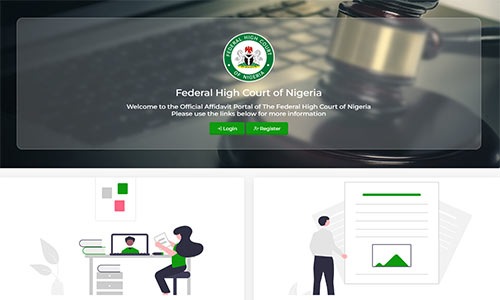
Nigerians can now obtain affidavits from the Federal High Court without travelling to any court premises, through the court’s Electronic Court Management System (ECMS) e-Affidavit Portal.

The fully digital platform allows an applicant to register, complete the relevant forms, upload supporting documents, make payment and download a verified affidavit from anywhere with an internet connection.
The portal was established to provide a secure and efficient process for affidavit applications and related court services, and operates under the Nigeria Data Protection Act 2023. It covers affidavits for name changes, correction of dates of birth, loss of documents, change of signature, next of kin, marriage, banking and a range of other purposes, and provides applicants with a means of tracking an application and downloading the completed document after payment and approval.
Step One: Create An Account
Applicants are required to register on the Electronic Court Management System portal at https://portal.fhc.gov.ng/.
Registration requires the applicant’s full name, phone number, date of birth, email address and a password. The name entered should be the name the applicant wishes to appear on the affidavit.
After registration, the applicant logs in and selects the affidavit module.
Step Two: Complete The Profile
Before beginning a new application, the applicant must complete an affidavit profile.
The portal requests the applicant’s native town, residential address, occupation, National Identification Number, country of origin, state of origin, gender, religion and date of birth. A passport photograph and an identity card must also be uploaded.
The court advises applicants to ensure that all information supplied is accurate before the profile is saved.
Step Three: Choose The Type Of Affidavit
Once the profile is complete, the applicant can access the list of available services, which are grouped into categories:
- Name change: Affidavit of Change of Name, Correction of Name and Harmonisation of Names
- Date of birth: Statutory Declaration of Age, Declaration of Age for a Minor and Correction of Date of Birth
- Loss and incidents: Loss of Items, Burglary, Theft, Robbery, Damage, Missing Person and related affidavits
- Identity and personal matters: Good Conduct, Next of Kin, Guardianship, Verification of Address and State of Origin
- Marriage: Bachelorhood, Marriage Declaration, Spinsterhood and Non-Impediment
- Banking: Change of Bank Phone Number, Non-Indebtedness and Single Account Ownership
- General purpose: Authorisation, Transfer of Ownership, Claim of Ownership, Sponsorship, Affidavit of Means and others
- Institutional: Good Conduct and Non-Membership of Secret Cult, Terrorist or Militant Group, Hostel Accommodation and other applications
There are also options for affidavits relating to academic documents, political office candidacy and other institutional purposes.
Step Four: Fill Out The Application
After selecting an affidavit, the applicant is taken to the relevant form. Depending on the type selected, the form may require personal details, the purpose of the affidavit and information specific to the application.
An application for correction of date of birth, for example, requires the applicant to state the reason for the correction, the incorrect date of birth and the correct one.
Applicants must also supply an email address and phone number, and select a preferred division of the Federal High Court. The available options include divisions in the various states and in Abuja.
Step Five: Upload The Required Documents
The portal requires a recent passport photograph, a valid means of identification, and a signature, which may either be uploaded or drawn directly on the platform.
Accepted means of identification include the National Identification Number, an international passport, a driver’s licence or a voter’s card.
Uploaded photographs, identification cards and signatures must meet the portal’s specifications, with each file limited to 300KB in the application form reviewed.
Step Six: Preview The Application
The applicant should then use the preview option to review the application. The preview displays the information supplied, including the applicant’s name, identification details, affidavit information, contact details and selected court.
Applicants are advised to check the details carefully at this stage, because the portal states that payments are final, non-refundable and non-transferable.
Step Seven: Accept The Terms And Submit
The applicant must agree to the portal’s terms and conditions and consent to the processing of personal data in accordance with the Nigeria Data Protection Act before the application can be submitted.
Step Eight: Pay The Fee
The portal then directs the applicant to make payment electronically, with Paystack and Remita among the available options.
The application reviewed for this report displayed a fee of N1,797 for the affidavit selected. Applicants should confirm the amount displayed for their own application before paying, as fees may vary by service or change over time. The portal warns again that payments are final, non-refundable and non-transferable.
Step Nine: Download The Affidavit
After payment and processing, the completed affidavit can be downloaded through the portal, and a copy is also sent to the applicant’s email address.
The court says affidavits issued through the portal are protected with unique barcodes and reference numbers which can be used for verification, and warns that falsifying, altering or misusing an affidavit is a criminal offence which may attract legal consequences.
What Applicants Should Know
An application queried for additional information or documents must be answered within 72 hours.
Failure to make the required payment, or to respond to a query within the stipulated period, can result in the automatic deletion of the application without a refund and without further notice. The applicant would then have to begin a fresh application and make a fresh payment.
The portal states that personal information supplied by applicants, including the National Identification Number, passport photographs, signatures and contact details, is collected for the purposes of affidavit applications, verification and other lawful purposes.
The practical value of this facility is obvious to anyone who has spent a morning queuing at a registry for a document that takes four minutes to prepare. The legal questions it raises are less obvious, and they are worth setting out because an affidavit is not an ordinary form.
An affidavit is a written statement of fact sworn or affirmed before a person authorised to administer oaths, and its force in law derives entirely from that act of swearing. Sections 107 to 120 of the Evidence Act 2011 govern the form and content of affidavits, the Oaths Act prescribes who may administer an oath and in what manner, and a document that is not properly sworn is not an affidavit at all. Nigerian courts have repeatedly struck out purported affidavits for defects in attestation, and that line of authority is why the mechanics of an online process matter more here than they would for, say, an online filing fee.
The framework nonetheless accommodates it. The Evidence Act now provides for the admissibility of electronic records, and the Nigerian judiciary has since the pandemic moved steadily towards remote and electronic processes, with virtual proceedings, electronic filing and electronic service now established in several divisions. A court-operated platform that captures the deponent’s identity, photograph and signature, applies a reference number and barcode, and issues the document under the court’s own seal is a considerable advance on the alternative it replaces, which in practice has often been a street-corner commissioner stamping a form with no verification of the deponent at all. The barcode is the most significant feature in the whole arrangement: forged affidavits are among the most commonly encountered false documents in Nigeria, and a verifiable reference number allows a bank, a school or an employer to check authenticity at source for the first time.
Two cautions belong alongside the convenience. The first is that a practitioner or institution should confirm that the receiving body accepts an electronically issued affidavit before relying on one. The Federal High Court issues these documents, but they are used overwhelmingly outside that court, by banks, pension administrators, immigration authorities, schools and state agencies, and acceptance practice varies. Where an affidavit is required for proceedings in a state High Court or before a tribunal, the rules of that forum govern.
The second is the deponent’s exposure. The warning on the portal is not decorative. A false statement in an affidavit is perjury, an offence under the Criminal Code and the Penal Code, and making a false statement on oath carries a term of imprisonment. The ease of obtaining the document does not dilute its character: what is sworn online is sworn on oath, and the consequences of a false declaration are identical to those attaching to a document sworn across a registry counter. The addition of the National Identification Number to the record makes the deponent considerably easier to trace than was previously the case.
Finally, two features of the terms deserve scrutiny rather than acceptance. A payment that is final, non-refundable and non-transferable in all circumstances is a broad stipulation for a public service, and it is not obvious that it should apply where an application fails through no fault of the applicant. And automatic deletion of a paid application, without refund and without further notice, after a 72-hour window, is a short period for a person who may be travelling, unwell or simply without reliable internet access. Since the portal collects an email address and a phone number, notice before deletion would be straightforward to provide. Those are administrative choices rather than legal requirements, and they are the sort of term a court, of all institutions, might be expected to set generously.
[A MUST HAVE] Evidence Act Demystified With Recent And Contemporary Cases And Materials

Available now for NGN 40,000 at ASC Publications, 10, Boyle Street, Onikan, Lagos. Beside High Court, TBS. Email publications@ayindesanni.com or WhatsApp +2347056667384. Purchase Link: https://paystack.com/buy/evidence-act-complete-annotation
______________________________________________________________________ “Enhance Legal Practice With Authoritative Reports” — Alexander Payne Offers Comprehensive Law Reports, Spanning Over A Century Of Nigerian Jurisprudence Interested buyers are encouraged to place their orders and enquiries via:
0704 444 4777, 0704 444 4999, 0818 199 9888
Website: www.alexandernigeria.com
Interested buyers are encouraged to place their orders and enquiries via:
0704 444 4777, 0704 444 4999, 0818 199 9888
Website: www.alexandernigeria.com