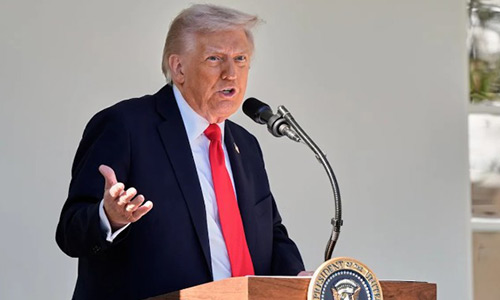
United States President Donald Trump has announced what he described as an immediate ban on CNN, MS NOW and Politico from the White House, accusing the three news organisations of repeatedly publishing what he called “fiction,” “lies” and “fake news” about his administration.
Trump made the announcement on Friday in a post on Truth Social, saying the three outlets were being barred because of what he described as their persistent negative and inaccurate coverage. He did not identify any specific report or story as the immediate trigger for the decision.
“I am proud to announce that, effective immediately, I am banning Fake News CNN, MSNOW … and Politico … from the White House as a result of their constant ‘reporting’ FAKE NEWS!” Trump wrote.
He added: “Media Outlets shouldn’t be able to constantly write or report FICTION and LIES when they’re covering the President of the United States, the Trump Administration, or the United States of America.”
Trump also warned that other media organisations could face similar action, writing: “Other Fake News Media Outlets to follow.”
Later, while answering questions in the Oval Office, the president described the decision as a “very simple ban” and said the dispute was not the result of one particular story but the accumulation of coverage over several years.
“It’s really just cumulative stories over the last few years,” Trump said. “You get sick of it.”
Asked how far the restriction would extend, Trump said he did not want the organisations in his office or at the White House, while suggesting the restriction could be reconsidered if, in his words, they “straighten themselves out.”
“I don’t want them in my office. I don’t want them here. I would say the ban would go as far as you can,” he said.
However, the precise scope and implementation of the announced ban remained unclear. CNN journalists were still working from the White House grounds after Trump made the announcement, and Reuters reported that the practical details of the restriction had not yet been fully explained.
CNN also had a crew travelling with Vice-President JD Vance in connection with an event in Iowa, underscoring the uncertainty over whether the announcement would apply only to access to particular White House spaces, to the wider complex, to the presidential press pool or more broadly to administration events.
Trump defended his action when asked how it could be reconciled with the First Amendment, arguing that the government should not be required to grant access to journalists whom he believes deliberately publish false accounts.
“I don’t think somebody should be allowed to come in and write fake stories,” Trump said. “They’re fake news, and that’s why they have no credibility.”
He added that while news organisations remained free to publish what they wished, he did not believe he was required to admit them to what he called “the People’s House.”
Trump also criticised The New York Times and The Washington Post when asked which other outlets might be affected, describing them as “fake news” and indicating that additional restrictions could follow, although he did not announce a formal ban on either newspaper at that time.
CNN responded by rejecting Trump’s description of its journalism and warning that any exclusion based on its reporting would face a constitutional challenge.
“CNN stands fully behind our White House team and their fair and accurate reporting,” the network said.
“We have a right under the U.S. Constitution to do that reporting without hindrance or interference from the government. Should the ban which President Trump threatened go ahead, it would be an illegal assault on that fundamental and constitutionally-protected right.”
Politico similarly said it would continue covering the administration and would defend its constitutional rights.
“Politico will continue to fairly report on this White House and future ones,” the organisation said, adding: “We will vigorously defend our First Amendment rights against any attempt to restrict them.”
MS NOW, the network formerly known as MSNBC, had not issued a substantive public response in the initial hours following the announcement.
The White House Correspondents’ Association also criticised the proposed restriction. Its president, Jacqui Heinrich, said the dispute went beyond the interests of the affected journalists and concerned the public’s access to information about government.
“The Constitution protects the freedom of the press from government interference,” Heinrich said, adding that the protection does not depend on whether a president approves of a news organisation’s coverage.
“This is about more than the rights of journalists. It is about the right of the American people to receive a full and independent account of the activities, policies and decisions of whoever occupies the nation’s highest office,” she said.
The association said it stood with CNN, MS NOW and Politico as the outlets were being singled out over their reporting.
Press-freedom organisations also argued that excluding particular organisations because of their editorial viewpoint would raise serious First Amendment questions.
Jameel Jaffer, Executive Director of the Knight First Amendment Institute at Columbia University, said the First Amendment restricts the government from punishing journalists because officials dislike their reporting.
He further argued that if Trump intended to remove the organisations from the White House press pool, the action would face an additional constitutional challenge because, in the institute’s view, access to the pool cannot be conditioned on whether government officials approve of a news organisation’s viewpoint.
The Reporters Committee for Freedom of the Press expressed a similar position.
“A ban like this would be flatly unconstitutional,” its president, Bruce D. Brown, said, characterising exclusion based on dislike of reporting as “viewpoint discrimination” and saying the organisation expected such a restriction to be challenged in court.
Trump himself acknowledged that litigation could follow, indicating that courts might ultimately determine whether the restriction could remain in place.
The latest confrontation follows a series of disputes between Trump and the White House press corps during his second term.
In February 2025, the administration changed the system by which access to the presidential press pool is organised, reducing the traditional role of the White House Correspondents’ Association in deciding which journalists participate.
The administration also restricted Associated Press access to some limited-access presidential events following a dispute over the organisation’s continued use of the geographical name “Gulf of Mexico” rather than the administration’s preferred “Gulf of America.” The AP challenged those restrictions in federal court.
Trump has also frequently criticised individual reporters and media organisations during White House events, aboard Air Force One and in public statements, while his administration has expanded access for bloggers, influencers and newer media organisations as part of an effort it says is intended to broaden the range of voices covering the presidency.
The dispute also recalls an episode during Trump’s first term involving then-CNN White House correspondent Jim Acosta, whose White House press credential was suspended in 2018. CNN sued, and a federal judge ordered the administration to restore his access while the case proceeded.
CNN remains one of a small group of major US television networks involved in providing video coverage through the rotating White House press pool.
For now, Trump’s announcement has created a fresh confrontation over the boundary between a president’s authority to manage access to White House facilities and the constitutional protection against government retaliation based on press coverage.
Whether the threatened prohibition will ultimately be enforced against all three organisations, how broadly it will apply, and whether courts will intervene remain unresolved.
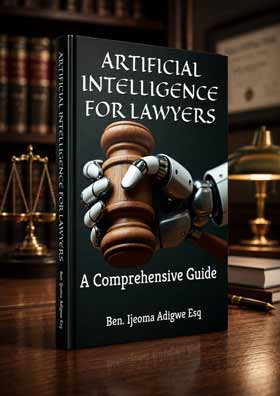 The book also examines Nigeria's legal ecosystem, focusing on the LPELR and NBA AI Guidelines. As a bonus, every purchase comes with a FREE eBook titled: How to Use the AI Features in LegalPedia and LawPavilion.
Ohio Books Ltd praises the publication, stating:
"....this is the only Nigerian book I know of on the topic."
How to Order:
📞 Call, Text, or WhatsApp: 08034917063 | 07055285878
📧 Email: benadigwe1@gmail.com
🌎 Website: www.benadigwe.com
Ebook Version: Access it directly online at https://selar.com/prv626
Authored by Ben Ijeoma Adigwe Esq., ACIarb (UK), LL.M, Dip. in Artificial Intelligence, Director at the Delta State Ministry of Justice, Asaba, Nigeria.
______________________________________________________________________
[A MUST HAVE] Evidence Act Demystified With Recent And Contemporary Cases And Materials
The book also examines Nigeria's legal ecosystem, focusing on the LPELR and NBA AI Guidelines. As a bonus, every purchase comes with a FREE eBook titled: How to Use the AI Features in LegalPedia and LawPavilion.
Ohio Books Ltd praises the publication, stating:
"....this is the only Nigerian book I know of on the topic."
How to Order:
📞 Call, Text, or WhatsApp: 08034917063 | 07055285878
📧 Email: benadigwe1@gmail.com
🌎 Website: www.benadigwe.com
Ebook Version: Access it directly online at https://selar.com/prv626
Authored by Ben Ijeoma Adigwe Esq., ACIarb (UK), LL.M, Dip. in Artificial Intelligence, Director at the Delta State Ministry of Justice, Asaba, Nigeria.
______________________________________________________________________
[A MUST HAVE] Evidence Act Demystified With Recent And Contemporary Cases And Materials

 Interested buyers are encouraged to place their orders and enquiries via:
0704 444 4777, 0704 444 4999, 0818 199 9888
Website: www.alexandernigeria.com
Interested buyers are encouraged to place their orders and enquiries via:
0704 444 4777, 0704 444 4999, 0818 199 9888
Website: www.alexandernigeria.com