Former Plateau State Governor, Simon Lalong, has said President Bola Tinubu should be given the opportunity to complete the economic reforms initiated by his administration, arguing that the country has reached a point where continuity is necessary to consolidate the changes already introduced.

Lalong made the remarks while speaking as a guest at a national forum of former presiding officers of state Houses of Assembly, where he focused particularly on the removal of petrol subsidy and the administration’s broader economic reform programme.
According to him, Tinubu has taken difficult decisions that previous governments struggled to fully confront, and Nigerians should allow time for the effects of those measures to materialise.
Lalong said the President had chosen what he described as the difficult path of reform rather than political convenience, maintaining that leadership should also be assessed by the willingness to address longstanding structural problems.
He linked that argument directly to the 2027 election, saying Tinubu had taken “bold steps” and expressing the view that voters should give him another mandate to complete the work already started. His remarks amount to political advocacy for continuity and reflect his assessment of the administration’s reforms.
The former governor devoted much of his address to the removal of petrol subsidy, describing it as one of the most consequential economic decisions taken by the administration.
Tinubu announced at his May 29, 2023 inauguration that the subsidy regime was ending, while stating that resources previously devoted to subsidy would instead be directed towards infrastructure, education, healthcare and jobs.
Lalong argued that successive governments had struggled with the subsidy question despite its implications for public finances, saying the old arrangement allowed Nigeria to spend heavily on consumption rather than productive investment.
“It was not an easy decision. It was not a politically convenient decision. But sometimes, leadership is tested not by the decisions that are easy to make, but by the courage to make decisions that the moment demands,” he said.
He further argued that for decades Nigeria had consumed petroleum products it did not sufficiently refine domestically, while transferring the cost of maintaining artificially lower pump prices to public finances.
“For decades, Nigeria consumed what we did not produce. We succeeded in making our future children pay for cheap petrol,” Lalong said.
The Tinubu administration has consistently defended subsidy removal on fiscal grounds. In May 2026, the President said the policy had helped prevent what he described as an impending fiscal crisis and created room for increased spending in other areas. That remains the administration’s assessment of the reform and its consequences.
Lalong said the significance of the policy should therefore be considered beyond the removal of subsidy itself, arguing that the larger objective must be to redirect public resources from consumption towards productive investments capable of expanding the economy.
“Our duty today goes beyond assessment. Our duty is to be ambassadors of this difficult but necessary reform,” he said.
He added: “President Tinubu has done his part by taking the bold decision. Our part is to help our people understand that the pains of today are the gains of tomorrow.”
Lalong said the next stage should focus on ensuring that resources made available through the reforms are converted into investments that improve Nigeria’s productive capacity.
The administration has paired the subsidy policy with other economic measures, including changes to the foreign-exchange system. At the beginning of his administration, Tinubu identified subsidy removal and exchange-rate reforms as central elements of his economic programme.
While Lalong argued that Nigerians would ultimately benefit from allowing the reforms to run their course, the economic measures have also brought significant adjustment costs, particularly through higher fuel and living costs. Tinubu himself acknowledged shortly after subsidy removal that households and businesses were experiencing hardship from higher fuel and food prices.
Lalong nevertheless maintained that the reforms required time to produce their intended results and urged Nigerians to view the present economic changes as part of a longer-term restructuring rather than measures whose full effects could be assessed immediately.
 Interested buyers are encouraged to place their orders and enquiries via:
0704 444 4777, 0704 444 4999, 0818 199 9888
Website: www.alexandernigeria.com
Interested buyers are encouraged to place their orders and enquiries via:
0704 444 4777, 0704 444 4999, 0818 199 9888
Website: www.alexandernigeria.com

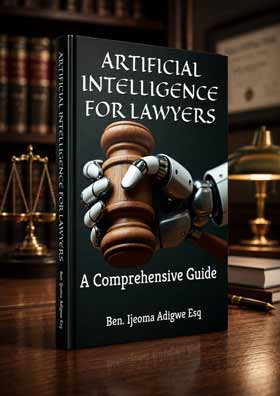 The book also examines Nigeria's legal ecosystem, focusing on the LPELR and NBA AI Guidelines. As a bonus, every purchase comes with a FREE eBook titled: How to Use the AI Features in LegalPedia and LawPavilion.
Ohio Books Ltd praises the publication, stating:
"....this is the only Nigerian book I know of on the topic."
How to Order:
📞 Call, Text, or WhatsApp: 08034917063 | 07055285878
📧 Email: benadigwe1@gmail.com
🌎 Website: www.benadigwe.com
Ebook Version: Access it directly online at https://selar.com/prv626
Authored by Ben Ijeoma Adigwe Esq., ACIarb (UK), LL.M, Dip. in Artificial Intelligence, Director at the Delta State Ministry of Justice, Asaba, Nigeria.
_______________________________________________________________________
The book also examines Nigeria's legal ecosystem, focusing on the LPELR and NBA AI Guidelines. As a bonus, every purchase comes with a FREE eBook titled: How to Use the AI Features in LegalPedia and LawPavilion.
Ohio Books Ltd praises the publication, stating:
"....this is the only Nigerian book I know of on the topic."
How to Order:
📞 Call, Text, or WhatsApp: 08034917063 | 07055285878
📧 Email: benadigwe1@gmail.com
🌎 Website: www.benadigwe.com
Ebook Version: Access it directly online at https://selar.com/prv626
Authored by Ben Ijeoma Adigwe Esq., ACIarb (UK), LL.M, Dip. in Artificial Intelligence, Director at the Delta State Ministry of Justice, Asaba, Nigeria.
_______________________________________________________________________