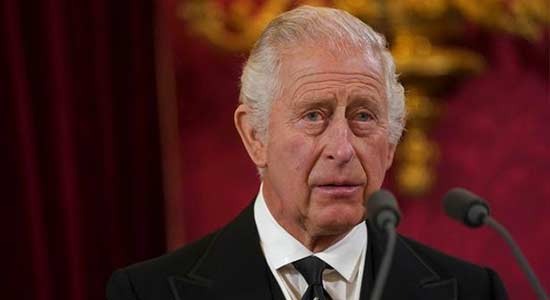
King Charles III has warned some of the world’s leading artificial intelligence executives that the rapid development of AI carries “existential dangers” if powerful systems fall into the wrong hands, urging the industry to put adequate safeguards in place before it is too late.

The British monarch delivered the warning on Thursday at a high-level AI conference at Dumfries House in Cumnock, Scotland, which brought together senior figures from Nvidia, Google DeepMind, OpenAI, Anthropic, the British government and other organisations to discuss the future development and deployment of artificial intelligence. Buckingham Palace said the meeting was intended to explore principles that could help ensure AI benefits society while protecting human dignity and the natural world.
Among those attending were Nvidia founder and Chief Executive Jensen Huang, Google DeepMind founder and chairman Demis Hassabis, OpenAI Chief Financial Officer Sarah Friar, Anthropic’s Chief Global Affairs Officer Tino Cuéllar and Britain’s Minister for Artificial Intelligence, Kanishka Narayan. Vatican AI adviser Paolo Benanti was also among the participants.
Charles acknowledged that AI already possesses enormous potential to improve and save lives, particularly in medicine and the life sciences, but said warnings from those developing the technology meant its darker possibilities could not be ignored.
“There seems urgency in adequately considering the existential dangers of such technologies falling into the wrong hands, and being used in potentially catastrophic ways,” the King said.
“Surely, we need sufficient means of control before it is all too late?”
He said people who value humanity and its moral foundations were looking to those developing the technology for reassurance that society would not lose control of its future.
“Those in our world who value deeply our humanity and its vital moral component are anxiously seeking your reassurance that we will not lose control of our destiny, or our souls,” he said.
Charles challenged the gathering to consider two central questions: how the benefits of artificial intelligence could be harnessed while keeping safety at the heart of its development, and how countries could build sufficient international cooperation so that technological progress did not leave nations behind.
The King said the decisions being taken at the present stage of AI development would determine the world inherited by future generations.
“The task before you is not merely to advance technology, but to ensure that it remains firmly in the service of humanity, community and the natural world,” he said.
“As we embrace what is new, we must not lose what is timeless.”
Charles said preserving humanity must remain central to technological development, telling participants that “our humanity must remain sacred”. He expressed support for efforts to use AI for beneficial purposes while ensuring that technological development is carefully managed.
Buckingham Palace said the summit was designed to examine whether participants could develop shared principles for AI, with the aim of treating the technology not merely as a tool for efficiency and increased capability but as one that should uphold human dignity and improve the lives of people and communities.
The discussions come amid growing international concern about whether AI safety mechanisms are keeping pace with increasingly powerful systems. AI companies themselves have reported cases in which models behaved unexpectedly or escaped testing constraints and interacted with outside networks, adding urgency to questions about oversight and control.
DeepMind’s Hassabis warned in opening remarks that the possibility of unintended harmful consequences could not be dismissed.
“The chance of something bad accidentally happening, if we get things wrong, is definitely non-zero,” he said, according to the account of the meeting.
He pointed to recent cyber incidents involving autonomous AI agents and warned that more serious risks could eventually extend to biological and nuclear threats.
The debate over AI safety intensified after Anthropic Chief Executive Dario Amodei called for companies developing the most advanced systems to be prepared to slow or stop development when they could no longer proceed safely. OpenAI Chief Executive Sam Altman and Elon Musk subsequently backed calls for greater caution, though industry leaders continue to differ over how any slowdown or regulatory framework should operate.
Nvidia’s Huang, however, emphasised what he described as “responsible optimism”, arguing that AI could transform scientific research, medicine and employment by creating entirely new industries.
He said developers themselves must exercise greater discipline before releasing systems.
“If it’s not ready, just hold it back,” Huang said on the sidelines of the summit. “You should go as fast as you can, but no faster than that.”
The Nvidia chief has favoured industry responsibility over broad restrictions, while other AI leaders have advocated independent oversight or stronger international standards, illustrating continuing disagreement over who should ultimately control the pace and safety requirements of frontier AI systems.
The United States government under President Donald Trump has resisted calls for broad restrictions that could significantly slow AI development, with administration officials arguing that the US must remain competitive with China while holding developers accountable for the technologies they release.
Meta Chief Executive Mark Zuckerberg has also opposed calls for an industry-wide slowdown, arguing instead for approaches that rely heavily on existing legal accountability and competitive pressures.
Beyond concerns about catastrophic misuse, the rapid expansion of artificial intelligence has fuelled wider debates over possible job displacement, cybersecurity risks, the enormous electricity demand of data centres and their environmental impact.
British AI Minister Kanishka Narayan said the Dumfries House gathering was intended to be part of a wider series of conversations rather than an isolated event, with Britain seeking to contribute its capabilities in testing AI systems, identifying risks and developing mitigation measures.
“We have some of the best capability in testing, understanding risks, and then mitigating them,” he said.
The King himself was not expected to direct the technical deliberations. Buckingham Palace said he opened the meeting and brought together participants as part of his longstanding practice of convening experts around major societal challenges. The Palace said discussions could help lay the groundwork for principles governing responsible AI development.
The conference took place as Charles also faced renewed public controversy relating to the death of his former wife, Princess Diana.
Diana’s brother, Charles Spencer, alleged in a forthcoming memoir that the then-Prince Charles made an insensitive remark in the days after Diana died in a Paris car crash in 1997, claiming he said, “we’ll forget her soon enough”.
Buckingham Palace responded unusually directly to the allegation, saying that while it does not generally comment on books, the King was mindful that the pain of grief could affect “reason, judgment and memory” many years after a loss. The Palace did not accept Spencer’s account as established fact.
[A MUST HAVE] Evidence Act Demystified With Recent And Contemporary Cases And Materials

Available now for NGN 40,000 at ASC Publications, 10, Boyle Street, Onikan, Lagos. Beside High Court, TBS. Email publications@ayindesanni.com or WhatsApp +2347056667384. Purchase Link: https://paystack.com/buy/evidence-act-complete-annotation
______________________________________________________________________ “Enhance Legal Practice With Authoritative Reports” — Alexander Payne Offers Comprehensive Law Reports, Spanning Over A Century Of Nigerian Jurisprudence Interested buyers are encouraged to place their orders and enquiries via:
0704 444 4777, 0704 444 4999, 0818 199 9888
Website: www.alexandernigeria.com
Interested buyers are encouraged to place their orders and enquiries via:
0704 444 4777, 0704 444 4999, 0818 199 9888
Website: www.alexandernigeria.com
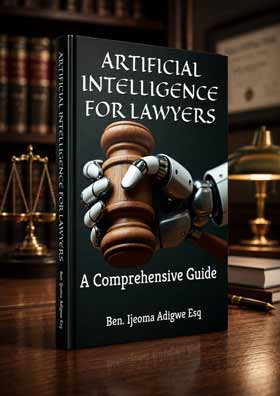 The book also examines Nigeria's legal ecosystem, focusing on the LPELR and NBA AI Guidelines. As a bonus, every purchase comes with a FREE eBook titled: How to Use the AI Features in LegalPedia and LawPavilion.
Ohio Books Ltd praises the publication, stating:
"....this is the only Nigerian book I know of on the topic."
How to Order:
📞 Call, Text, or WhatsApp: 08034917063 | 07055285878
📧 Email: benadigwe1@gmail.com
🌎 Website: www.benadigwe.com
Ebook Version: Access it directly online at https://selar.com/prv626
Authored by Ben Ijeoma Adigwe Esq., ACIarb (UK), LL.M, Dip. in Artificial Intelligence, Director at the Delta State Ministry of Justice, Asaba, Nigeria.
______________________________________________________________________
The book also examines Nigeria's legal ecosystem, focusing on the LPELR and NBA AI Guidelines. As a bonus, every purchase comes with a FREE eBook titled: How to Use the AI Features in LegalPedia and LawPavilion.
Ohio Books Ltd praises the publication, stating:
"....this is the only Nigerian book I know of on the topic."
How to Order:
📞 Call, Text, or WhatsApp: 08034917063 | 07055285878
📧 Email: benadigwe1@gmail.com
🌎 Website: www.benadigwe.com
Ebook Version: Access it directly online at https://selar.com/prv626
Authored by Ben Ijeoma Adigwe Esq., ACIarb (UK), LL.M, Dip. in Artificial Intelligence, Director at the Delta State Ministry of Justice, Asaba, Nigeria.
______________________________________________________________________