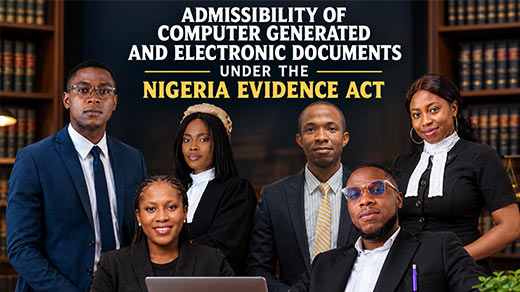
By C.K. Anyanwu, Ll.M., P.N. Vitalis, Esq., Kelechi Onyekwere, Esq., Chisom Marvelous Ndubuisi, Esq., Goodness Nnadozie, Esq., O.M. Alade, Esq., C.K. Ezeaku, Esq.,J.B. Joshua (Miss)


INTRODUCTION
The use of electronic evidence has become an important part of litigation in Nigeria. Bank statements, photographs, emails, downloaded documents, videos, electronic records and other documents generated or stored through computers and similar devices are now frequently relied upon by parties in judicial proceedings. However, the fact that a document is relevant to a case does not automatically make it admissible in evidence. The admissibility of computer-generated evidence is principally governed by section 84 of the Evidence Act 2011. The section lays down specific conditions which must be satisfied before a statement contained in a computer-generated document can be admitted in evidence. The courts have, over time, interpreted these requirements and clarified the circumstances in which electronic evidence may be admitted, the methods by which compliance may be established, and the consequences of failing to comply with the statutory requirements.
Furthermore, the courts have also established situations where some documents cannot be categorised as computer-generated evidence, to which the requirement to comply with the provisions of section 84 of the Evidence Act, 2011 does not apply. Conclusively, this piece considers the legal status of computer-generated evidence and the exceptions thereto.
THE STATUTORY REQUIREMENTS OF SECTION 84 OF THE EVIDENCE ACT
The requirements of section 84 of the Evidence Act
Section 84(1) of the Evidence Act 2011 provides that a statement contained in a document produced by a computer is admissible as evidence of any fact stated in it, of which direct oral evidence would be admissible, provided the conditions contained in section 84(2) are satisfied.
The conditions under section 84(2) include the following:
- The computer must have been regularly used during the relevant period to store or process information for activities regularly carried on by a person, body, or organisation.
- Information of the kind contained in the document must have been regularly supplied to the computer in the ordinary course of those activities.
- The computer must have been operating properly during the relevant period, or any malfunction must not have affected the production or accuracy of the document.
- The information contained in the document must reproduce, or be derived from, information supplied to the computer in the ordinary course of those activities.
Section 84(4) further provides for a certificate identifying the document, explaining how it was produced, giving particulars of the device used and dealing with the matters relating to the conditions in section 84(2). The certificate should be signed by a person occupying a responsible position in relation to the operation of the relevant device or management of the relevant activities.
TWO METHODS OF PROVING COMPLIANCE
An important point established by the Supreme Court is that section 84 does not make the certificate the only method of proving the conditions for admissibility.
In Dickson v. Sylva & Ors (2016) LPELR-41257(SC), the Supreme Court explained that section 84 provides two methods of proof. Compliance may be established through oral evidence under section 84(1) and (2), or through a certificate under section 84(4). In either case, however, the conditions contained in section 84(2) must be satisfied.
The Court stated:
“Section 84 (supra) consecrates two methods of proof, either by oral evidence under Section 84(1) and (2) or by a certificate under Section 84(4). In either case, the conditions stipulated in Section 84(2) must be satisfied.”
Thus, it is incorrect to suggest that a party must invariably tender a certificate and also call oral evidence. The law permits either method, subject to the requirements of section 84(2).
This position was also recognised in I.G.P. v. Bello (2023) 1 NWLR (Pt. 1865) 265 C.A., where the Court of Appeal held that the conditions in section 84 may be satisfied either by oral evidence or by a certificate under section 84(4). The Court rejected the argument that a party must both tender a certificate and call oral evidence in every case.
The certificate under section 84(4)
Where a party chooses to rely on a certificate, the certificate must contain sufficient information to establish the statutory requirements.
In Dickson v. Sylva & Ors (2016) LPELR-41257(SC), the Supreme Court explained that section 84(4) requires a certificate identifying the document, describing the manner in which it was produced, giving particulars of the device involved in its production and dealing with the matters contained in section 84(2). The certificate must also purport to be signed by a person occupying a responsible position in relation to the operation of the relevant device or management of the relevant activities.
The purpose of these requirements is essentially to establish the reliability of the computer or device from which the evidence was produced.
The Supreme Court observed in Dickson v. Sylva (supra) that section 84 is concerned with establishing the authenticity and reliability of the device from which the electronic evidence was produced.
FAILURE TO COMPLY WITH SECTION 84 OF THE EVIDENCE ACT
Failure to satisfy the requirements of section 84 can have serious consequences. A document that requires compliance with section 84 cannot simply be admitted because the opposing party failed to object when it was tendered.
This was clearly stated in Polaris Bank v. Centre Point Travel Agency Ltd (2022) LPELR-57359(CA). In that case, the respondent challenged the decision of the lower court to expunge its statement of account, Exhibit P-P81, because it was computer-generated and had not complied with section 84 of the Evidence Act.
The Court of Appeal relied on Kubor & Anor v. Dickson & Ors (2012) LPELR-9817(SC) and held that where the certificate required under section 84(2) is not tendered with the computer-generated evidence, the document becomes inadmissible and may be expunged at the judgment stage.
The Court further made an important distinction between documents that are legally admissible but were admitted without objection and documents which the law expressly makes inadmissible unless certain statutory conditions have been fulfilled. In the latter situation, the fact that the document was admitted without objection does not prevent the court from subsequently expunging it.
The Court stated: “Therefore, where the certificate required by Section 84(2) of the Evidence Act is not tendered along with the computer-generated evidence, the said document becomes illegally admissible evidence and it must be expunged at judgment stage.”
The Court further held that Exhibit P-P81 was clearly a computer-generated document, even though the information contained in it had originally been entered by human beings. The fact that human beings supplied the information did not change the fact that the resulting document was generated electronically.
COMPUTER-GENERATED EVIDENCE NOT LIMITED TO DOCUMENTS DOWNLOADED FROM THE INTERNET
Another important issue is whether section 84 applies only to documents obtained from the internet. The courts have firmly rejected such a narrow interpretation.
In Lanlehin v. Akanbi & Ors (2015) LPELR-42147(CA), the Court of Appeal, relying on Omisore v. Aregbesola (2015) 15 NWLR (Pt. 1482) 205 S.C., held that the admissibility requirements of section 84 are not limited to internet-generated documents.
The Court explained that the definition of a computer under the Evidence Act is sufficiently broad to include any device used for storing and processing information.
Similarly, in Omisore v. Aregbesola (2015) 15 NWLR (Pt. 1482) 205 (SC), the Supreme Court held that it is not only internet-generated documents that fall within section 84. The phrase “a statement contained in a document produced by the computer” is broad enough to cover other electronically generated documents.
The Court relied on the definition of “computer” under section 258(1) of the Evidence Act, which includes any device for storing and processing information.
Therefore, electronic evidence such as photographs, bank statements, electronic records and other computer-generated documents may fall within section 84 even where they were not downloaded from the internet.
WHEN A DOCUMENT IS NOT REGARDED AS A COMPUTER-GENERATED DOCUMENT
Although section 84 has a broad application, not every document that happens to be printed using a computer is necessarily a computer-generated document for the purposes of the provision.
In Arocom Global Investment Ltd v. United Parcel Service Ltd (2021) LPELR-52891(CA), the Court of Appeal considered a bundle of waybills and invoices and held that the documents had not been shown to qualify as computer-generated documents.
The Court considered section 84(5), which provides that a document is regarded as having been produced by a computer whether it was produced directly by the computer or, with or without human intervention, through appropriate equipment.
The Court also referred to Lanlehin v. Akanbi & Ors (2015) LPELR-42147(CA) and Rose-Hill Ltd v. GTB Plc (2016) LPELR-41665(CA) in explaining the scope of computer-generated documents.
The decision demonstrates that the party seeking to rely on section 84 must establish that the document falls within the category of evidence contemplated by the provision.
BANK STATEMENTS AND ELECTRONIC RECORDS
Bank statements provide one of the most common examples of computer-generated evidence. Modern banking systems involve the electronic storage and processing of a large volume of information, and statements of account are ordinarily produced from such systems.
In A.-G., Fed. v. Anuebunwa (2022) 14 NWLR (Pt. 1850) 211 (SC), the Supreme Court recognised that a bank statement is a computer-generated document and that certification is required where the statement is being relied upon under section 84.
The Court explained that certification serves to assure the court that the source data entered into the computer was not illegally or improperly altered and that the computer was operational or in good working order when the document was generated.
The Supreme Court also made an important observation concerning the purpose of section 84. The provision is intended particularly to deal with complex evidence generated by computers where the accuracy of the computer’s calculations or processing is relevant and requires scrutiny. It is not intended to create unnecessary difficulty concerning ordinary documents merely because they happen to have been printed from a computer.
PUBLIC DOCUMENTS GENERATED ELECTRONICALLY
Electronic generation does not change the character of a document that is otherwise a public document.
In Ayoola & Anor v. Dominion Trust Ltd & Ors (2025) LPELR-82534(CA), the Court of Appeal considered the relationship between section 84 and public documents. The Court relied on Dickson v. Sylva (2016) LPELR-41257(SC) and Kubor v. Dickson (2012) LPELR-9817(SC) and explained that a computer-generated document which qualifies as a public document must satisfy the requirements applicable to computer-generated evidence under section 84 and, additionally, the certification requirements applicable to public documents under section 104 of the Evidence Act.
Thus, electronic production does not remove the requirement of certification applicable to a public document.
WHO CAN TENDER THE CERTIFICATE
An interesting issue arises where the person tendering the electronic document is not the person who operated the computer or device that generated it.
According to Ayoola & Anor v. Dominion Trust Ltd & Ors (2025) LPELR-82534(CA), a person who is not in control of the computer device that produced the document generally cannot validly certify that the computer was in good working condition.
This issue is important because section 84 requires evidence concerning the operation and reliability of the relevant device. A person signing the certificate should therefore occupy a responsible position from which he or she can properly speak to the operation of the device or the management of the relevant activities.
PHOTOGRAPHS AND ELECTRONICALLY GENERATED EVIDENCE
The requirements of section 84 also apply to photographs and other digital material generated through electronic devices.
In Oguntoyinbo & Ors v. Ogunfolaji (2025) LPELR-81675(CA), the Court of Appeal reaffirmed that electronically generated evidence may be proved through either a certificate or oral evidence.
In that case, although there was no certificate accompanying the photographs, the evidence of DW1, who had operated the digital camera, provided the necessary foundation. Her evidence dealt with the type of device used, the process through which the photographs were generated and the integrity of the system.
The Court relied on Dickson v. Sylva (2016) LPELR-41257(SC) and emphasised that the two methods of proving compliance with section 84 are oral evidence and certification.
This demonstrates that the absence of a certificate does not necessarily make electronic evidence inadmissible where sufficient oral evidence has been given to establish the conditions required by section 84(2).
ELECTRONIC EVIDENCE ADMITTED WITHOUT OBJECTION
A recurring issue in electronic evidence cases is whether an objection can still be raised where the document was admitted without objection at the time it was tendered.
The decision in Polaris Bank v. Centre Point Travel Agency Ltd (2022) LPELR-57359(CA) makes it clear that the answer depends on the nature of the defect.
Where the document is one which the law regards as inadmissible unless specific statutory requirements are satisfied, admission without objection does not necessarily cure the defect. The court retains the power to consider its admissibility and expunge it at judgment.
This principle was also illustrated in Davou v. COP Plateau State Command (2019) LPELR-47034(CA), where the Court of Appeal held that photographs which failed to satisfy the requirements of section 84 were wrongly admitted and consequently expunged from the record.
Therefore, counsel should not assume that failure to object at the point of tendering an electronic document automatically makes the document safe from challenge.
The decision in I.G.P. v. Bello (2023) 1 NWLR (Pt. 1865) 265 (CA) further clarifies the practical operation of section 84.
The Court of Appeal reiterated that section 84(1) makes computer-generated evidence admissible where the requirements of section 84(2) are satisfied. Section 84(5)(a) recognises that information may be supplied to a computer directly or through appropriate equipment, with or without human intervention. Similarly, section 84(5)(c) recognises that a document may be produced by a computer directly, with or without human intervention.
The Court therefore recognised that modern electronic evidence should not be excluded merely because human intervention was involved in its production.
Most importantly, the Court confirmed that compliance with section 84 may be established through either oral evidence or a certificate. The certificate is not an additional requirement where the necessary foundational facts have already been established through acceptable oral evidence.
CONCLUSION
The Nigerian courts have consistently recognised the importance of electronic evidence in modern litigation while insisting that its reliability must be properly established. Section 84 of the Evidence Act 2011 therefore strikes a balance between admitting useful electronic evidence and protecting the integrity of the judicial process. The most important lesson is that electronic evidence should not be tendered casually. Counsel seeking to rely on a computer-generated document should determine at the outset whether section 84 applies and, where it does, ensure that the requirements of section 84(2) are established either through appropriate oral evidence or through a properly prepared certificate under section 84(4). Failure to do so may render an otherwise relevant and potentially valuable document inadmissible or liable to be expunged at the judgment stage.
[A MUST HAVE] Evidence Act Demystified With Recent And Contemporary Cases And Materials

Available now for NGN 40,000 at ASC Publications, 10, Boyle Street, Onikan, Lagos. Beside High Court, TBS. Email publications@ayindesanni.com or WhatsApp +2347056667384. Purchase Link: https://paystack.com/buy/evidence-act-complete-annotation
______________________________________________________________________ “Enhance Legal Practice With Authoritative Reports” — Alexander Payne Offers Comprehensive Law Reports, Spanning Over A Century Of Nigerian Jurisprudence Interested buyers are encouraged to place their orders and enquiries via:
0704 444 4777, 0704 444 4999, 0818 199 9888
Website: www.alexandernigeria.com
Interested buyers are encouraged to place their orders and enquiries via:
0704 444 4777, 0704 444 4999, 0818 199 9888
Website: www.alexandernigeria.com
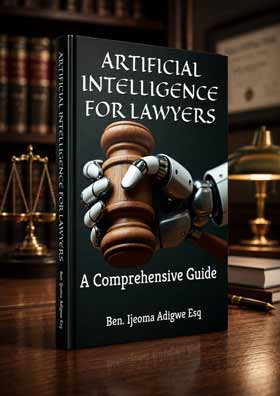 The book also examines Nigeria's legal ecosystem, focusing on the LPELR and NBA AI Guidelines. As a bonus, every purchase comes with a FREE eBook titled: How to Use the AI Features in LegalPedia and LawPavilion.
Ohio Books Ltd praises the publication, stating:
"....this is the only Nigerian book I know of on the topic."
How to Order:
📞 Call, Text, or WhatsApp: 08034917063 | 07055285878
📧 Email: benadigwe1@gmail.com
🌎 Website: www.benadigwe.com
Ebook Version: Access it directly online at https://selar.com/prv626
Authored by Ben Ijeoma Adigwe Esq., ACIarb (UK), LL.M, Dip. in Artificial Intelligence, Director at the Delta State Ministry of Justice, Asaba, Nigeria.
______________________________________________________________________
The book also examines Nigeria's legal ecosystem, focusing on the LPELR and NBA AI Guidelines. As a bonus, every purchase comes with a FREE eBook titled: How to Use the AI Features in LegalPedia and LawPavilion.
Ohio Books Ltd praises the publication, stating:
"....this is the only Nigerian book I know of on the topic."
How to Order:
📞 Call, Text, or WhatsApp: 08034917063 | 07055285878
📧 Email: benadigwe1@gmail.com
🌎 Website: www.benadigwe.com
Ebook Version: Access it directly online at https://selar.com/prv626
Authored by Ben Ijeoma Adigwe Esq., ACIarb (UK), LL.M, Dip. in Artificial Intelligence, Director at the Delta State Ministry of Justice, Asaba, Nigeria.
______________________________________________________________________