The Nigerian Law Society has called on the Economic and Financial Crimes Commission to act strictly within its statutory mandate following a statement attributed to the anti-graft agency warning that lawyers who charge professional fees in foreign currency could face prosecution.
In a statement dated September 15, 2026 and signed by its Acting President, Abdulqadir Alhaji Sani, the NLS said while it fully supports the EFCC’s responsibility to investigate and prosecute economic and financial crimes, the commission must exercise its powers within the Constitution and the legislation establishing it.
The professional body argued that the mere fact that a lawyer and client agree that professional fees should be expressed or denominated in United States dollars, pounds sterling, euros or another foreign currency does not, without more, amount to an economic or financial crime.
According to the NLS, the regulation of lawyers’ professional fees is principally governed by the Legal Practitioners’ Remuneration (For Business, Legal Service and Representation) Order 2023, made pursuant to the Legal Practitioners Act, which provides a framework for professional remuneration and agreements between lawyers and clients.
The society also referred to Sections 15 and 20 of the Central Bank of Nigeria Act 2007 dealing with the naira as Nigeria’s unit of currency and legal tender.
It noted that while Section 20(5) makes it an offence to refuse to accept the naira as a means of payment, the legislation also recognises the power of the Central Bank of Nigeria to prescribe circumstances and conditions under which other currencies may be used as a medium of exchange.
The NLS therefore cautioned against interpreting the CBN Act as creating a blanket criminal offence merely because a professional fee is expressed, negotiated or agreed by reference to a foreign currency.
It said the legality of any particular transaction must instead depend on its specific circumstances, including the parties involved, the manner of payment, applicable CBN regulations and guidelines, relevant foreign-exchange legislation, the terms of the professional engagement and any applicable exemptions.
The society further relied on the Foreign Exchange (Monitoring and Miscellaneous Provisions) Act, saying the existence of specific statutory restrictions on particular foreign-exchange transactions reinforces the principle that criminal liability must arise from conduct clearly prohibited by law.
It expressed concern that a broad public declaration that lawyers who charge fees in foreign currency would be prosecuted could create the impression that every such arrangement is automatically criminal.
“That position requires careful reconsideration,” the NLS said.
The society consequently urged the EFCC to distinguish between conduct amounting to an economic or financial crime, a breach of a regulatory directive, a professional or ethical issue, a contractual disagreement between lawyer and client, and a lawful commercial agreement between competent parties.
“These categories are not interchangeable,” it said.
The NLS stressed that where a lawyer is suspected of money laundering, fraud, tax evasion, dealing in proceeds of unlawful activity or any other offence within the EFCC’s jurisdiction, the commission is entitled and obliged to investigate and prosecute where the evidence establishes a prima facie case.
It, however, maintained that the denomination of a professional fee in foreign currency cannot, without evidence establishing the ingredients of a recognised offence, automatically turn a legal practitioner into an economic or financial criminal.
The society also warned against what it described as the criminalisation of professional conduct through public pronouncements rather than legislation.
“The Nigerian Law Society strongly believes that criminal liability must arise from law and not from administrative pronouncement, press statements or policy preferences,” the statement said.
It added that where a statutory prohibition applies to a transaction, the relevant law or regulation should be specifically identified and the facts assessed against the elements of the alleged offence.
Where the issue concerns compliance with professional remuneration rules, the NLS said professional and regulatory mechanisms should also be considered rather than treating every dispute as a criminal matter.
The organisation therefore called on the EFCC to exercise restraint in making sweeping statements capable of being interpreted as criminalising an entire category of professional conduct without sufficient legal qualification.
It further asked the commission to clarify its recent position and identify precisely the statutory provision or binding regulation upon which any proposed prosecution of a lawyer merely for charging professional fees in foreign currency would be based.
The NLS also urged the EFCC not to interpret the CBN Act beyond its express language and the regulations lawfully made under it.
Beyond the EFCC, the society called on the Central Bank of Nigeria and other relevant regulatory bodies to issue clear and authoritative guidance on when professional fees may lawfully be denominated, invoiced or paid in foreign currency, particularly in matters involving foreign clients, international commercial transactions and cross-border legal services.
The NLS said it supports lawful foreign-exchange regulation, protection of Nigeria’s financial system, enforcement of the Legal Practitioners’ Remuneration Order 2023 and the prosecution of lawyers or other persons who genuinely commit economic and financial crimes.
It nevertheless rejected what it described as the blanket criminalisation of lawful professional-fee arrangements without a clearly established statutory basis.
The society also called for a clear distinction between regulatory non-compliance, professional misconduct, contractual arrangements and criminal offences, while insisting that enforcement agencies must respect due process, fair hearing and the rule of law.
“The fight against corruption must itself be conducted within the law,” the NLS said.
“No institution should be above the law, and no citizen — including a legal practitioner — should be below the protection of the law.”
The society said it remained willing to engage with the EFCC, the Central Bank of Nigeria, the Nigerian Bar Association and other stakeholders towards developing what it described as a clear, legally sustainable and balanced regulatory framework.
“Nigeria’s war against corruption must be strong, but it must equally be lawful, evidence-based and consistent with the Constitution and the rule of law,” it added.
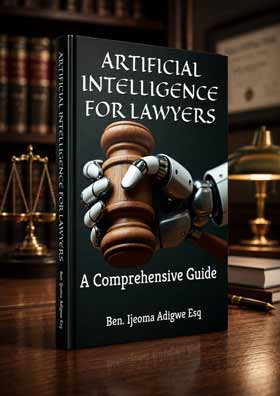 The book also examines Nigeria's legal ecosystem, focusing on the LPELR and NBA AI Guidelines. As a bonus, every purchase comes with a FREE eBook titled: How to Use the AI Features in LegalPedia and LawPavilion.
Ohio Books Ltd praises the publication, stating:
"....this is the only Nigerian book I know of on the topic."
How to Order:
📞 Call, Text, or WhatsApp: 08034917063 | 07055285878
📧 Email: benadigwe1@gmail.com
🌎 Website: www.benadigwe.com
Ebook Version: Access it directly online at https://selar.com/prv626
Authored by Ben Ijeoma Adigwe Esq., ACIarb (UK), LL.M, Dip. in Artificial Intelligence, Director at the Delta State Ministry of Justice, Asaba, Nigeria.
______________________________________________________________________
[A MUST HAVE] Evidence Act Demystified With Recent And Contemporary Cases And Materials
The book also examines Nigeria's legal ecosystem, focusing on the LPELR and NBA AI Guidelines. As a bonus, every purchase comes with a FREE eBook titled: How to Use the AI Features in LegalPedia and LawPavilion.
Ohio Books Ltd praises the publication, stating:
"....this is the only Nigerian book I know of on the topic."
How to Order:
📞 Call, Text, or WhatsApp: 08034917063 | 07055285878
📧 Email: benadigwe1@gmail.com
🌎 Website: www.benadigwe.com
Ebook Version: Access it directly online at https://selar.com/prv626
Authored by Ben Ijeoma Adigwe Esq., ACIarb (UK), LL.M, Dip. in Artificial Intelligence, Director at the Delta State Ministry of Justice, Asaba, Nigeria.
______________________________________________________________________
[A MUST HAVE] Evidence Act Demystified With Recent And Contemporary Cases And Materials

 Interested buyers are encouraged to place their orders and enquiries via:
0704 444 4777, 0704 444 4999, 0818 199 9888
Website: www.alexandernigeria.com
Interested buyers are encouraged to place their orders and enquiries via:
0704 444 4777, 0704 444 4999, 0818 199 9888
Website: www.alexandernigeria.com