*Says NDC Builds 13-Man Structure In Every Polling Unit

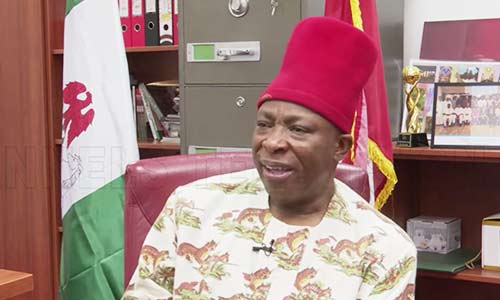
Senator Victor Umeh, who represents Anambra Central Senatorial District and is a former National Chairman of the All Progressives Grand Alliance (APGA), has cautioned the Independent National Electoral Commission (INEC) against any reliance on artificial intelligence in the conduct of the 2027 general elections, describing the commission’s emerging interest in the technology as “the most anxious one” of all the concerns currently surrounding the electoral process.
The lawmaker, a chieftain of the NDC and a figure in the back room of the Peter Obi campaign organisation, spoke on Channels Television’s Politics Today.
Responding to the disclosure that the INEC Chairman had been in Canada discussing the use of artificial intelligence in elections, Senator Umeh said the proposal alarmed him more than any other aspect of the commission’s preparations.
“That is even the most anxious one,” he said. “If you use artificial intelligence, the chances are that everything you’re going to do will be manipulated.”
He illustrated the risk with the ease of synthetic media manipulation: “When you use artificial intelligence to take the head of a man and plant it in the body of a woman, and it will be seamless. Or you see, this is your head, I take it and put it in victim A’s body, and use it to do things. That’s the risk in artificial intelligence.”
Told that the commission had spoken of the responsible use of AI, and that the technology could help break down work, clean up unclear result sheets uploaded to the IReV portal and speed up collation, the senator was unmoved.
“I wonder, does it make sense?” he asked, before adding: “Don’t put any confidence on the deployment of artificial intelligence in this process.”
Pressed directly on whether he did not want INEC to consider AI at all, Umeh pointed to the fragility of devices that are now trusted to capture and reproduce records automatically.
“Today, you have devices where you are told that you do not need to take notes in hand with a pen and all that. That you just listen, do conversation… it will translate your meetings and produce minutes of the meeting. And you put reliance on such a thing. Some virus can enter that device and destroy what you have put together, unless you have an antivirus that will ensure that there will be no glitch.”
“Up To Today, INEC Has Not Told Us What Was Responsible For The Glitch”
The senator tied his scepticism directly to the unresolved failure that marred the 2023 presidential election.
“In 2023, what messed up the election was the announced glitch in the collation of the presidential election, the transmission of the result of the presidential election. There was a glitch. Up to today, INEC has not told us what was responsible for the glitch, and Nigeria has passed it, and we’re moving into another one. We don’t know what will come up in 2027, and we pray nothing like that happens again.”
His comments come as INEC deepens international engagement on artificial intelligence and cybersecurity. The commission is considering the responsible use of artificial intelligence and other emerging technologies to strengthen the conduct, security and efficiency of the 2027 general elections. The INEC Chairman, Professor Joash Amupitan, SAN, held strategic talks with senior officials of Microsoft and the International Foundation for Electoral Systems (IFES) on the sidelines of the Global Conference on Responsible AI and Elections in Ottawa, Canada, focusing on how emerging technologies could enhance the resilience, transparency and security of Nigeria’s electoral process while addressing potential technological risks.
Professor Amupitan, accompanied by INEC’s Director of ICT, Dr. Lawrence Bayode, met Microsoft officials on cybersecurity and responsible AI, and separately engaged the IFES Chief AI Adviser on the application of artificial intelligence in electoral administration. INEC said the engagements are part of efforts to build institutional capacity and draw on global expertise as it explores innovative technologies ahead of the 2027 polls, stressing that any deployment must be responsible, secure and capable of strengthening public confidence in the electoral process.
“I Opposed The Removal Of Indirect Primaries”
Asked whether, with the benefit of hindsight, there were areas of the amended Electoral Act that gave him concern as a lawmaker, Umeh answered without hesitation.
“Well, of course, yes,” he said. “When we were debating the clause by clause consideration of the proposed amendments, I know that a majority of us, particularly those who have had experience with party administration, I opposed the removal of indirect primaries and leaving only direct primaries and consensus as a means of nominating candidates for elections.”
He grounded the objection in his decade as a party chairman: “From my own experience as national chairman of the party for ten years, participating in several nomination processes, I knew that this arrangement will not work.”
“Indirect primaries are just like a general election, and political parties are not equipped to conduct primaries that look like general elections. If INEC that is equipped with the resources and the materials to conduct general elections still experiences a lot of problems, how much more a political party that has nothing in place?”
The senator said the argument that direct primaries would strip governors of their influence has already been disproved by the recently concluded nomination exercises.
“Some people thought that direct primaries will give people advantage and remove the awesome powers the governors wielded in indirect primaries. But we have just gone through it, and you’ve seen that the governors dictated everything. In many instances, the governors stayed in their houses and chose the candidates and called the party people together and announced them as consensus candidates, without any due process.”
He concluded that the legislature should not have regulated the internal nomination processes of parties at all: “I had thought that we had no need to go to regulate the political parties on the way they will nominate their candidates for any type of election. The experience we have had in the recent exercises has vindicated my position.”
On The Removal Of Automatic Electronic Transmission
Umeh listed the removal of automatic transmission of polling unit results to the INEC Result Viewing (IReV) portal as the second amendment he regards as dangerous.
“We are yet to go into that election, but there is still anxiety that when we get there, we might experience a lot of problems, particularly as the proviso that was put in that clause before passage was that in the event of failure of communication, INEC will have resort to manual processes. So it leaves room for all kinds of…”
Asked whether that gave him fears of possible manipulation, he said: “Yeah, the fear is there, but it imposes a lot of responsibility on the part of political parties to be able to produce agents that will stay in all the polling units where elections will take place, so that the process will be monitored. If we have, for example, five political parties actively at the polling unit, it will be very difficult to change the results, even if it is not transmitted automatically. People will take away the polling unit results.”
“Agents Will Not Remove The Primary Responsibility From INEC”
Confronted with the criticism that his party fielded too few polling unit agents in 2023 and thereby failed to protect Peter Obi’s vote, Umeh conceded the shortfall but insisted the burden does not shift from the commission.
“There’s no doubt that our party won in so many places where there were no agents to protect the results of the election. But agents will not remove the primary responsibility from INEC to ensure that the results of the election will be a reflection of the ballots cast by the voters, put in the ballot boxes, brought out and sorted.”
“Whether any agent is present or not, the people who conduct the election are bound, with the oath they have taken, to ensure that the votes are brought out and counted and entered.”
He reached back to 1979 for the extremity of the problem: “I remember in 1979, in the old Anambra State, people who did not have candidates in some places were declared winners of the election without a candidate, for NPP, Nigerian People’s Party, at that time. A party won without candidates, and the results were declared that this party won, but they have no candidate. So that was the level of integrity of the process at that time. But here you have a candidate who is sitting by the ballot box, he will win, and the result will be taken away in open eyes.”
“I had thought that, improving on what happened since 1979, the emphasis will not be placed on agents, but on the neutrality and the integrity of those who conduct the election.”
He nonetheless accepted the practical reality: “It will be wishful thinking today for anybody to go to any election without an agent. If you don’t have an agent, their result will not be entered for you. But there are presiding officers in the polling unit who brought out the ballot papers from the ballot box, counted them, and they had the result sheets there… they look around, nobody is there, they will change it. So that is where INEC should be put to task.”
On The Cost Of Fielding Agents
On the logistics and expense of maintaining a nationwide agent network, Umeh acknowledged the scale of the financial demand.
“You have to train your party agents. Training them, you have to also pay them during the training period. Two days, three days before the election, you have to keep them somewhere. On the day of the election, you have also to pay them, because we’ve seen situations where party agents are being lured by money, by other political party agents.”
Told that a minimum of N20,000 to N40,000 per agent is required in allowances on election day alone, running into millions of naira nationwide, he replied: “That is the situation today. But it’s not impossible to do.”
“That Removed A Governor That Had Been Sworn In”
The senator offered the 2003 Anambra governorship election as proof that a disciplined agent network can overturn a stolen result.
“This Mr. Peter Obi, who is making waves today in Nigeria, came into the election in 2003, and he won the election with the polling unit results that were collected by agents we had. He was not declared winner, but we had planned to collect the polling unit results on the day of election, and our agents got all of it.”
“With that, we were able to prosecute an election petition that, for the first time in Nigeria’s history, removed a governor that had been sworn in through election petition. We were able to tender all the results, and I was the PW1 that tendered all those results at that place, and eventually the tribunal, with the polling unit results, determined that Peter Obi won the election instead of the PDP.”
“So it can be done again. It’s only left for political parties to learn from what happened in the past, to prepare to monitor and be active at the polling units and collect all the polling unit results.”
Asked whether his insistence that votes must count betrayed a fear of manipulation, Umeh answered with a proverb: “They say that when the bee stings you, when you see a big fly, you run away. The fly is not harmful, but you become anxious when you see a big fly.” The 2023 outcome, he said, “is giving everybody anxiety, not just one person.”
“To Be Forewarned Is To Be Forearmed”
Umeh returned to the controversy over Peter Obi’s declaration that votes must count, which critics have characterised as a veiled threat to electoral officials.
“The whole essence was to ask me questions about Peter Obi’s cry that votes must count, and if the votes are not counted properly, that they’ll count the people who are meant to count the votes. They turned that around to say that it was handing down threats, that if the votes are not properly counted, those who are in charge may be lynched. You see, to be forewarned is to be forearmed.”
“Everybody wants a free and fair election, transparent, credible, free and fair election, and anybody who makes a statement supporting or calling for a credible, free and fair election cannot be held in the negative, because it is important that those who are doing this should know that the responsibility they have to discharge on behalf of Nigerians on the day of election is to make sure that the votes count and the votes will determine the winners of the elections.”
Put to him that he appeared to be doubling down on what was perceived as a threat, Umeh said the accountability he means is prosecution, not violence.
“They should be held accountable… by prosecuting them. We have never prosecuted election offenders in Nigeria. People turn around results of votes of the people and you gloss over them. And next time around you appoint them again.”
“You Don’t Have Such People In The Electoral Commission Today”
The senator held up former Resident Electoral Commissioner Mike Igini as the standard the commission no longer meets, recalling the 2011 supplementary election in Imo State.
“Mike Igini is a unique person. He’s not like every other person on election duty. I experienced him when we had a supplementary election in Imo State in 2011. At that time, he came from Cross River as a resident electoral commissioner. Professor Jega sent him to Imo State to conduct that supplementary poll.”
“He came there with all the officers from his location from where he came, and took some people from his own place. That day, he was using the armoured personnel carrier to raid homes of people who were already identified to be election riggers.”
He said the then Speaker of the Imo State House of Assembly was among those neutralised: “He went there and took him because he was part of the people that messed up the first election. So Mike came prepared and went to his house, waited for him in the morning with a barrage of security personnel. He came out in the morning, they escorted him to the polling unit, he voted, they escorted him back home and held him hostage there.”
“So you don’t have such people in the electoral commission today. People who will be motivated by national spirit to do something that is good for Nigeria. If we have such people working in all the elections we have had in Nigeria, these things would have stopped long ago.”
Allegations Of Politically Motivated Postings
Umeh alleged that transfers within the commission are already being influenced ahead of the polls.
“I heard recently that transfer is already going on in the commission. Some governors are requesting for people that will be posted to their states to conduct the election for them. Such things never happened in the past. So if you continue to move electoral personnel from one state to another place on the request of authorities, that kind of juggling erodes confidence. You cannot be doing such a thing.”
Asked whether he could validate the claim, he said the pattern is historic: “It has happened even before. I have been part of this process for a long time now. I know that when election comes, efforts are made to put ad hoc staff that will serve the purpose of certain powerful people in various locations, and they are the people who do this. We have warned consistently.”
“INEC Should Be Able To Have Its Own Trained Personnel”
The senator welcomed the commission’s ongoing recruitment and urged it to phase out ad hoc staff entirely.
“I’m happy that INEC is doing recruitment now. INEC should be able to recruit people and find a way to do away with ad hoc staff. An ad hoc staff is a temporary staff. He comes on duty, does what he wants to do, makes money, and goes away.”
“But officers of the commission, if they’re able to have enough manpower, because we have appropriated a lot of money for the commission, they should be able to increase their manpower, and at this time employ a lot of people and train them so that at least at the collation level, it will not be going to tertiary institutions to bring university professors to come and do collation and become returning officers.”
“INEC should be able to have its own trained personnel to be collation officers and be returning officers so that anything that happens starts and ends with INEC. Not going to University of Sokoto, you bring the professor from there, put him in Anambra State to be returning officer.”
“INEC Is In A Position To Check The Desperate Ambition Of Politicians”
Challenged on whether INEC could fairly be blamed for failures arising from a law he helped to review, Umeh insisted the commission retains full control of the process.
“INEC is in a position to check the desperate ambition of politicians, because the politician cannot come and write result. He cannot. It is INEC that will stop politicians having access to its preparations in terms of recruiting ad hoc staff.”
“Jostling for who will be collation officer here, who will be returning officer here, is a business. So when the election season and cycle comes, politicians will go and begin to write names of people who will be collation officers and send to them. I’ve seen it happen several times, and each time I laugh. Because this is not what the law intends.”
He pointed to the oath of neutrality: “There is an oath that electoral officials will take, oath of neutrality and integrity. You must sign that form before you are put on duty. They will sign it and when they do anything wrong, nobody gets back to the oath they have taken. So it is the electoral commission… the whole thing starts and ends at the desk of the electoral commission. Because this is the mandate they have been given, to conduct a credible and free and fair election in Nigeria.”
“Which Parallel? What Makes It Parallel?”
Umeh firmly rejected the suggestion that Peter Obi is planning a parallel results system by transmitting polling unit results independently to the party’s own situation room alongside INEC’s transmission.
“No, he’s not,” he said. “Which parallel? What makes it parallel? I believe he must have been misquoted.”
Confirming that the party will indeed operate a situation room, he explained: “What Mr. Obi is actually saying is that the party will have its agents at every polling unit, and once the results are collected and declared and put in the prescribed results form, they will be doing their own collation in the situation room.”
“You must be sending the results of your polling unit to the NDC situation room. INEC has no monopoly of collation of data. And the same gadget you use to upload, even though they use their own BVAS machine to do so, your telephone, if you get something, you can snap it and send it to your situation room. So while INEC is collating, you’ll be collating your own. And the important thing is to get the prescribed form where the result has been entered, which you will also snap and send to the situation room.”
On The 13-Member Polling Unit Structure
Asked about reports that the party is building 13-member polling unit executives and a nationwide polling agent network, Umeh confirmed it as a constitutional requirement of the party.
“Of course. Even our constitution provides that we shall have a 13-man executive in every polling unit. So every polling unit in Nigeria, by NDC constitution, shall have 13 people working as executive members of the party in that polling unit. So it is those 13 people that, from them, you can put one person as required by the commission to put as an agent.”
Reminded that the party could not field a single agent in every polling unit in 2023 and now proposes 13 across more than 8,500 polling units, he said the arithmetic has changed because the candidate base has changed.
“Not in all polling units. Well, in some places. Let me tell you, the whole dynamics have changed. Today, NDC has 28 governorship candidates already submitted to INEC. We have 109 senatorial candidates already submitted to INEC and published. We have 360 candidates for House of Representatives. We have candidates for all the House of Assembly constituencies in Nigeria.”
“There is nothing like structure other than these people. If you have people who are contesting elections, they build the structure for you down to the polling unit. It’s only when you don’t have them that you can be caught napping. So if you have candidates contesting for every vote in every constituency, then you are standing on a very strong ground to protect your own election, the results, because every candidate of a party has a duty to raise agents that will monitor his own election. But where you don’t have those candidates, you will be open for massacre.”
He disclosed his own arrangement: “Like me, I’m contesting, and I have put in process of recruiting 20 people per polling unit. These people will be people from that polling unit that will also vote on the day of election. So it’s a strategy that I think, if properly deployed, the polling units will be properly monitored.”
“He Should Go Back To The Pulpit”
Umeh reserved his harshest words for the blockade that prevented Peter Obi from entering Benue State, describing it as a breach of a constitutional guarantee.
“You saw how the road was barricaded with the trucks and things that prevented him from crossing, and policemen were all over the place, because the state chairman had written to notify the Commissioner of Police that he’s coming. And what they did to prevent him from having access to Benue State was to block the road in a country where freedom of movement is guaranteed to all citizens by Section 41 of the Constitution, and this is a democracy we are practising. He was prevented from going to Benue State.”
“This was the second time he was being prevented from going to Benue State. Last year, the governor of Edo State warned him not to set his foot on the Edo soil, and the day he went, there were casualties. So our democracy should not be a barbaric democracy.”
He then turned on the Benue State governor, a Catholic priest.
“What happened in Benue was most despicable, because the governor of that state wears a cassock as a reverend father, a reverend father who cannot allow people to come into his state. Even if, as the chief security officer, has he been able to prevent the killings of his people? And when his people have been killed like fowls, has he ever condemned any of these things?”
“So if he cannot guarantee freedom of movement in Benue State, what is he doing there? He should go back to the pulpit, where he has chosen as a vocation to be a priest. A priest is never a politician. So what is happening in Benue State is an embarrassment both to the Catholic Church and the civilian society. He has no business there… He should be preaching against these things, and he’s the one perpetrating them.”
The senator demanded prosecution of those arrested over the incident: “The one Governor Alia did in Benue State is worthy of reprimand. They have arrested 46 brigands, including officers of his government, who blocked the roads, and we want to see how those people will be prosecuted and put to jail so that nobody will repeat it.”
“Tinubu Is Free To Come To The Southeast To Campaign”
Contrasting Benue with his own region, Umeh said the Southeast is open to every candidate.
“Take the Southeast, for example, that’s where Peter Obi comes from. That Southeast is open. We are very civilised people. Tinubu is free to come to the Southeast to campaign. Atiku Abubakar is free to come to the Southeast to campaign. Adebayo is free to come to the Southeast and campaign. Our people will receive you and listen to you and see what you are telling them that will make them vote for you. This exchange of ideas and programmes and policies you want to implement should be allowed to sell through to the voting public.”
“Nobody should be intimidated. There were cases when, in the 2023 election, people were ordered not to come out. Even in Lagos State, the Igbos were threatened not to come out on election day. Those things cannot be allowed to prevail in our democracy. Let us be able to go anywhere. Let us be able to go to Borno State. Let us be able to go to Zamfara State.”
“The Front Runner Can Be Overtaken At Any Point”
Presented with the 2023 figures, in which Bola Tinubu polled roughly 37 per cent, Atiku Abubakar about 29 per cent and Peter Obi about 25 per cent, and asked what has fundamentally changed to move Obi from a quarter of the national vote to the presidency, Umeh framed the contest as a race still in motion.
“It’s like a race where the front runner can be overtaken at any point. This exercise we are getting into requires a very transparent, credible, free and fair process for you to begin to use outcomes or results of elections to determine its integrity.”
He recalled how far the expectations of 2023 were exceeded: “From the performance of Peter Obi in 2023, nobody gave him any chance that he would even score 10 per cent. In fact, I remember that the previous governor of my state said he would not get 25 per cent in more than one state. So he was considering that he may get 25 per cent in only Anambra State. But he stunned everybody. He scored 25 per cent in over 20 states and won 12 states outright.”
“So with that first performance, I’m sure his opponents are rattled now, particularly those in government. And what you need to continue to measure the development in our democracy is to ensure that the institutions that will manage the process will be more transparent than they have been in the past, so Nigeria will be held as a country that is capable of conducting elections.”
“Even Tinubu Can Win, But Let Him Win On His Record”
Umeh warned against treating the ruling party as unbeatable on the strength of its control of the states.
“If we take that somebody is ubiquitous or a party is ubiquitous, they cannot be beaten, therefore that party cannot be challenged, we’ll be making a mistake. Because today what we read is that APC has 32 governors… 31 or 32. Sometimes they say 32 because you don’t know who will defect and join them tomorrow. So there are those who are not in their party, but they’re working for them. So if you add them, they may be having 34.”
He held up Osun State as the counter-example.
“The thing that shall be always in the minds of Nigerians will be what played out in Osun State recently. Osun State, Ademola Adeleke, governor, came through the Accord Party. Accord Party had nothing in Nigeria, and with that Accord Party, he defeated the APC candidate hands down. That is the power of the ballot box, the power of the citizen’s right to choose who will represent them.”
“If not for the people of Osun State, if they were disenfranchised and, after voting, the results are manipulated, Ademola would be in one corner chilling. But because the people came all out and INEC was alive to its responsibility, allowed the process to take place.”
He acknowledged the cynical reading of that outcome and challenged the commission to repeat it: “People are arguing now that INEC used that as a decoy to allow a credible election to take place in Osun so that you see that, oh, they will do well in the next general elections. Let them keep to it so that they repeat their neutrality in Osun State across Nigeria.”
“The contention about who will defeat or who will not win should not be anybody’s problem. Anybody can win. Even Tinubu can win, the president, but let him win on his record and approval by the Nigerian citizens.”
“People Are Afraid Of Peter Obi”
Asked why there appears to be resistance to Peter Obi’s acceptance in Northern Nigeria, Umeh dismissed the premise outright.
“No, he’s accepted. People are afraid of Peter Obi… That is a make-believe, it is propaganda.”
Pressed on the 2023 voting pattern and the fact that Obi did not win a single state in the North East or North West, the senator pointed to threshold performance and to the FCT.
“He got good votes both in Adamawa State. He got votes in other parts of the North… But he got the fundamental 25 per cent.” On the FCT, where a disagreement arose with the anchor over whether the territory is Northern or Central, Umeh maintained: “FCT is in Northern Nigeria. The North, we know, has been 19 states. Not just this one. 19 states. Southern Nigeria, 17 states. So in Northern Nigeria, Peter Obi won some states and got consequential 25 per cent victory in a place like Adamawa State. In Borno, he did very well. Go and look at the figures.”
He said the generational shift is the decisive variable: “Things are changing, and today, the youths, who own Nigeria and tomorrow’s Nigeria, have seen that they cannot remain with the prejudices and the misdirection of their leaders in the past. Because the things that have happened in the past have not helped them too.”
“In Lagos That He Governed Eight Years, Peter Obi Defeated Him”
On the argument that Bola Tinubu’s record in Lagos and his structural capacity outstrip Peter Obi’s record in Anambra, Umeh answered with the 2023 Lagos presidential result.
“Let me take you on the sagacity, as you put across, of the president. In Lagos that he governed eight years, Peter Obi defeated him. Has he not put paid to that argument? You cannot say somebody is invincible anywhere, because if it is so, he will win Lagos. He didn’t win Lagos, votes declared. So it is like that in all situations.”
On the comparison of gubernatorial records, he pointed to the disparity in resources: “In terms of ideas, you cannot compare Anambra with Lagos in terms of resources. Lagos IGR is more than 20 times what they get in Anambra. And Lagos is the commercial city of Nigeria. So with what Peter Obi had in Anambra in eight years, he was able to make that state a model state. He managed the resources of the state well.”
“Everywhere Can Spring A Surprise”
Turning to the 2027 map, Umeh declined to name states the party expects to flip, describing such forecasting as premature.
“It’s like one counting his chickens before they are hatched. We have four months to campaign. What we need to do is to allow joining of issues by all the candidates. Let them do debates. Saying today, ‘I will win here,’ election can change within 24 hours.”
He made one exception: “Nobody can beat Kwankwaso in Kano. He’s the vice presidential candidate of NDC. No matter the noise they make in Kano, nobody will beat him there. I can bet it, once the election is credible, transparent, free and fair. I’m working with him and the other leaders of the party very closely. The party is well more prepared to be an opposition party that will contest this election with very credible candidates.”
On Rivers State, where Dumo Lulu-Briggs is contesting against the backdrop of Nyesom Wike’s influence and the Rainbow Coalition, he said: “Look at what Dumo Lulu-Briggs did in Port Harcourt. Just first outing, Port Harcourt was shut down. Those people that were following them in Port Harcourt last week are Nigerians and are these people that will vote. Why are they following them around? Why were they following Peter Obi, like Jesus was crossing and people were amassing around him? Something must be motivating and driving the people, the voting population.”
“Anything can happen, because that day they were in Port Harcourt, they had a town hall meeting. Many important stakeholders in Rivers State were at that town hall meeting. So it’s not something you can stay in your room and say that it’s all over. Everybody will work hard. The Rainbow Coalition will work hard in Rivers State. They cannot say that they have won… they cannot rule out the element of surprise in that election.”
Asked whether Rivers could spring a surprise, he answered: “Everywhere can spring a surprise.”
On whether the Obidient movement remains a force, Umeh replied: “You are seeing it and you’re asking me the question. He went to Rivers State and shut down Rivers State. And were the Obidients there? Of course, Obidients were there.”
He summed up his position on prediction: “You cannot predict victory for anybody in a clean electoral process. So let us not deceive ourselves. As we go on, we are only asking for the liberties of all candidates and parties to be respected. Let there be no intimidation or muzzling of anybody.”
“Nobody Held Him Hostage”
In a final exchange, Umeh was confronted with the argument, advanced by some commentators, that Peter Obi’s present treatment is retribution for what was allegedly done to Nasir El-Rufai during an election in Anambra State, when El-Rufai was said to have been held until after the poll.
The senator rejected the claim and spoke from his position at the time.
“I was national chairman of APGA during that election, and nobody held him hostage. The reason I tell you so is that I was on ground, and I was one of the people that directed the election on behalf of APGA. What happened was that he came on the day of election.”
“Campaigns end two days to the election, and when you finish your nationwide campaign, you should go back to your state and prepare to vote on the day of election. If you came to a state and do your campaigns unmolested, you are not a voter. You have no business to do in the streets… So he was not held hostage.”
He disclosed that the dispute produced litigation that has never been resolved: “Even now, he took me to court that time. Because, as national chairman, I said he had no business in Anambra State. So we are still in court over that matter… I don’t know what has happened, whether they have struck it out, because he couldn’t prove his case against me.”
The exchange closed with the observation that the two men are now political allies, with Peter Obi having visited El-Rufai. “You can see now they’re friends,” the anchor noted. “They are friends,” Umeh agreed.
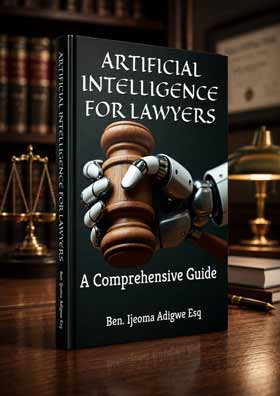 The book also examines Nigeria's legal ecosystem, focusing on the LPELR and NBA AI Guidelines. As a bonus, every purchase comes with a FREE eBook titled: How to Use the AI Features in LegalPedia and LawPavilion.
Ohio Books Ltd praises the publication, stating:
"....this is the only Nigerian book I know of on the topic."
How to Order:
📞 Call, Text, or WhatsApp: 08034917063 | 07055285878
📧 Email: benadigwe1@gmail.com
🌎 Website: www.benadigwe.com
Ebook Version: Access it directly online at https://selar.com/prv626
Authored by Ben Ijeoma Adigwe Esq., ACIarb (UK), LL.M, Dip. in Artificial Intelligence, Director at the Delta State Ministry of Justice, Asaba, Nigeria.
_______________________________________________________________________
“Enhance Legal Practice With Authoritative Reports” — Alexander Payne Offers Comprehensive Law Reports, Spanning Over A Century Of Nigerian Jurisprudence
The book also examines Nigeria's legal ecosystem, focusing on the LPELR and NBA AI Guidelines. As a bonus, every purchase comes with a FREE eBook titled: How to Use the AI Features in LegalPedia and LawPavilion.
Ohio Books Ltd praises the publication, stating:
"....this is the only Nigerian book I know of on the topic."
How to Order:
📞 Call, Text, or WhatsApp: 08034917063 | 07055285878
📧 Email: benadigwe1@gmail.com
🌎 Website: www.benadigwe.com
Ebook Version: Access it directly online at https://selar.com/prv626
Authored by Ben Ijeoma Adigwe Esq., ACIarb (UK), LL.M, Dip. in Artificial Intelligence, Director at the Delta State Ministry of Justice, Asaba, Nigeria.
_______________________________________________________________________
“Enhance Legal Practice With Authoritative Reports” — Alexander Payne Offers Comprehensive Law Reports, Spanning Over A Century Of Nigerian Jurisprudence
 Interested buyers are encouraged to place their orders and enquiries via:
0704 444 4777, 0704 444 4999, 0818 199 9888
Website: www.alexandernigeria.com
Interested buyers are encouraged to place their orders and enquiries via:
0704 444 4777, 0704 444 4999, 0818 199 9888
Website: www.alexandernigeria.com