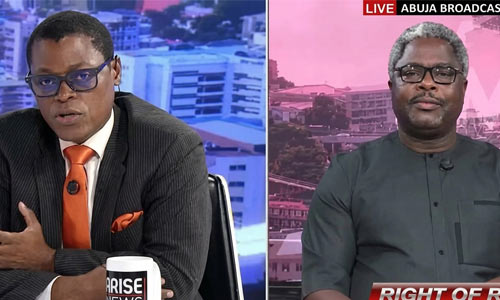
The spokesperson to the Minister of the Federal Capital Territory, Lere Olayinka, has continued a running attack on the Arise News anchor Rufai Oseni on social media, a day after an interview on the station’s Morning Show was brought to an end when he refused to answer the journalist’s questions.


In a series of replies to the anchor’s posts on X on 4 and 5 September, Olayinka moved the dispute away from the subject of the interview and onto the journalist personally. One reply questioned why a 46-year-old man who has never married should be in high spirits, and went on to make a claim about his physical capacity in relation to women. Two further replies asserted that the anchor was born of what Olayinka termed a mistake pregnancy, and set out an account of the circumstances of his birth, alleging conduct on the part of his mother. Each reply ended with laughing emojis.
The posts responded to messages in which Oseni had written that he would keep asking difficult questions, that the day’s conversation had turned on the quality of questions, and that when people run from questions it is a sign that the right ones are being asked.
What Happened On Air
The exchange took place on Friday during the Morning Show, while the panel was discussing corruption allegations, the political weaponisation of investigations, and the FCT Minister’s defence of individuals under investigation by anti-corruption agencies.
Oseni asked Olayinka why corruption investigations were being used as political weapons against some politicians, while comparable issues involving members of the governing All Progressives Congress were treated differently, referring to the inclusion of the former Minister of Humanitarian Affairs, Betta Edu, in a presidential campaign council despite the allegations against her.
Olayinka declined the question.
“I’m very sorry to say this, Oseni Rufai. I don’t want to answer any question from you,” he said. “I want to concentrate. I want this conversation to be among these reasonable human beings. People who will not come and tell, who will not come and describe other people as gbewudani.”
The Anchor’s Intervention
His co-anchor, Ayo Mairo-Ese, objected immediately.
“Mr. Olayinka, we take exception to that,” she said, repeating the objection as Olayinka pressed his position. He restated it: “I am not answering questions from Oseni Rufai.”
The anchor then set out the ground rules of the programme.
“When you were coming to this interview on the morning show, I’m sure that you were aware that there are three anchors on the show,” she said. “And so if you’re coming to present yourself to the morning show, then the onus is on you to present yourself to the three anchors who are here based on their credibility and their experience.”
She closed the interview. “But no more questions since you say you do not want to answer. We thank you very much for your time with us this morning and hopefully see you again when you’re ready to speak to the three of us.”
The programme brought the segment to an end.
Where “Gbewudani” Came From
Olayinka’s objection referred to a remark made on air the previous day.
Reacting to the FCT Minister’s argument that hunger does not determine how Nigerians vote, Oseni had asked why, if that were so, money is distributed to voters and welfare schemes are launched around elections.
“Nigerian people, hunger is on the ballot. Subsidy is on the ballot. Lack of economic growth is on the ballot. Your plight is on the ballot,” he said. “Not because one man says it. The only difference is that he says it on television. If you had that television voice too, you would say more than that.”
He then turned to the minister’s position within his own party, saying that whoever emerges as the PDP presidential candidate must be a “professional gbewudani,” glossing the Yoruba expression on air, and asking why it did not trouble the party’s candidate that a serving member of the party was openly campaigning for the President.
“There is a PDP candidate and you are openly saying you are going to support the President. That means you have made a mockery of the presidential candidate,” he said, before noting that the programme’s director and producer were signalling for the segment to end.
“I Will Continue To Speak Truth To Power”
Reacting to the controversy on his verified X account, Oseni thanked Nigerians who had reached out with messages of support and said the episode would not change his approach.
He drew a comparison with the late labour leader, Pa Michael Imoudu, during the 1945 general strike, noting that Imoudu faced resistance both from the colonial authorities and from Nigerians who benefited from the system, an example he said showed how those who benefit from an oppressive arrangement may defend it rather than challenge it.
“It takes a trained mind to see oppression. I will continue to speak truth to power despite opposition from people benefiting from the ruination of Nigeria,” he said. “For those benefiting from the ruination of Nigeria, we will never agree, and we ought not to.”
Sam Amadi’s Assessment
The Director of the Abuja School of Social and Political Thought, Dr Sam Amadi, addressed the conduct of both parties.
“Hosts should serve as conduits for public understanding, helping to expose weaknesses or false claims tactfully rather than joining the fight directly,” he said. “If Lere was invited, he is still expected to address the questions. Refusing to do so sets a poor precedent. However, their relationship has a history that tends to get personalised and combative. While one can argue that you cannot pick who interviews you, an official who attends an interview should engage constructively.”
He said the constitutional protection of press freedom carries a corresponding professional duty.
“That responsibility requires professionalism. Media anchors and show hosts should respect the dignity of the person being interviewed. Walking in with an attitude of ‘I’m going to get him’ leads to lost opportunities to engage a public official on substantive principles. The media’s role is to inform and communicate with the audience, not to engage in shouting matches.”
On the wider political climate ahead of 2027, Amadi said politicians will always seek to outsmart one another, including through name-calling, but that the discourse can be raised if the demand changes.
“If political constituencies mobilise attention around policy issues, politicians will have an incentive to focus on them,” he said. “Currently, the framing leans toward personality, conspiracies, and drama. Issues like the economy, hunger, security, health insurance, and the rule of law should be the focus.”
He added that scrutiny of character remains legitimate. “Effective governance is about policy and personality. Can we trust you to deliver what you promise? Yes, we should be less smearing, but we should bring up everything that shows that a candidate is good or not good.”
Three separate standards are in play here, and they should not be collapsed into a single argument about who was ruder.
The first belongs to the public official. A spokesperson who accepts an invitation to a programme with three anchors does not acquire the right to select which of them may question him. The question he declined was a legitimate one, and it remains unanswered: why the presence of a person facing corruption allegations on a presidential campaign council attracts a different response than similar allegations against opponents. Refusing the question did not make it go away; it guaranteed that it would be asked again, and by more people.
The second belongs to the broadcaster. Dr Amadi’s caution is the uncomfortable half of the story for the media, and it is fair. An anchor who characterises a party’s candidate in a term of abuse on Thursday has given a guest a grievance to arrive with on Friday. The question about Betta Edu was strong enough to stand on its own; it did not need the previous day’s framing, and the framing is what allowed the substance to be evaded. Journalism holds power to account most effectively when the person being questioned has nothing to point at except the question.
The third standard concerns what happened after the cameras stopped, and it is the least defensible conduct in the entire sequence. Whatever the merits of the on-air dispute, the response was to publish material about a journalist’s marital status, his body and the circumstances of his birth, including assertions about the conduct of his mother, a woman who is not a public figure and has no part in any of this. That is not political combat. It carries no argument, answers no question, and exposes its author to a straightforward action in defamation. It also comes from the office of a serving public official.
The sequence tells a fuller story than any single moment in it. A substantive question about accountability was put, then declined, then buried under abuse. Somewhere underneath all of it, Betta Edu is still on the campaign council, and nobody has explained why.
 Interested buyers are encouraged to place their orders and enquiries via:
0704 444 4777, 0704 444 4999, 0818 199 9888
Website: www.alexandernigeria.com
Interested buyers are encouraged to place their orders and enquiries via:
0704 444 4777, 0704 444 4999, 0818 199 9888
Website: www.alexandernigeria.com

 The book also examines Nigeria's legal ecosystem, focusing on the LPELR and NBA AI Guidelines. As a bonus, every purchase comes with a FREE eBook titled: How to Use the AI Features in LegalPedia and LawPavilion.
Ohio Books Ltd praises the publication, stating:
"....this is the only Nigerian book I know of on the topic."
How to Order:
📞 Call, Text, or WhatsApp: 08034917063 | 07055285878
📧 Email: benadigwe1@gmail.com
🌎 Website: www.benadigwe.com
Ebook Version: Access it directly online at https://selar.com/prv626
Authored by Ben Ijeoma Adigwe Esq., ACIarb (UK), LL.M, Dip. in Artificial Intelligence, Director at the Delta State Ministry of Justice, Asaba, Nigeria.
_______________________________________________________________________
The book also examines Nigeria's legal ecosystem, focusing on the LPELR and NBA AI Guidelines. As a bonus, every purchase comes with a FREE eBook titled: How to Use the AI Features in LegalPedia and LawPavilion.
Ohio Books Ltd praises the publication, stating:
"....this is the only Nigerian book I know of on the topic."
How to Order:
📞 Call, Text, or WhatsApp: 08034917063 | 07055285878
📧 Email: benadigwe1@gmail.com
🌎 Website: www.benadigwe.com
Ebook Version: Access it directly online at https://selar.com/prv626
Authored by Ben Ijeoma Adigwe Esq., ACIarb (UK), LL.M, Dip. in Artificial Intelligence, Director at the Delta State Ministry of Justice, Asaba, Nigeria.
_______________________________________________________________________