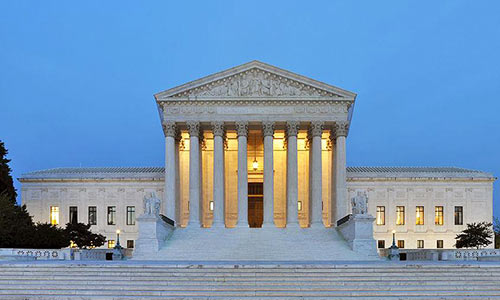
The United States Supreme Court has allowed President Donald Trump to continue construction of a new White House ballroom while litigation challenging the project proceeds, handing the administration a significant interim victory in the dispute over whether the president can undertake the project without congressional approval.

In a 5-4 decision issued on Monday, the Supreme Court granted an emergency application filed by the Trump administration and blocked lower court rulings that would have halted construction of the aboveground portion of the ballroom project.
The decision followed an interim order issued on August 21 by Chief Justice John Roberts which had temporarily permitted construction to continue while the full court considered the administration’s request.
The legal challenge was brought by the National Trust for Historic Preservation, which argued that Trump lacked unilateral authority to demolish, redesign and construct major additions to the White House without obtaining approval from Congress.
The Supreme Court, however, did not decide whether the ballroom project itself was lawful or whether congressional authorisation was required.
Instead, the unsigned majority ruling concluded that the National Trust was likely unable to establish the legal standing required to maintain its challenge in federal court.
“Today, we do not pass upon the legality of the government’s East Wing project. We conclude only that, based on the submissions before us, the government is likely to prevail in showing that the Trust lacks … standing to challenge the project in federal court,” the court said.
The majority said federal courts had not previously recognised standing merely because an individual objected aesthetically, culturally or historically to a government construction project.
“To the contrary, we have repeatedly held that mere offense, disagreement, or distaste does not qualify as a concrete and particularized injury,” the court stated.
The National Trust’s standing argument was largely based on a declaration by one of its members, Alison Hoagland, a preservationist who lives in Washington and serves on the organisation’s board of trustees.
Hoagland said she regularly walks past the White House and would suffer professional and personal harm to her aesthetic, cultural and historical interests if a ballroom of the proposed size and design were constructed.
Chief Justice Roberts ultimately disagreed with the majority and joined the court’s three liberal justices in dissent.
Roberts said he believed Hoagland had demonstrated a sufficiently concrete injury to establish standing because of her professional interest in historic preservation and frequent enjoyment of the White House as a historic site.
“Construction of the ballroom has proceeded apace for the better part of a year. That construction is likely unlawful,” Roberts wrote.
According to the administration’s court filings, construction was approximately 65 per cent complete as of August 24, with about 250 workers operating for 20 hours each day, seven days a week.
The White House has said the project will cost about $400 million and will be funded entirely by private donations.
That funding claim has been disputed, however, because government funds, including Secret Service resources, have already reportedly been directed towards security-related elements of the project.
The overall plan extends beyond the ballroom itself and includes substantial underground construction containing secure spaces and medical facilities which the administration says are necessary for national security and the protection of the First Family.
Trump welcomed the Supreme Court’s ruling in a post on Truth Social, saying the project remained ahead of schedule and below budget.
“When completed in the Summer of 2028, the magnificent Ballroom and Military Complex will be something that the entire Country is very proud of,” Trump wrote.
He also criticised the National Trust for Historic Preservation for bringing the lawsuit.
The National Trust expressed disappointment with the Supreme Court’s ruling but stressed that the justices had not resolved the substantive legal question surrounding the project.
Brent Leggs, President and Chief Executive Officer of the organisation, said the ruling concerned standing rather than the legality of the ballroom.
“This is not the final decision on the merits of our case and does not resolve our fundamental argument, that each President is a temporary steward of the People’s House and does not have the unilateral authority to demolish and redesign it without the approval of Congress,” Leggs said.
A federal district judge had earlier ruled partly in favour of the National Trust, allowing underground construction to continue but preventing work on the ballroom itself while the litigation remained pending.
On August 7, the United States Court of Appeals for the District of Columbia Circuit upheld that decision.
The National Trust argued that federal law requires the “express authority of Congress” before construction can take place on federal land in Washington.
The Trump administration countered that other provisions of federal law empower the president to make improvements to the White House grounds.
The Supreme Court’s latest order means construction may continue for now while the underlying litigation proceeds.
Crucially, however, the 5-4 ruling does not constitute a final determination that Trump has legal authority to build the ballroom without congressional approval. The court confined its decision to the preliminary question of whether the National Trust was likely to have standing to pursue its challenge.
[A MUST HAVE] Evidence Act Demystified With Recent And Contemporary Cases And Materials

Available now for NGN 40,000 at ASC Publications, 10, Boyle Street, Onikan, Lagos. Beside High Court, TBS. Email publications@ayindesanni.com or WhatsApp +2347056667384. Purchase Link: https://paystack.com/buy/evidence-act-complete-annotation
______________________________________________________________________ “Enhance Legal Practice With Authoritative Reports” — Alexander Payne Offers Comprehensive Law Reports, Spanning Over A Century Of Nigerian Jurisprudence Interested buyers are encouraged to place their orders and enquiries via:
0704 444 4777, 0704 444 4999, 0818 199 9888
Website: www.alexandernigeria.com
Interested buyers are encouraged to place their orders and enquiries via:
0704 444 4777, 0704 444 4999, 0818 199 9888
Website: www.alexandernigeria.com