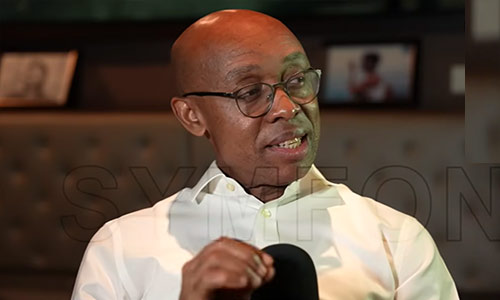
Professor of law and former Chairman of the National Human Rights Commission, Chidi Anselm Odinkalu, has described the emerging “rainbow coalition” in Nigerian politics as political criminality rather than political pragmatism, and said the country is running a civilian government rather than a democracy because judges rather than voters determine who holds office.

Odinkalu spoke on Channels Television’s Hard Copy, in a discussion that also covered the courts, poverty, insecurity and the conduct of the coming election.
Asked about his remarks at the Nigerian Bar Association conference on the role of the judiciary in the electoral system, Odinkalu began by rejecting the term ordinarily used to describe the Nigerian system.
“I like to speak about what we do in Nigeria as civilian government, not democracy. Civilian government is a different thing from a democracy,” he said. “I do recognise that we have civilians exercising the responsibilities of public office at the moment. Whether it’s a democracy is another matter.”
He set out his reason. “Fundamental to a democracy is the idea that the people decide who governs. When judges decide, as they did in 2023, about 82 per cent of the offices contested, that’s not a democracy. We can find another name for it, but it’s not a democracy.”
He said the pattern is long established. “In 2007, by the way, it was just under 86.5 per cent of the offices contested that were decided by the courts. This goes way, way back.”
Odinkalu cited a case from the 2003 cycle in support of his argument.
“In the Anambra North senatorial zone, the Uba brothers bought the seat for their eldest brother, Ugochukwu Uba. He was installed as senator with N27 million and two buildings to two judges out of three in the Court of Appeal,” he said.
He stressed the source. “This is not me making up a story. This is the report of the National Judicial Council.”
He noted the outcome. “He went on to serve out his tenure notwithstanding that the National Judicial Council had actually made this finding, and the justices of appeal who collected the money were fired by President Obasanjo.”
He said such cases are numerous. “I could keep you on this show for as long as you want with names and dates of judges who were shown to have collected bribes in election petitions. The fact of the matter is that we have many established cases of such situations, but there are no effective remedies.”
He said the Bar is implicated as well as the Bench, recalling an election petition tribunal chairman who was eventually dismissed over improper contacts with counsel. “The senior advocate of Nigeria who led his team in corrupting that panel was initially disciplined by the Legal Practitioners Disciplinary Committee, but then the Supreme Court freed him on a technicality,” he said.
Turning to the rainbow coalition, Odinkalu opened with a joke before making his argument.
“I really don’t know whether I’m qualified to talk about rainbow coalitions for two reasons. Number one, I’m actually certifiably colour blind, and the last time I checked, rainbows had to do with a spectrum of colours,” he said.
“But quite seriously, secondly, a rainbow cannot be made up of one colour. When I look at the so-called Nigerian rainbow coalition, all I see is black people, people with black skin pigment, and people who are also ideologically free. These are not people with any particular ideology other than access to power and plunder based on power.”
He concluded: “I therefore find it quite difficult to discuss rainbow coalition other than as acts of plunder and acts of desperation for power under any circumstance.”
Odinkalu was particularly critical of the position of the Minister of the Federal Capital Territory.
He recalled that the Minister, as a governor elected on the platform of the People’s Democratic Party, had said on camera some years ago that he was the only person who could carry out anti-party activity.
“He says he is the leader of the APC and the leader of the PDP in Rivers State, and has actually been installed as such, or recognised as such, by the President. This, as far as I’m concerned, is not politics. It verges quite honestly on criminality,” he said.
He continued: “You have somebody claiming to be PDP and actually being a member of the APC for all practical purposes. And he’s gone on record to say that if President Tinubu had wanted to win the Osun State governorship election, he would have been deployed to Osun State in order to finagle that electoral theatre for the APC. That is not democracy. That is criminality. Let us be very clear about that.”
Put to him that the Minister defends the arrangement as pragmatism, Odinkalu said the distinction lies between alliance and abandonment of identity, and that Nigerian history supplies the model.
“These people speak as if we are all idiots and have no memory,” he said.
He traced the precedent. “Coalition politics is not unusual in Nigerian history. At independence, we had the Northern People’s Congress, which won all of its seats in the northern region. We had the NCNC, which won pretty much all of its seats in the eastern region. And we had the Action Group, which won most of its seats in the old western region, although it did win one or two seats in the North, particularly in the middle belt.”
He described what followed. “What was then established at the centre was a coalition government involving the NPC, which designated Abubakar Tafawa Balewa as Prime Minister, and the NCNC, which joined the NPC in a coalition at the centre. And that held until the coup of 1966.”
He also recalled 1979, when Shehu Shagari reached the presidency “by the skin of his teeth at the end of a brutal contest at the Supreme Court,” a reference to the case remembered for the argument over two-thirds of nineteen states.
He then put the question and answered it. “Is it possible to retain party affiliation and identity on the one hand while being able to do electoral alliance on the other hand? And the answer is yes. Is that what we’re having now? Absolutely no.”
He repeated his conclusion. “What we have now is quite honestly political criminality. It has nothing to do with political pragmatism. And to describe it as political pragmatism is to give an entirely new meaning to pragmatism.”
Asked whether the country is progressing in its democratic experiment, Odinkalu turned the question on the audience.
“Every person watching this programme has got to answer the question. Are you doing well? Are you safe? Are you safer today than you were in 2020 or 2018? Are you better fed today than you were in 2018 or 2015? Can you move a little more safely from point A to point C today than you were five or seven years ago? Can your children get better education today than they did 10 years ago? Are the prices in your markets more affordable today than they were? Is your police better able to protect you today than they did? And by the way, are your courts better and fairer today than they were 10 years ago?”
He concluded: “If the answer to that is yes, then we’re doing better. If the answer is no, oh well.”
Asked about the growing number of children begging on the streets of the capital, Odinkalu began by objecting to the language used to describe them.
“To be able to address it, we’ve got to call it by its name. I don’t think we’re dealing with poverty. We’re dealing with impoverishment,” he said. “Impoverishment is different from poverty. Impoverishment is a transitive verb. To impoverish somebody is transitive. It’s something that people do to one another. I can impoverish you.”
He linked that to his earlier distinction. “That is why I say we are running a civilian government, not a democracy. Because there is a logic to democracy, which is: government does well, it improves your lot, you renew its mandate. Government doesn’t improve your lot, you withdraw the mandate.”
He said that logic does not operate here. “In Nigeria, the question of whether or not government cares about you or does well does not arise, because government can procure a mandate without you being relevant. Why? Because they go to courts to buy it. We are not dealing here with government that is interested in addressing the needs of people. We are dealing with impoverishment. We are dealing with the treatment of the patrimony into narrow pockets.”
He objected to the word “urchins” applied to the children concerned.
“I worry when we describe Nigerians as urchins, because what that does is remove them from the category of humans and put them into a category of expendables,” he said. “That expendability was a colonial institution. The idea that if you’re black you can be liquidated without consequence.”
He said the children have a specific origin. “Most of those people in Abuja in particular are internally displaced people or children of internally displaced persons, from Niger State, from Kaduna State, many of them from the North East, some of them from parts of Nasarawa State or Benue State, where the government has chosen not to respond to massacres and atrocities.”
He cited figures for one state. “I don’t know whether you’ve seen the numbers from Benue State suggesting that up to three million people have been internally displaced in Benue State, over 700 or thereabouts places of worship destroyed, over 5,000 people killed in one year. And what has government done? Absolutely nothing. Has the president gone there? No. Has he visited any of those places, families, communities? Absolutely not.”
He added: “In the time he chose to go to them, the victims were made to worship him by the governor.”
Asked whether the problem can be solved, Odinkalu said it can, and gave a structural answer.
“Structurally, the solution is very simple. Restore the underlying logic of the democratic system. Take judges away from our electoral outcomes. Return the source of the mandate to the people. If the people are the source of the mandate, the people can wield the mandate as they see fit. And that’s the underlying logic of a democracy.”
He described what has replaced it. “What our politicians have done is to remove that foundational basis of the democratic logic. Remove the people from the equation and keep power amongst a small elite: judges, security officials and the politicians. The people no longer matter, and now we call them urchins.”
He added: “Once the people matter, their children will no longer be urchins.”
He said the alternative method is force. “This issue is political and has got to be resolved politically. The politicians don’t want to do it. They choose to resolve it through violence. So when we have elections, they militarise the entire country and therefore make it impossible for the people to choose, and they then introduce so-called glitches everywhere. And the glitch decides who becomes the winner or loser.”
Put to him that a previous guest had argued the President should publicly recant his remark that all is fair in politics, Odinkalu answered in three parts.
“Number one, I do not think the President will come out and say something, because actually this reflects who he is. This reflects his politics,” he said.
He said a recantation would in any case be insufficient. “It would not just stop at him recanting. He would instruct the law enforcement agencies to stamp down this nonsense.”
He identified what that would mean in practice. “That would mean that the killer senator from Osun State, whose name I simply will not dignify on set, would be charged to court and let him go to court and at least go through the process of a trial. It would mean that this area boy who is chairing an area council in Abuja would be charged. It would mean that the police would do their work.”
He set out the consequence of inaction. “No matter what the President says, if there are no consequences for this kind of misbehaviour and violent language, which by the way is an offence under the Electoral Act, the people who are doing it will continue to do it, because they believe they are fulfilling the will of the president and his party, and the president will notice them.”
He added: “And if they are announced as the winners in 2027, they will then get preferment, because they have enabled the president to come back to power through violence.”
[A MUST HAVE] Evidence Act Demystified With Recent And Contemporary Cases And Materials

Available now for NGN 40,000 at ASC Publications, 10, Boyle Street, Onikan, Lagos. Beside High Court, TBS. Email publications@ayindesanni.com or WhatsApp +2347056667384. Purchase Link: https://paystack.com/buy/evidence-act-complete-annotation
______________________________________________________________________ “Enhance Legal Practice With Authoritative Reports” — Alexander Payne Offers Comprehensive Law Reports, Spanning Over A Century Of Nigerian Jurisprudence Interested buyers are encouraged to place their orders and enquiries via:
0704 444 4777, 0704 444 4999, 0818 199 9888
Website: www.alexandernigeria.com
Interested buyers are encouraged to place their orders and enquiries via:
0704 444 4777, 0704 444 4999, 0818 199 9888
Website: www.alexandernigeria.com