*Says “You Brought Over 24,000 Lawyers To A Conference With A 2,000-Capacity Main Hall”

A Senior Advocate of Nigeria, Dr Monday Onyekachi Ubani, has defended his critical assessment of the 66th Annual General Conference of the Nigerian Bar Association, saying the Bar should stop rotating the event to states that lack the facilities to host it, and that more than 24,000 registered delegates were served by a main hall seating only 2,000.
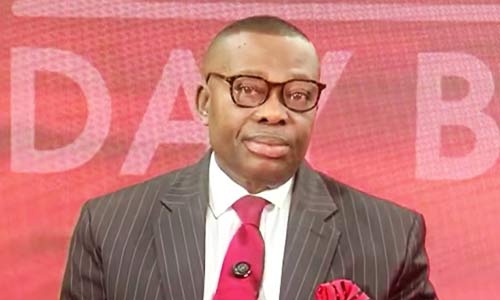
Ubani spoke on Channels Television’s Sunrise Daily on Friday morning, a day after publishing an interim report on the conference in Port Harcourt.
Asked how his review had been received by colleagues, Ubani said the response had been broadly supportive.
“The reaction from the lawyers, and that is a very important constituency, is that they virtually agreed with what I said. It’s something that many people were not bold enough to speak, but I had to do this,” he said.
He was careful to separate his criticism from the outgoing leadership. “It is not clearly a criticism of Afam’s governance or leadership. It’s just that the observation I made is that the standard of our conference this year fell below standard, and that is the truth.”
He set out his standing to make the assessment. “I’ve been to over 20-something conferences since I became a lawyer. I was once the chairman of a branch of the Nigerian Bar Association. I was once the Vice President of the Nigerian Bar Association, a former chairman of the Section on Public Interest and Development Law, and a very active stakeholder in the legal profession. I have been to many conferences, both international and local.”
On the logistics, the senior advocate was specific.
“This year’s conference really fell below standard in terms of logistics and organisational planning. We were put into a lot of discomfort. There was no place for you even to go and urinate easily, and that was not taken into consideration,” he said.
He described the halls. “The places where we had our programme were not conducive. The air conditioners were not functioning properly and the environment was very, very hot. And so you saw many lawyers outside taking pictures and socialising rather than being inside the hall in order to listen to some of the lectures that were going on.”
He referred to the footage that has since circulated online. “It wasn’t really conducive when it came to feeding, carrying plates, you know, begging for meat and all that.”
Ubani described his own experience leaving the venue.
“Yesterday, you see the pool of water. I was lifted like a small boy into my car. I had to be lifted by this young man and I had to pay for it,” he said. “Others were exploited by the people trying to lift them, because there was this pool of water, flood, that made it very difficult for people to have access to the venue.”
He said he had been held up on another occasion. “There was a time yesterday I was in a hold-up for almost two hours in a particular place because of the large number of persons.”
Ubani said the scale of attendance was itself the story, and that planning had not matched it.
“I think this is the highest ever in the history of the NBA. Over 24,000 lawyers registered for this conference. So you will expect all those organisational hiccups,” he said. “But my problem is that it may not be 100 per cent, but there must have been some level of standard expected in terms of planning, knowing the number of people that are coming for this conference.”
He put the mismatch in figures. “Imagine you are bringing 24,000 lawyers to a conference and the biggest platform you created for them is 2,000 only. So you begin now to do all other smaller platforms for the conference, and that’s why you saw many more lawyers being outside than inside.”
He said delegates had paid for a different experience. “It’s like there was no proper arrangement made for the number of persons that were coming, and you took money from them and you made them pass through a rigorous and strenuous process in a conference that’s supposed to be simple, entertaining and very exciting. We look forward every year to this kind of annual conference. But this year, honestly, has been a bit of a strain.”
Pressed on why his written report opened with the quality of the conference bag rather than with the controversies over guests or welfare, Ubani said the materials are what delegates keep.
“There have been presidents who ran the NBA and gave us very quality bags, and up to now I’m still using those bags,” he said, recalling earlier conferences. “I want a situation where after a conference I should be able to use the materials that I’ve got from the conference.”
He drew a comparison with another professional body. “If you go to any ICAN conference, they gave me a quality bag, and I’m still using those bags to travel.”
He said the cost of attendance sharpened the point. “I paid over N200,000 or N300,000 for the conference,” he said, adding that quality need not come from members’ fees alone. “You should be able to get sponsors to do this, and that is what other professions do. You meet a sponsor and an investor: look, I want you to be the one to do the bag. And they would never forget you.”
Of this year’s bag, he said: “If you see the bag, it looks like that of a market woman. Somebody said a funeral souvenir. Last year and this year’s bags have been very unimpressive.”
Asked whether the shortcomings could fairly be laid at the organisers’ door, given that the conference is meant to rotate around the country, Ubani said the rotation itself is the problem.
“If it has become known to us that the number of lawyers for our annual conferences is increasing, and we do not have the facility in any particular state, then we should avoid that state,” he said. “It is not compulsory that we must go to every state. If you don’t have that facility, we have discovered that Abuja can conveniently host conferences without any issue. The same with Lagos, which conveniently hosted us. It was superb, and I wrote about it.”
He said the alternative is to build. “It is also a notice we are giving to governors and government that we can begin to erect international convention centres. We’ve been to other countries in the world and we see international convention centres that can take 30,000 at a go, 40,000, 25,000. We can do it. We have the resources.”
He suggested the Association could take the project on itself. “If others are not doing it, maybe the NBA will begin to look into investing in that. We can make it a project of maybe five or six years. Let’s build a convention centre where we can be holding our annual conferences.”
He tied the proposal to the conference theme. “The topic is Beyond Limits. We should go beyond traditional boundaries and begin to innovate and do things that are extraordinary. That’s the way nations think. Maybe this Beyond Limits can push us into having a convention centre, begin to build and lay a foundation for it, and ask sponsors.”
Asked whether the level of state government support affects the quality of the conference, Ubani said it does, and drew comparisons with previous hosts.
“Most of the conferences we have held in the past, the state government comes in in terms of helping with funding. I remember the one we held in Port Harcourt when Governor Wike was the governor. He was very forthcoming,” he said. He also recalled the Lagos conference held under a former governor of that state, who he said “practically believed so much in the project, believing that so much money will come into the state economically.”
He said the economic return to a host state is substantial. “The kind of money that has come in during this conference is in the billions. All the hotels were taken over, all those that sell increased their prices, and they were all smiling to the banks.”
Of the previous year’s host, he said: “The one in Enugu, the governor was all over the place. Security was tight. Everything was intact. You saw the presence of government in the planning and organisation that happened in Enugu. That’s the kind of thing we want every other state to be involved in.”
He said he had not seen the same this year. “I’m sorry to say this, I didn’t see it. I don’t know whether the governor was doing this. He came there, he was there and made beautiful speeches, but I didn’t see much of the presence of governance on the ground to show that we are welcome. The level of preparedness and what I saw on ground wasn’t all that.”
Ubani said the Association’s credibility as a critic of national institutions depends on how it manages its own affairs.
“If we can sit down and criticise what goes on at the national level, then we must be above board in terms of the way we organise our electoral process and the way we organise our conferences,” he said.
He added: “We are saying this not to run down any person, but for future planning, for those who are taking over, that we don’t allow such things to happen. There’s an international Bar conference coming up in Denmark in October. If you see the level of planning, if you see the level of standard, we should be able to look at those things and come back and replicate them here and begin to improve our standard. Not that every year we keep on going down.”
He said the profession’s standing makes the point important. “For a profession that represents the voice of the voiceless, that represents standard, that represents the best of the best, when it comes to the issue of planning, when it comes to the issue of the electoral process, we should seem to be above board. But I’m not seeing that over the years, and it’s making me not feel very happy as a legal practitioner. And I have a right to voice that.”
On the controversy over guests, which has divided senior figures during the week, Ubani clarified that his objection is to the process of selection rather than to diversity of voices.
“I don’t have any problem with having mixed voices in our conference. Hear from everyone, even the low and the rich, the elite, the intellectuals, even the market woman. But let it be that you are conscious of the environment where you are bringing the guests, so that we don’t run into problems at the end of the day when a particular guest comes and people now start quarrelling, why must you have brought that particular person,” he said.
He set out what he expects of the planning committee. “Whoever you are bringing at every point in time, you must do a fact check. You must look at the antecedents. You must look at the character. Do all your background check before bringing any guest. Don’t bring any guest that will create a lot of controversy.”
He said his standard is what a delegate takes away. “The language you deploy is also very important to me. The things you will say, very important. It must be measured and it must be very factual. I want to go out of the lecture hall feeling that I have benefited from this person.”
Put to him that Professor Chidi Odinkalu had defended the invitation as a form of feedback the Association should not fear, and that the Bar President had also pushed back, Ubani said the disagreement is not a sign of deeper division.
“People have a right to their view. It is not a measure of deeper division. People will take individual positions on a matter at any point in time,” he said, recalling his one criticism of the previous conference. “Last year it was the issue of junior lawyers taking the centre stage. You can’t do that in a profession where you have old lawyers and young lawyers. Yes, you have to give them an opportunity, but let it not be that you put them ahead of senior lawyers.”
He also drew a distinction between the entertainment and the intellectual portions of the programme. “The entertainment aspect should be there. Leave it for the young ones. I don’t have any issue with that. But when it comes to the discussion of topics, remember that you have all these people in that hall. Those bringing guest speakers must be very intentional about it.”
Asked what Nigerians should expect from the conference, Ubani described it as a gathering of lawyers, judges, policy makers, business leaders and government officials, and said the value lies in what follows the speeches.
“We should go beyond the issue of talking and begin to insist on implementing these things. Every year we keep on talking and issuing communiqués that should be implemented by those who are policy makers, and that is the way we can move our country forward,” he said.
He said other bodies achieve it. “I’m a council member of the African Bar Association, and I see presidents of countries come to our conferences and they listen to us and say, we are going home with all the things you guys have said in your conference. I want it to be seen also in Nigeria when we are having our conferences. Get the policy makers to be part of the process, in order to hear what we are trying to interrogate.”
[A MUST HAVE] Evidence Act Demystified With Recent And Contemporary Cases And Materials

Available now for NGN 40,000 at ASC Publications, 10, Boyle Street, Onikan, Lagos. Beside High Court, TBS. Email publications@ayindesanni.com or WhatsApp +2347056667384. Purchase Link: https://paystack.com/buy/evidence-act-complete-annotation
______________________________________________________________________ “Enhance Legal Practice With Authoritative Reports” — Alexander Payne Offers Comprehensive Law Reports, Spanning Over A Century Of Nigerian Jurisprudence Interested buyers are encouraged to place their orders and enquiries via:
0704 444 4777, 0704 444 4999, 0818 199 9888
Website: www.alexandernigeria.com
Interested buyers are encouraged to place their orders and enquiries via:
0704 444 4777, 0704 444 4999, 0818 199 9888
Website: www.alexandernigeria.com