*Says “Supreme Court’s Decision Has Left Lawyers Sanctioned By LPDC Without Clear Appeal Route”

The President of the Nigerian Bar Association, Mazi Afam Osigwe, SAN, has raised concern over the uncertainty now confronting legal practitioners seeking to challenge decisions of the Legal Practitioners Disciplinary Committee, following the Supreme Court’s decision striking down the statutory provision that allowed direct appeals from the LPDC to the apex court.
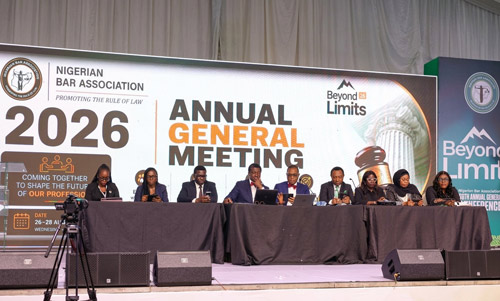
Osigwe disclosed at the Annual General Meeting of the Nigerian Bar Association in Port Harcourt, Rivers State, on Thursday, that the Association has proposed an amendment to the Legal Practitioners Act to make the Court of Appeal the appropriate appellate court for decisions of the LPDC.
According to the NBA President, the Supreme Court struck down Section 12(7) of the Legal Practitioners Act, which had provided for appeals against LPDC Directions directly to the Supreme Court, on the basis that such jurisdiction could not be conferred on the apex court by ordinary legislation outside the constitutional appellate structure.
“The Supreme Court struck down Section 12(7), I think, of the LPA, which initially empowered the Supreme Court to hear appeals against sanctions of the LPDC,” Osigwe told members at the AGM.
He explained that the development had created a difficult situation for lawyers who may be dissatisfied with disciplinary Directions issued against them.
The NBA President noted that the previous appeal mechanism through the Body of Benchers had also been affected by amendments to the legal framework, leaving practitioners sanctioned by the LPDC facing uncertainty as to the proper procedure for challenging such decisions.
Osigwe said those presently affected would need to obtain independent legal advice on the remedies available to them pending the expected amendment of the Legal Practitioners Act.
“The current decision will require persons who are affected by this to seek the counsel of their lawyers. I’m not going to give you any legal advice,” he said.
According to Osigwe, the NBA has already proposed a legislative solution in a memorandum submitted to the Attorney-General of the Federation and Minister of Justice.
He said the Association recommended that the provision presently being amended should no longer provide for a direct appeal from the LPDC to the Supreme Court but should instead grant an aggrieved practitioner a right of appeal to the Court of Appeal.
“What we had, in a memo submitted to the Attorney-General, suggested that [the provision] presently undergoing an amendment, which provides for appeal to the Supreme Court, should be replaced with an appeal to the Court of Appeal,” Osigwe said.
He argued that the proposal would fit more appropriately within Nigeria’s constitutional framework because the National Assembly is capable of conferring appellate jurisdiction on the Court of Appeal over decisions of tribunals and other bodies exercising judicial or quasi-judicial functions.
Osigwe drew attention to the procedure applicable to military tribunals as an example.
“You will recall that under the Armed Forces Act, appeal against [the decision] of a General Court Martial goes straight to the Court of Appeal,” he said.
“So we have made that suggestion, and I’m hoping that we will call on that by ensuring that amendment is quickly concluded.”
The NBA President also indicated that engagements had taken place with relevant lawmakers, including the leadership of the Senate Committee responsible for judiciary matters, as part of efforts to address the problem through legislation.
The issue has assumed particular significance following the recent decision of Joe-Kyari Gadzama, SAN, to approach the Federal High Court in Abuja for judicial review of a Direction of the LPDC.
On August 20, 2026, Justice Obiora-Atuegwu Egwuatu of the Federal High Court granted Gadzama leave to commence judicial review proceedings seeking an order of certiorari to quash an LPDC Direction delivered on July 29, 2026.
The case, Suit No. FHC/ABJ/CS/1954/2026, was instituted by Gadzama against the Body of Benchers, Legal Practitioners Disciplinary Committee, Chief Registrar of the Supreme Court, Chris Alashi, Esq., and Ocha P. Ulegede, Esq.
The Direction being challenged arose from Complaint No. BB/LPDC/1314/2024, Chris Alashi, Esq. v Ocha P. Ulegede, Esq. & Anor.
Gadzama’s motion ex parte was dated August 18 and filed on August 19, 2026. His counsel, M.E. Oru, SAN, urged the Federal High Court to grant him permission to seek judicial review pursuant to Order 34 of the Federal High Court Civil Procedure Rules.
Justice Egwuatu granted leave for Gadzama to apply for an order of certiorari bringing the LPDC Direction before the Federal High Court for the purpose of seeking its quashing.
The court directed that the substantive application be filed within seven days from August 20 and adjourned the matter to September 4, 2026, for hearing, subject to service on the respondents.
The order granted to Gadzama was, however, only permission to proceed with the substantive judicial review application and did not amount to a finding that the LPDC Direction was unlawful or invalid.
The respondents had also not been heard at the leave stage.
Against the background of Osigwe’s remarks at the NBA AGM, Gadzama’s case highlights the practical uncertainty surrounding the procedure for challenging LPDC decisions following the Supreme Court’s ruling on direct appeals.
It should, however, not be concluded that the Supreme Court decision was necessarily the reason Gadzama chose judicial review at the Federal High Court. The enrolled order granting him leave does not state that this was the basis for adopting that procedure.
His application could nevertheless bring into focus several important questions, including whether judicial review is available against an LPDC Direction, whether the Federal High Court possesses jurisdiction to entertain such a challenge and what legal remedy is presently open to a practitioner dissatisfied with an LPDC decision.
Before the recent development, Section 12(7) of the Legal Practitioners Act provided the statutory framework under which a practitioner aggrieved by a Direction of the LPDC could proceed directly to the Supreme Court.
Osigwe’s position is that following the Supreme Court’s intervention, legislation is required to provide a constitutionally sustainable appellate mechanism.
The NBA’s proposal would therefore insert the Court of Appeal between the LPDC and the Supreme Court, rather than restoring the former arrangement of direct appeals to the apex court.
For the NBA President, completing the amendment has become urgent because affected lawyers should not be left uncertain about where and how to exercise their right to challenge disciplinary decisions.
Until the legislative process is completed, however, Osigwe said practitioners affected by LPDC Directions would have to seek legal advice and determine the appropriate remedies available under the existing legal framework.
[A MUST HAVE] Evidence Act Demystified With Recent And Contemporary Cases And Materials

Available now for NGN 40,000 at ASC Publications, 10, Boyle Street, Onikan, Lagos. Beside High Court, TBS. Email publications@ayindesanni.com or WhatsApp +2347056667384. Purchase Link: https://paystack.com/buy/evidence-act-complete-annotation
______________________________________________________________________ “Enhance Legal Practice With Authoritative Reports” — Alexander Payne Offers Comprehensive Law Reports, Spanning Over A Century Of Nigerian Jurisprudence Interested buyers are encouraged to place their orders and enquiries via:
0704 444 4777, 0704 444 4999, 0818 199 9888
Website: www.alexandernigeria.com
Interested buyers are encouraged to place their orders and enquiries via:
0704 444 4777, 0704 444 4999, 0818 199 9888
Website: www.alexandernigeria.com