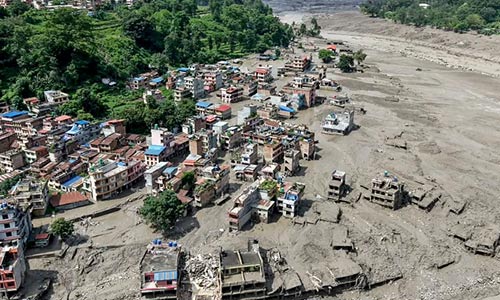
At least 157 people have been confirmed dead in Nepal, while hundreds of residents, tourists, security personnel and workers remain missing after massive flash floods and landslides devastated communities along the Nepal–Tibet border.

Nepalese police confirmed that 157 bodies had been recovered as search and rescue operations continued across some of the worst-hit areas, including Rasuwa, Nuwakot, Gorkha and Dhading districts.
On the Tibetan side of the border, Chinese state media reported at least three deaths and 265 people missing, raising fears that the overall casualty figure could climb substantially as rescuers reach isolated communities.
The disaster struck an area popular with pilgrims, trekkers and international tourists, with more than 500 tourists reported missing in Nepal alone.
According to Nepal’s tourism authorities, those unaccounted for include more than 100 Indian nationals, 54 Americans, 33 British citizens and more than 100 Nepalese tourists.
Ukraine’s Foreign Ministry separately said 53 Ukrainian citizens were missing, while Canadian authorities said 24 Canadians were unaccounted for.
Australian officials also confirmed that a number of their nationals had been in the affected area, while New Zealand authorities were working to determine whether any of their citizens were among those missing.
Dozens of Nepalese police officers, soldiers and electricity workers are also among those missing.
Nepal police said 28 officers in Rasuwa remained unaccounted for as canine teams, drones and emergency personnel searched devastated communities.
Dramatic footage from the affected region showed a huge wall of muddy water, rocks and debris tearing through valleys, sweeping away homes, roads, vehicles and bridges as residents scrambled to higher ground.
At the Gyirong border crossing, surveillance footage showed people running for safety moments before a wall of floodwater and debris slammed into buildings.
Another video showed the torrent engulfing the Rasuvagadhi border checkpoint, a multi-storey facility along the Trishuli River.
Verified footage from Betrawati in Nepal also showed more than a dozen people fleeing uphill through trees as floodwaters rapidly swallowed houses along the Trishuli River.
Within seconds, entire sections of the village were engulfed while residents could be heard crying out as they attempted to escape.
Authorities initially suggested that an earthquake near the Nepal–Tibet border may have triggered the landslide and subsequent flooding.
However, further analysis by the United States Geological Survey concluded that the seismic activity detected in the region was more likely generated by the landslide itself rather than an earthquake.
The USGS said its revised analysis indicated that “the seismic energy was instead generated by a landslide.”
Scientists are now investigating what caused the landslide.
One possibility being examined is whether heavy rainfall or melting ice destabilised the ground or glaciers, triggering a chain reaction involving landslides, blocked rivers and sudden flooding.
Researchers are also studying satellite images to determine whether a glacial lake may have suddenly drained or whether debris temporarily blocked a river before collapsing and releasing a massive volume of water downstream.
Although climate change is known to be accelerating glacier melt across the Hindu Kush Himalaya region, scientists cautioned that it is still too early to determine whether climate change directly contributed to this particular disaster.
The Nepalese government has deployed large numbers of military and emergency personnel to affected areas.
The office of Prime Minister Balendra Shah said 1,697 personnel had been deployed for rescue operations, with another 656 placed on standby.
Six military helicopters rescued 94 people during the day, while five civilian helicopters evacuated another 12. Ground rescue teams rescued 27 people.
Authorities also delivered 800 kilogrammes of tents and 200 kilogrammes of medical supplies to affected communities.
Search and rescue operations were expected to continue overnight, with people stranded around Timure scheduled to be evacuated by air.
Prime Minister Shah said the entire country was “shocked and deeply distressed” by the scale of the disaster.
The tragedy has been particularly severe because the affected corridor is heavily used by pilgrims and tourists travelling to major religious and trekking destinations.
The region contains important pilgrimage sites including Lake Mansarovar near Mount Kailash in Tibet and Gosaikunda Lake in Nepal’s Rasuwa district, which are revered by Hindus, Buddhists and Jains.
Tens of thousands of visitors pass through Nepal each year on their way to the region, with the current period traditionally attracting large numbers of pilgrims.
International assistance has begun arriving.
India dispatched about 10 tonnes of humanitarian aid to Nepal and said it was prepared to provide additional assistance.
Indian Prime Minister Narendra Modi said his country was ready to provide “all possible types of humanitarian assistance,” while the United States said it was in contact with Nepal’s government and stood ready to assist.
The European Union, United Kingdom, Canada and Pakistan also expressed solidarity and offered assistance.
The United Nations has also mobilised support.
UN Secretary-General António Guterres expressed sadness over the loss of life, missing persons and widespread destruction in Nepal and China, saying UN teams and partners were mobilising personnel and supplies to support the Nepalese government-led response.
The World Health Organisation said it had dispatched essential emergency medical supplies, medicines and multipurpose tents to Nepal.
The agency also said it was monitoring public-health risks, strengthening disease surveillance and working to maintain access to essential healthcare services in affected areas.
Families have meanwhile gathered at hospitals and emergency centres in Kathmandu seeking information about missing relatives as helicopters continue to transport survivors for treatment.
Some survivors have described watching family members being swept away by the floodwaters, while trekking companies operating in the region have struggled to establish contact with missing guides and tourists.
Authorities have warned that the number of casualties could rise substantially as rescue teams gain access to remote areas and the true scale of destruction becomes clearer.
Nepal police have urged residents to stay away from rivers, stream banks, flood-affected communities and other dangerous locations while rescue operations continue.
[A MUST HAVE] Evidence Act Demystified With Recent And Contemporary Cases And Materials

Available now for NGN 40,000 at ASC Publications, 10, Boyle Street, Onikan, Lagos. Beside High Court, TBS. Email publications@ayindesanni.com or WhatsApp +2347056667384. Purchase Link: https://paystack.com/buy/evidence-act-complete-annotation
______________________________________________________________________ “Enhance Legal Practice With Authoritative Reports” — Alexander Payne Offers Comprehensive Law Reports, Spanning Over A Century Of Nigerian Jurisprudence Interested buyers are encouraged to place their orders and enquiries via:
0704 444 4777, 0704 444 4999, 0818 199 9888
Website: www.alexandernigeria.com
Interested buyers are encouraged to place their orders and enquiries via:
0704 444 4777, 0704 444 4999, 0818 199 9888
Website: www.alexandernigeria.com