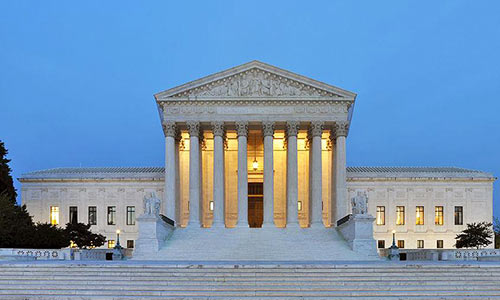
The United States Supreme Court has allowed President Donald Trump’s administration to implement significant portions of his executive order on mail-in voting ahead of the November 2026 midterm elections, handing the administration a partial legal victory in an ongoing battle over federal authority and state-run elections.

The court ruled 6-3 on Monday, with its three liberal justices dissenting.
Under the decision, the Department of Homeland Security may proceed with compiling a federal citizenship list and sharing information with states, while the Attorney General may prioritise the prosecution of state officials accused of issuing ballots to persons who are not eligible to vote.
The ruling also clears the way for the United States Postal Service to implement rulemaking governing the design and handling of state mail ballots.
However, the Supreme Court did not permit implementation of one of the most controversial elements associated with Trump’s order — a requirement that the Postal Service verify the voting eligibility of each person receiving a mail ballot and withhold ballots from persons not appearing on a government eligibility list.
That provision remains blocked in separate litigation.
In an unsigned per curiam opinion, the Supreme Court’s conservative majority held that the Democratic-led states challenging the executive order had not yet demonstrated that they had suffered injury from the measures and that lower courts had gone too far in preventing the administration from proceeding.
The justices stressed that their decision should not be interpreted as determining whether the administration’s eventual implementation of the executive order is lawful.
“On that score, time will tell,” the court said.
The majority added that states would remain free to bring another challenge if the Postal Service’s final rules cause them injury.
“If the Postal Service’s final rule harms the states, they may challenge that rule,” the opinion stated.
The immediate effect of the ruling on November’s midterm elections remains uncertain, although election law experts have suggested that the decision, standing alone, may not cause major changes for individual voters.
Justice Sonia Sotomayor dissented, joined by Justice Elena Kagan, arguing that the executive order had already created potential harm to states and that the dispute should be considered on its merits.
Justice Ketanji Brown Jackson issued a separate dissent, accusing the conservative majority of increasing the risk of confusion in the electoral process shortly before voting.
The Supreme Court’s intervention comes as the Postal Service moves ahead with new nationwide rules governing ballots transported through the mail.
The USPS published a final rule on Friday setting out requirements states must follow when printing ballots intended to be carried and tracked through the postal system.
Under the new arrangement, states would be required to collect basic voter information, including a voter’s name and residential address, and connect it to a unique barcode placed on each mail-in ballot distributed.
At present, there is no single national standard requiring states to track mail ballots in that manner, with individual states generally operating their own systems.
State election authorities would be required to submit the specified information through a newly created “federal ballot mail portal” before election materials enter the postal system.
The USPS rule states that ballots from states that do not comply with the new requirements would not be accepted for delivery under the relevant process.
The Postal Service, however, has insisted that the measures do not make it responsible for determining whether an individual is legally entitled to vote.
According to the USPS, information such as voters’ dates of birth, Social Security numbers and other voter-registration details will not be uploaded to the portal.
“The Postal Service will not play any role in determining voter eligibility, maintaining voter rolls, or counting ballots,” the agency stated.
Solicitor General John Sauer similarly told the Supreme Court that the Postal Service would not independently verify voter eligibility or refuse to transmit a ballot simply because a person did not appear on a state-provided list.
The USPS nevertheless said the information collected could assist federal law enforcement by providing a record of persons to whom states intended to mail ballots, together with the associated barcode data.
According to the agency, the system is intended to provide greater visibility into mail ballot movement and facilitate the investigation of suspected violations of federal law.
The final rule therefore falls short of some of the broader measures sought by Trump in his March executive order.
Trump had sought statewide citizenship verification lists drawing on federal databases, greater uniformity in ballot procedures and coordination between the Postal Service, its Inspector General and the Department of Justice over suspected unlawful use of the mail involving federal election materials.
While several elements of those proposals were incorporated into the USPS framework, the final rule does not require the Postal Service itself to determine citizenship or voter eligibility.
It is also not a ban on voting by mail.
The development forms part of a broader push by the Trump administration and congressional Republicans to tighten voting requirements ahead of the midterm elections.
Trump has also strongly backed the proposed SAVE America Act, which would require photo identification and proof of citizenship for voting.
The President has repeatedly criticised mail-in voting and called for stricter rules, while proposing exceptions for members of the military and persons affected by disability, illness or travel.
Democrats and some Republicans have opposed aspects of the proposed legislation, warning that additional documentary requirements could disenfranchise otherwise eligible voters.
Republican Senator Lisa Murkowski of Alaska, while expressing support for voter identification generally, has criticised the SAVE America Act, warning of the difficulty involved in rapidly implementing broad federal mandates.
She argued that election reforms should be approached cautiously at a time when public confidence in elections is already under strain.
The Postal Service said it received more than 200,000 public comments on its proposed mail-ballot changes before finalising the rule.
Responding to concerns about the extent of voter fraud, the agency said the frequency of fraud did not determine the legal basis for its regulation, arguing that greater visibility into mailed ballots could help identify potential problems that might otherwise go undetected.
The final USPS rule is scheduled for official publication on August 26.
A federal appeals court had previously upheld an injunction issued by a district judge in July, preventing changes to the mail-ballot system while litigation continued.
Monday’s Supreme Court ruling removes that barrier for the portions now permitted to proceed, but it does not finally resolve the underlying legal dispute over the extent of presidential and federal authority in an electoral system traditionally administered primarily by the states.
[A MUST HAVE] Evidence Act Demystified With Recent And Contemporary Cases And Materials

Available now for NGN 40,000 at ASC Publications, 10, Boyle Street, Onikan, Lagos. Beside High Court, TBS. Email publications@ayindesanni.com or WhatsApp +2347056667384. Purchase Link: https://paystack.com/buy/evidence-act-complete-annotation
______________________________________________________________________ “Enhance Legal Practice With Authoritative Reports” — Alexander Payne Offers Comprehensive Law Reports, Spanning Over A Century Of Nigerian Jurisprudence Interested buyers are encouraged to place their orders and enquiries via:
0704 444 4777, 0704 444 4999, 0818 199 9888
Website: www.alexandernigeria.com
Interested buyers are encouraged to place their orders and enquiries via:
0704 444 4777, 0704 444 4999, 0818 199 9888
Website: www.alexandernigeria.com