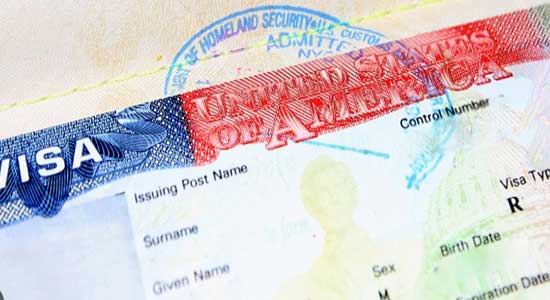
The United States government is preparing to revoke the business and tourism visas of as many as 200,000 foreign nationals who entered the country as short-term visitors but later applied for asylum, in what could become one of the largest mass visa revocation exercises in US history.

The proposed action targets holders of B1 and B2 nonimmigrant visas issued between 2016 and 2026 who subsequently sought asylum after entering the United States.
The US State Department is expected to begin announcing the revocations in the coming weeks in coordination with the Department of Homeland Security (DHS).
State Department spokesman Tommy Pigott confirmed the planned action, although he cautioned that the number of people eventually affected could change as the review continues.
“We are coordinating with DHS to identify and revoke the nonimmigrant visas of foreigners who have come to the United States claiming to be short-term visitors, but then file for asylum to stay here permanently,” Pigott said.
He added that “the number of revocations remains dynamic” and that the exercise would be carried out “on a rolling basis.”
The proposed measure would not, however, automatically result in the immediate deportation of affected individuals.
Foreign nationals whose asylum applications remain pending would lose their B1 or B2 visitor visa status, while their asylum claims would continue to be considered under the applicable immigration process.
The development therefore represents a distinction between a person’s visitor visa and a separately pending asylum application: revocation of the former would not, by itself, amount to a final decision on the latter.
US Deputy Secretary of State Christopher Landau defended the planned policy, arguing that visitor visas should not be used as an alternative route into the country’s asylum system.
“Asylum isn’t supposed to be a loophole to circumvent immigration law,” Landau said.
B1 visas are generally issued to foreign nationals travelling temporarily to the United States for business purposes, while B2 visas are commonly used for tourism, family visits and medical treatment.
Applicants for both visa categories are generally expected to demonstrate that their proposed stay is temporary and that they intend to leave the United States at the end of the authorised visit.
The planned revocations are therefore aimed at persons whose subsequent asylum applications are being treated by the administration as inconsistent with the temporary purpose for which their visitor visas were granted.
The proposed policy could affect Nigerian nationals among other foreign visa holders, although the US government has not disclosed how many Nigerians are included in the estimated 200,000 cases under review.
Nigerians have historically accounted for a significant number of African asylum applications in the United States.
Figures previously attributed to the United Nations High Commissioner for Refugees showed that 2,827 Nigerians applied for asylum in the United States in 2024.
Between 2022 and 2024, US immigration courts reportedly granted asylum to 1,372 Nigerians, while 1,534 Nigerian applications were denied.
Those figures do not establish how many of the applicants entered the United States on B1 or B2 visas and would therefore fall within the scope of the proposed revocation exercise.
For Nigerians currently in the United States who entered on business or tourist visas and subsequently applied for asylum, however, the policy could mean the formal cancellation of their B1 or B2 visas and increased scrutiny of their immigration records while their asylum applications remain pending.
The move also signals a tougher approach by the US government towards foreign nationals who enter as temporary visitors and later seek to remain permanently through asylum proceedings.
The government has not yet disclosed the full operational details of the exercise, including whether every B1 or B2 holder with a pending asylum application would automatically lose the visa or whether individual cases would undergo further review.
For now, the State Department says the process will proceed gradually and in coordination with Homeland Security, with the final number of affected visa holders expected to remain subject to change as cases are identified and reviewed.
[A MUST HAVE] Evidence Act Demystified With Recent And Contemporary Cases And Materials

Available now for NGN 40,000 at ASC Publications, 10, Boyle Street, Onikan, Lagos. Beside High Court, TBS. Email publications@ayindesanni.com or WhatsApp +2347056667384. Purchase Link: https://paystack.com/buy/evidence-act-complete-annotation
______________________________________________________________________ “Enhance Legal Practice With Authoritative Reports” — Alexander Payne Offers Comprehensive Law Reports, Spanning Over A Century Of Nigerian Jurisprudence Interested buyers are encouraged to place their orders and enquiries via:
0704 444 4777, 0704 444 4999, 0818 199 9888
Website: www.alexandernigeria.com
Interested buyers are encouraged to place their orders and enquiries via:
0704 444 4777, 0704 444 4999, 0818 199 9888
Website: www.alexandernigeria.com