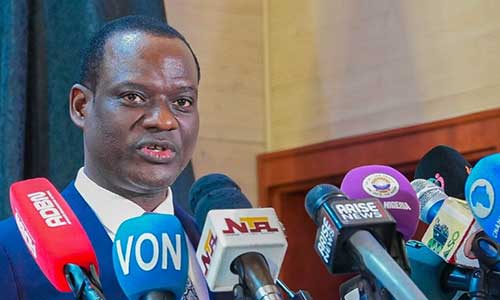
The Minister of Finance and Coordinating Minister of the Economy, Taiwo Oyedele, has rejected calls for the Federal Government to publish details of how it intends to spend funds drawn from its $5 billion financing facility with First Abu Dhabi Bank, saying the transaction has been subjected to unnecessary scrutiny.

Oyedele spoke on Wednesday at a media briefing at the Federal Ministry of Finance in Abuja, held as part of a presentation titled “Nigeria’s Reform Scorecard: The Benefits and Harms Prevented.” The exercise followed a directive by President Bola Tinubu that the Minister publicly account for the gains, costs and impacts of the administration’s economic reforms since 2023.
“There’s Nothing Special About That Loan”
The government recently drew about $1.5 billion, the first tranche of the $5 billion Total Return Swap facility arranged with First Abu Dhabi Bank, notwithstanding concerns raised by the International Monetary Fund and Fitch Ratings over the transparency and risks associated with such structures.
The facility was approved by the National Assembly on 31 March 2026, with the initial drawdown expected to support the 2026 budget, infrastructure projects and the refinancing of existing debt obligations.
Asked whether details of the transaction would be made public, the Minister said the government publishes information on how it spends public funds, but questioned why this particular facility was drawing special attention.
“We will not publish how we are spending it. We will publish how we spend government money. There’s nothing special about that loan,” he said.
He continued: “Nobody has asked us whether we’re going to publish the money we took from the World Bank, whether we publish the one from Eurobond, whether we publish the one from Sukuk. Why is this one special?”
“What Else Can Be More Public?”
Oyedele dismissed suggestions that the transaction was conducted without due process, noting that it had passed through the legislature.
“The loan was approved not only by FEC, it was taken to the National Assembly, because what some people are doing is they are comparing with other countries where they did it under the table,” he said. “What else can be more public than what you gave to the National Assembly?”
“We’re Accessing It In Phases”
The Minister said the government had assessed the transaction carefully and was drawing the funds in stages to avoid unnecessary cost.
“We’re accessing it in phases. You don’t want to take all the money at once, because if you don’t spend it at once, you incur cost on the extra amount you’ve taken,” he said.
“This Transaction Is Flexible Rates”
He explained that the arrangement differs from the country’s traditional fixed-rate borrowing.
“You need to understand the transaction. There’s always the textbook analysis and there’s the real life of what you’re doing. We’re used to raising bonds on fixed interest rate terms. I can tell you our Eurobond, for example, they were raised when the coupon was double digits. Today, our yield is down to around seven, 7.5 per cent,” he said.
He noted that the country cannot benefit from the lower yield on its existing fixed-rate debt.
“This First Abu Dhabi Bank transaction is flexible rates. It means if rates go up, we pay more. If rates come down, we benefit more. There’s nothing that says we must always do one thing. And the all-in rate for this transaction is lower than our existing portfolio,” he said.
He stated the purpose plainly: “The objective is to use it to refinance expensive debt so you can save money.”
Under the arrangement, the government is required to pledge securities worth about 133 per cent of the amount drawn as collateral.
The International Monetary Fund had warned that derivative financing structures such as total return swaps could be difficult to track and value in real time, potentially obscuring the extent of a country’s financial obligations. Fitch Ratings warned that the arrangement could increase sovereign debt risks and reduce transparency in public debt reporting.
Oyedele said further clarification would be published shortly. “In the next few days, you will see on the website of both the Ministry of Finance and the DMO the frequently asked questions about this particular debt or bond, just so everybody can please themselves,” he said.
He added: “I spend time on it because I think it’s important, and the international media also, for some reason, have taken so much interest in it. But that is what it is.”
“They Went And Destroyed The ATM”
At the same briefing, the Minister faulted Nigerians who took to social media to attack the World Bank over its lending to the country, saying their conduct reflected a misunderstanding of how the system works.
“People went to the social media account of the World Bank to go and be abusing them that they’re giving Nigeria loan. World Bank just switched off the comments. We’ve gotten the loan, because that’s not how the system works,” he said.
He illustrated the point with an analogy. People without knowledge of how an automated teller machine works, he said, might see others withdrawing money and assume the government was allowing only some people to access funds.
“Some people who have no knowledge of how it works said, why is government allowing some people withdraw money here and they’re not giving to the rest of us,” he said.
He continued: “So some leaders emerged from their group and said this is not fair, government has to, and then they went and destroyed the ATM, beat up some other people withdrawing money there, and they were hailing their hero.”
He said the demand ignored a basic fact. “Yes, let everybody withdraw money from the ATM. They haven’t put money in the bank.”
The outcome, he said, would resolve nothing. “After breaking the bank and the ATM and beating people up, they still can’t collect money, because that’s not how the system works.”
He drew the lesson for public accountability. “If you don’t understand how the system works, you waste energy. Part of your ability to hold government to account is having the right knowledge. If you don’t, you’re wasting your energy.”
On The Use Of Data
The Minister warned against the manipulation of economic data for political purposes.
“I know what’s going to happen after today now is some people will take this data and turn it upside down for campaign,” he said.
He put a question to his audience: “You have to be honest with yourself. Are you trying to build your country, or are you trying to tear it apart?”
“Ask Your Children To Be Honest With You”
Responding to an audience member who said his three children in school had not received support from the Nigerian Education Loan Fund and knew of no friends who had, Oyedele urged him to ask whether they had in fact applied and to demand evidence.
“It is possible they’ve collected the money, and they are collecting from you,” the Minister said, adding: “You need to ask your children to be honest with you.”
He said the man could assist his children to apply if they had not done so. “If there’s anything that everyone can attest to, it is this NELFUND,” he said.
He pointed to what the scheme covers. “We’ve seen videos of students randomly rejoicing, because it’s not only the tuition that was being paid, they get monthly stipend, interest free, in a high inflationary environment,” he said, adding that students could access up to N1.5 million.
He offered direct assistance. “You can go to the website. In fact, what you can do, ask any of those your three children to give you their details. Help them apply. If you can’t find the link, come to the Ministry of Finance. We will help you. You will do it yourself. You apply for one of those three children and you get the amount.”
He disclosed that uptake was higher in one part of the country than the other. “Interestingly, the uptake is more in the North than in the South, because we spend all our energy here doubting everything that government does,” he said.
He recalled his own experience supporting indigent students through a personal foundation. “Many of them were still coming to me after I said go and apply. I sent the link to them. Within two weeks, they said we got alerts,” he said.
[A MUST HAVE] Evidence Act Demystified With Recent And Contemporary Cases And Materials

Available now for NGN 40,000 at ASC Publications, 10, Boyle Street, Onikan, Lagos. Beside High Court, TBS. Email publications@ayindesanni.com or WhatsApp +2347056667384. Purchase Link: https://paystack.com/buy/evidence-act-complete-annotation
______________________________________________________________________ “Enhance Legal Practice With Authoritative Reports” — Alexander Payne Offers Comprehensive Law Reports, Spanning Over A Century Of Nigerian Jurisprudence Interested buyers are encouraged to place their orders and enquiries via:
0704 444 4777, 0704 444 4999, 0818 199 9888
Website: www.alexandernigeria.com
Interested buyers are encouraged to place their orders and enquiries via:
0704 444 4777, 0704 444 4999, 0818 199 9888
Website: www.alexandernigeria.com