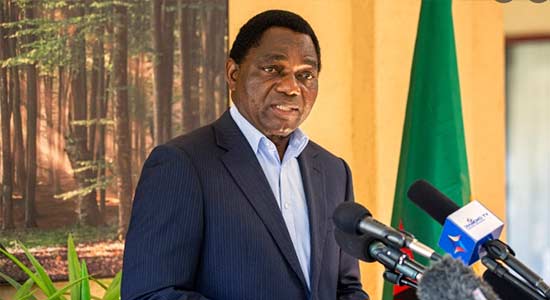
Zambian President Hakainde Hichilema has secured a second five-year term in office after winning about 61.4 per cent of valid votes cast in the country’s presidential election, amid opposition allegations of irregularities and heightened tensions that have reportedly forced his main challenger, Brian Mundubile, into hiding.

The Electoral Commission of Zambia formally declared Hichilema president-elect in the early hours of Tuesday, August 18, 2026, following the conclusion of the vote count from the August 13 election.
Commission Chairperson Mwangala Zaloumis announced the result, saying: “I therefore declare Hichilema Hakainde S to be president-elect of the Republic of Zambia this 18th day of August, 2026.”
Official results showed Hichilema, candidate of the ruling United Party for National Development, UPND, receiving approximately 61.4 per cent of valid votes, while Mundubile, his closest challenger, secured about 38 per cent.
Twelve other presidential candidates trailed far behind the two leading contenders.
The election marked Hichilema’s seventh presidential contest. He was first elected president in 2021 after five earlier unsuccessful attempts to win the country’s highest office.
For 55-year-old Mundubile, candidate of the National Reconciliation Party for Unity and Prosperity, NRPUP, the 2026 contest was his first presidential bid.
Following confirmation of the result, hundreds of Hichilema’s supporters took to the streets of Lusaka dressed in the red colours of the UPND, singing, dancing and setting off firecrackers to celebrate his re-election.
Hichilema, 64, thanked voters for granting him another mandate and promised to govern both those who supported him and citizens who voted for his opponents.
“We are truly humbled by the trust you have placed in our hands,” he said.
Addressing supporters of opposition candidates, the president added: “To those citizens who preferred the ideas presented by our opponents, we hear you, and we will continue to work for you.”
Hichilema also described the election as evidence that Zambia remained committed to resolving political differences democratically.
He said the country remained a place of “peace, law and order” and “a democratic nation that settles our differences at the ballot box, and nowhere else.”
Mundubile did not immediately publicly respond to the official declaration.
His party, however, said he had moved to a secure location because of alleged threats against him.
The NRPUP told the BBC that its presidential candidate was “in a secure location under the protection of an international human rights body due to threats made against him.”
“He will communicate directly with the Zambian people and the media as soon as circumstances allow,” the party said.
Local reports suggested that Mundubile and his running mate, Makebi Zulu, had sought refuge at a United Nations-linked facility in Lusaka because of fears that they could be arrested.
The development followed several days of political tension surrounding the election.
On election night, authorities arrested 11 people, including prominent opposition figures, during a raid in which gunfire was reportedly exchanged.
Mundubile was said to have been present when the operation took place.
The government said the security operation targeted alleged “militia activity” and claimed those arrested were found with military-grade weapons intended for an armed insurrection.
The opposition rejected the government’s account.
The NRPUP said the operation was carried out at Mundubile’s residence and claimed that a member of parliament was wounded by gunfire during the raid.
Mundubile described allegations of an insurrection plot as fabricated.
Tensions increased further when the Electoral Commission temporarily suspended vote counting the following day after reports of violence directed at polling officials and the alleged theft of ballot papers.
Mundubile subsequently alleged that he had received information suggesting that result forms from some polling stations could have been altered.
He called for an urgent independent investigation into the allegations.
The opposition candidate had earlier claimed victory and alleged voting irregularities, although he did not publicly present evidence substantiating the claim.
Hichilema’s camp rejected the allegations and accused Mundubile of making false claims.
International election observers offered a mixed assessment of the electoral process.
The European Union observation mission said voting was largely peaceful but raised concerns about the broader political environment in which the election was conducted.
Michael McNamara, chief of the EU observation mission, said the “broader electoral process took place in an environment that limited fundamental freedoms.”
He also cited late legal changes, legal uncertainty and unequal campaign conditions, saying these factors had “distorted the playing field.”
Despite the controversies, approximately five million votes were cast in the presidential election.
Zambia, with a population of about 22 million people, is Africa’s second-largest copper producer and has long been regarded as one of the continent’s countries with a strong history of peaceful transfers of political power.
Since the restoration of multiparty democracy in 1991, every change of president in Zambia has taken place through elections.
Hichilema’s latest victory gives him another five years in office, but the immediate post-election period remains marked by opposition complaints, arrests, allegations of intimidation and questions surrounding the whereabouts and security of his principal challenger.
While the electoral commission has declared the contest concluded with Hichilema’s victory, Mundubile’s party maintains that its candidate remains in a secure location and will address Zambians when circumstances permit.
[A MUST HAVE] Evidence Act Demystified With Recent And Contemporary Cases And Materials

Available now for NGN 40,000 at ASC Publications, 10, Boyle Street, Onikan, Lagos. Beside High Court, TBS. Email publications@ayindesanni.com or WhatsApp +2347056667384. Purchase Link: https://paystack.com/buy/evidence-act-complete-annotation
______________________________________________________________________ “Enhance Legal Practice With Authoritative Reports” — Alexander Payne Offers Comprehensive Law Reports, Spanning Over A Century Of Nigerian Jurisprudence Interested buyers are encouraged to place their orders and enquiries via:
0704 444 4777, 0704 444 4999, 0818 199 9888
Website: www.alexandernigeria.com
Interested buyers are encouraged to place their orders and enquiries via:
0704 444 4777, 0704 444 4999, 0818 199 9888
Website: www.alexandernigeria.com