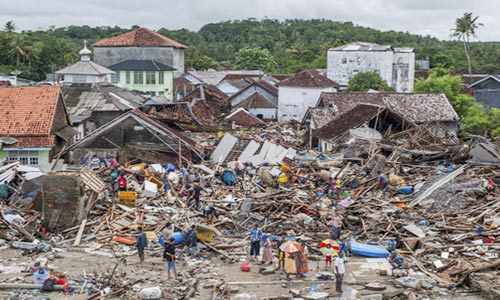
At least 54 people have been killed and more than 100 injured after a powerful 7.7-magnitude earthquake struck eastern Indonesia, forcing about 12,800 people from their homes as repeated aftershocks, landslides and damaged roads complicated rescue and relief operations.

The earthquake struck early on Saturday near the northern coast of Flores Island, with some of the worst damage reported in parts of East Nusa Tenggara, including Sikka, Manggarai, East Manggarai, Nagekeo and surrounding areas.
Initial assessments on Sunday put the death toll at 53, with more than 130 people injured and about 5,000 evacuated. By Monday, authorities said the number of fatalities had risen to 54, while the number of people unable to return to their homes had increased sharply to about 12,800.
Many of the injured were reported to have suffered fractures and other trauma as buildings and structures collapsed during the earthquake.
Indonesia’s national disaster agency, BNPB, said displaced residents were sheltering in schools, sports arenas, police stations, government buildings and makeshift camps across several towns on Flores Island.
More than 3,300 residents in the Sikka region alone had earlier evacuated their homes or moved into a designated sports arena.
Fear of further tremors has prevented many families from returning home.
Indonesia’s meteorology, climatology and geophysics agency, BMKG, had recorded nearly 1,000 aftershocks by Sunday. That figure had risen to more than 1,600 by Monday, leaving thousands preparing to spend a third night outdoors.
In Mbay, Nagekeo regency, close to the epicentre, residents erected makeshift shelters using tarpaulins and poles after their homes were either destroyed or badly cracked.
One resident, Junaidin, 32, said about 30 people were sleeping inside one makeshift shelter because their houses were no longer considered safe.
“Our houses are no longer liveable, because many have collapsed and are full of cracks, so we can’t go inside anymore,” he said.
“We only go back home to get water, clothes, pillows, and then we spend the nights here.”
Some survivors also expressed frustration over what they described as delays in receiving government assistance.
“We’re on our own here,” Junaidin said, appealing for tents, medicine, food and drinking water.
“Please open your eyes, government. We are your people, we are part of you. So please look after us.”
Another resident, Siti Saudah Daso, a 31-year-old mother of three, said her family fled with virtually nothing.
“We fled with nothing. Just the clothes on our backs. We’re victims; we’re going through a disaster,” she said.
“They said they would give us something, but there’s no proof. So honestly, we’re a bit upset, disappointed.”
Authorities, however, have begun moving large quantities of emergency supplies into the affected region.
The Indonesian Air Force said it was transporting 13 tonnes of emergency aid aboard two Hercules aircraft and a Boeing, while helicopters were being deployed to carry supplies directly to isolated communities.
The relief materials included food, clothing, clean water and emergency medical supplies.
More than 3,500 military and police personnel were also deployed to the region to assist rescue teams, secure affected communities and distribute relief materials.
Search-and-rescue teams continued to comb damaged communities by land and air despite authorities saying they had received no formal reports of missing persons.
Rescue official Fathur Rahman said teams were continuing operations as a precaution.
“We conduct land and air operations from helicopters. There haven’t been any reports on missing persons, but we are still scouring the area just to be sure,” he said.
Another rescue official, Suryaman, said clearing rubble in Manggarai, East Manggarai and Nagekeo was among the priorities, particularly because some people could still potentially be trapped in damaged structures.
However, persistent aftershocks and landslides have made access to some locations difficult, while roads have been blocked by debris.
At least 914 houses were severely damaged, according to disaster officials, with hundreds more sustaining varying degrees of damage.
Dozens of public buildings, including schools, health facilities and government offices, were also affected.
The earthquake also damaged electricity infrastructure, although state electricity company Perusahaan Listrik Negara said power had been almost completely restored by Sunday, with repair teams still working on damaged distribution lines.
At the port in Maumere, collapsed roofing and damaged walls left debris scattered across the facility, which was subsequently closed.
Residents sheltering nearby said the continuing aftershocks had heightened fears about returning indoors.
At a sports stadium designated as an evacuation centre, hundreds of people gathered under temporary shelters. Mothers improvised cradles for babies by hanging clothing from tent frames, while children played outside as families waited for assistance.
Among those sheltering there was 22-year-old Lisda, who remained in a tent with her twin babies because she feared sleeping inside her home.
Another survivor, 67-year-old Yuvienta Saen, recalled being forced to make a difficult decision when the earthquake struck while she was praying.
Her paralysed husband reportedly told her to save herself.
“He told me, you run, I’m handing my fate to God,” she recalled.
She also complained about shortages of clean water and blankets at the evacuation camp.
For many residents, the latest disaster revived memories of a devastating earthquake that struck Flores in 1992.
That earthquake, which was also about magnitude 7.7 according to some accounts, triggered a tsunami and killed approximately 2,500 people.
Margaretha Movaldes Da Maga Bapa, head of a regional disaster management agency, said Saturday’s quake had reopened old wounds.
“We’ve had quakes often. But this one really brings back the trauma of the one from 1992,” she said.
The East Nusa Tenggara provincial government has declared an emergency, enabling authorities to mobilise additional personnel, resources and funding for rescue and recovery efforts.
Humanitarian concerns have also extended to children.
Save the Children estimated that more than 8,000 children could face safety risks and disruption to their education following the disaster.
Indonesia is particularly vulnerable to earthquakes and volcanic eruptions because it sits along the Pacific Ring of Fire, a zone of intense seismic activity where several tectonic plates meet.
The country has suffered a series of deadly earthquakes over the years. Saturday’s disaster was described as Indonesia’s deadliest earthquake since the 2022 West Java earthquake that killed hundreds of people.
One of Indonesia’s worst natural disasters occurred in 2004 when a magnitude-9.1 earthquake struck off the coast of Sumatra, triggering a massive Indian Ocean tsunami.
About 220,000 people were killed across the region, including approximately 170,000 in Indonesia, making it one of the deadliest natural disasters in recorded history.
As rescue operations continue in Flores, authorities are now focused on reaching isolated communities, clearing blocked roads, restoring essential services and providing shelter, food, clean water and medical supplies to thousands of residents who remain afraid to return to their damaged homes.
[A MUST HAVE] Evidence Act Demystified With Recent And Contemporary Cases And Materials

Available now for NGN 40,000 at ASC Publications, 10, Boyle Street, Onikan, Lagos. Beside High Court, TBS. Email publications@ayindesanni.com or WhatsApp +2347056667384. Purchase Link: https://paystack.com/buy/evidence-act-complete-annotation
______________________________________________________________________ “Enhance Legal Practice With Authoritative Reports” — Alexander Payne Offers Comprehensive Law Reports, Spanning Over A Century Of Nigerian Jurisprudence Interested buyers are encouraged to place their orders and enquiries via:
0704 444 4777, 0704 444 4999, 0818 199 9888
Website: www.alexandernigeria.com
Interested buyers are encouraged to place their orders and enquiries via:
0704 444 4777, 0704 444 4999, 0818 199 9888
Website: www.alexandernigeria.com