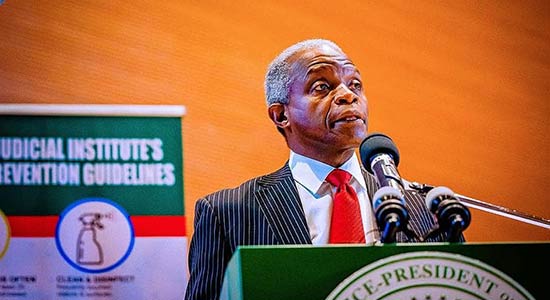
Former Vice President, Prof. Yemi Osinbajo, SAN, has called for a fundamental shift in Nigeria’s justice reform agenda, urging stakeholders to redesign the system around the needs and everyday experiences of citizens rather than the convenience of institutions.

Osinbajo made the call on Tuesday during a panel session at the ongoing 66th Annual General Conference of the Nigerian Bar Association in Port Harcourt, Rivers State.
He was represented at the session by former Attorney-General and Commissioner for Justice of Lagos State, Ade Ipaye.
According to the former Vice President, a people-centred justice system would strengthen governance, improve transparency within the legal profession and provide better protection for Nigerians.
He argued that meaningful reform must be based on evidence, clear priorities and local ownership, stressing that stakeholders should begin by gathering reliable data on citizens’ justice needs, how cases are resolved and the actual outcomes produced by the system.
“What is measured is what gets funded and fixed,” Osinbajo said.
He identified pre-trial detention, small claims, first-response mechanisms and legal assistance as areas where reforms could produce significant and immediate benefits.
According to him, achieving early successes in such areas could help generate public and institutional support for more difficult and far-reaching reforms.
Osinbajo further maintained that justice reforms would have greater prospects of success when domesticated by state governments and embedded within permanent institutions rather than treated solely as programmes of a particular administration.
He challenged the Nigerian Bar Association and the wider legal profession to take a leading role in shaping policy, strengthening professional development and promoting reforms capable of widening access to justice without compromising professional quality and ethical standards.
The former Vice President specifically urged the NBA to promote continuous professional development in mediation, legal aid, legal technology and community justice.
He also called on the Association to assist in gathering data on the justice needs of Nigerians and advocate improved funding for the justice sector.
Osinbajo identified pro bono legal services as one of the most powerful tools available to the profession for expanding access to justice, particularly for citizens who cannot afford private legal representation.
He argued that given the size of Nigeria’s legal profession, lawyers could collectively create a significant nationwide legal aid mechanism if they took their pro bono responsibilities more seriously.
According to him, the central question facing the country was no longer whether the justice system required reform, but whether those responsible for the system were prepared to redesign it from the perspective of the people who depend on it.
“The people-centred approach asks us to move from abstraction to reality, from system convenience to citizen need, from exclusive pathways to inclusive ones,” he said.
Osinbajo urged stakeholders to stop viewing justice merely as an institutional process administered by courts and government agencies, describing it instead as “a living public good” whose effectiveness should be measured by the experiences of ordinary people.
He recalled the historical role played by Nigerian lawyers in the struggle for independence and resistance to military rule, saying the present generation of legal practitioners had a similar responsibility to ensure that the law remained an instrument for protecting and serving citizens.
“It falls to our generation today to prove that law can give service to the people, all of the people,” he said.
Osinbajo maintained that placing citizens at the centre of justice delivery would not only make the legal system more accessible but also strengthen government institutions and make the legal profession more accountable and transparent.
He said a justice system capable of responding effectively to the needs of citizens would ultimately benefit government, lawyers and the wider society.
“That surely is in everyone’s interest,” he added.
[A MUST HAVE] Evidence Act Demystified With Recent And Contemporary Cases And Materials

Available now for NGN 40,000 at ASC Publications, 10, Boyle Street, Onikan, Lagos. Beside High Court, TBS. Email publications@ayindesanni.com or WhatsApp +2347056667384. Purchase Link: https://paystack.com/buy/evidence-act-complete-annotation
______________________________________________________________________ “Enhance Legal Practice With Authoritative Reports” — Alexander Payne Offers Comprehensive Law Reports, Spanning Over A Century Of Nigerian Jurisprudence Interested buyers are encouraged to place their orders and enquiries via:
0704 444 4777, 0704 444 4999, 0818 199 9888
Website: www.alexandernigeria.com
Interested buyers are encouraged to place their orders and enquiries via:
0704 444 4777, 0704 444 4999, 0818 199 9888
Website: www.alexandernigeria.com