
Islamic cleric Sheikh Ahmad Gumi has defended the use of public funds to facilitate marriages in states operating under Shariah law, arguing that such intervention constitutes a legitimate and responsible component of governance where relationships outside marriage are prohibited by religious and state laws.


Gumi made the argument in a statement shared on Facebook amid public debate over the Kano State Government’s recent mass wedding programme involving 1,500 couples.
According to the Kaduna-based Islamic scholar, governments operating within a Shariah framework have a responsibility to respond to social conditions created by laws prohibiting prostitution, fornication, adultery and promiscuity.
He maintained that where those forms of sexual relationships are prohibited, government assistance to people who genuinely need to marry but lack the means to do so should not be regarded as an improper use of public resources.
“In a Shariah law-driven state, where prostitution, fornication, adultery, and promiscuity are prohibited by both divine and state laws, using public funds to facilitate the marriage of women who are in excess of the available pool of eligible men, or of any young person in dire need of marriage, is a legitimate and responsible component of good governance,” Gumi said.
The cleric argued that supporting marriage should be considered within the wider social responsibilities of government in societies governed by Shariah principles.
He particularly identified young people in urgent need of marriage and women facing limited opportunities to secure suitable spouses as categories that could legitimately benefit from government intervention.
Gumi’s comments followed criticism and public discussion surrounding the Kano State Government’s mass wedding programme, popularly known as “Auren Gata.”
Under the initiative, 1,500 couples were joined in marriage at a ceremony organised by the Kano State Hisbah Board as part of the state government’s social intervention programme.
The mass wedding was designed to assist vulnerable couples who may otherwise struggle with the financial costs associated with marriage.
Beyond facilitating the marriages themselves, the programme is intended to provide economic and household support to beneficiaries as they begin married life.
The ceremony, held last Friday, subsequently generated debate over whether public funds should be deployed to finance or support private marriage arrangements.
Some critics questioned the propriety of committing state resources to such programmes, while supporters have defended the initiative on religious and social welfare grounds.
Responding to the controversy, Gumi said the policy should be assessed within the legal, religious and social framework of a state operating under Shariah rather than considered in isolation.
His position is that where the state prohibits particular forms of sexual conduct and seeks to promote marriage as the lawful alternative, assisting citizens who are unable to bear the financial burden of marriage can reasonably form part of government social policy.
He therefore rejected the suggestion that the use of public funds for such purposes was inherently inappropriate, maintaining instead that facilitating lawful marriages for people in genuine need could amount to responsible governance.
Gumi’s intervention adds to the continuing debate over Kano’s mass wedding initiative and the broader question of how far governments in Shariah-operating states should use public resources to support marriage and other programmes intended to address social and religious concerns.
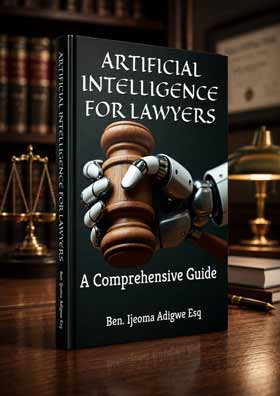 The book also examines Nigeria's legal ecosystem, focusing on the LPELR and NBA AI Guidelines. As a bonus, every purchase comes with a FREE eBook titled: How to Use the AI Features in LegalPedia and LawPavilion.
Ohio Books Ltd praises the publication, stating:
"....this is the only Nigerian book I know of on the topic."
How to Order:
📞 Call, Text, or WhatsApp: 08034917063 | 07055285878
📧 Email: benadigwe1@gmail.com
🌎 Website: www.benadigwe.com
Ebook Version: Access it directly online at https://selar.com/prv626
Authored by Ben Ijeoma Adigwe Esq., ACIarb (UK), LL.M, Dip. in Artificial Intelligence, Director at the Delta State Ministry of Justice, Asaba, Nigeria.
_______________________________________________________________________
The book also examines Nigeria's legal ecosystem, focusing on the LPELR and NBA AI Guidelines. As a bonus, every purchase comes with a FREE eBook titled: How to Use the AI Features in LegalPedia and LawPavilion.
Ohio Books Ltd praises the publication, stating:
"....this is the only Nigerian book I know of on the topic."
How to Order:
📞 Call, Text, or WhatsApp: 08034917063 | 07055285878
📧 Email: benadigwe1@gmail.com
🌎 Website: www.benadigwe.com
Ebook Version: Access it directly online at https://selar.com/prv626
Authored by Ben Ijeoma Adigwe Esq., ACIarb (UK), LL.M, Dip. in Artificial Intelligence, Director at the Delta State Ministry of Justice, Asaba, Nigeria.
_______________________________________________________________________
“Order Justice Omolaye-Ajileye’s Electronic Evidence Books Now” — Essential Guides On Evidence Act, Case Law And Digital Proof
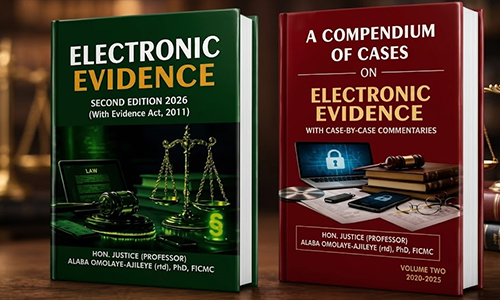
 Interested buyers are encouraged to place their orders and enquiries via:
0704 444 4777, 0704 444 4999, 0818 199 9888
Website: www.alexandernigeria.com
Interested buyers are encouraged to place their orders and enquiries via:
0704 444 4777, 0704 444 4999, 0818 199 9888
Website: www.alexandernigeria.com