Nigeria is seeking to expand local cloud infrastructure to reduce the cost of digital services, limit capital outflows and create jobs as the government pushes to strengthen the country’s digital economy.


The National Information Technology Development Agency is working with local data centre operators and global cloud providers to increase domestic cloud capacity under a new National Sovereign Cloud initiative, NITDA Director-General Kashifu Inuwa said.
Inuwa said more than 85 per cent of Nigeria’s workloads currently run on public cloud platforms, with much of the infrastructure hosted outside the country.
The government wants global cloud providers to invest in local infrastructure rather than simply serve Nigerian customers remotely, he said.
“Our goal is not to take away the public cloud. It’s to get hyperscalers to localise,” Inuwa said in an interview.
The initiative is intended to build domestic capacity for what NITDA describes as digital self-determination, while ensuring that critical data and services can continue operating during disruptions to international connectivity.
Nigeria’s reliance on overseas cloud infrastructure also means that businesses and consumers can be exposed to foreign-currency costs, Inuwa said.
NITDA and Galaxy Backbone are working on a memorandum of understanding aimed at making cloud services cheaper for startups and allowing them to pay in naira, according to Inuwa.
He said greater local competition should also put downward pressure on prices as more providers build capacity in the Nigerian market.
“Right now, lack of competition means hyperscalers set their own price,” Inuwa said. “With local competition and capacity, prices will naturally drop.”
The push comes after Nigeria introduced a Cloud First policy in 2019 to discourage government ministries, departments and agencies from building separate data centres and instead encourage them to use cloud services.
According to Inuwa, the policy succeeded in shifting government and private-sector workloads towards cloud computing but also exposed a weakness: many organisations moved directly to international public cloud platforms rather than helping develop local infrastructure.
NITDA subsequently brought international hyperscalers and Nigerian data centre operators together to discuss the barriers to localising cloud infrastructure. A technical working group comprising both groups was established in November 2024.
The process has resulted in three guidelines covering data classification and cloud policy, minimum requirements for cloud service providers, and digital quality assurance, Inuwa said.
The sovereign cloud initiative is not intended to exclude international technology companies, he said, but to encourage them to establish and expand infrastructure in Nigeria.
“For us, the sovereign cloud is not about protectionism or shutting out big cloud providers. It’s about asking them to come and build with us in Nigeria,” Inuwa said.
The government also plans to develop a more resilient national cloud infrastructure, including multiple locations that can serve as backups if one facility or network connection fails.
Inuwa said the strategy could position Nigeria as a digital gateway for West and Central Africa while reducing the vulnerability of critical services to disruptions such as submarine cable cuts.
For consumers, the government expects greater local cloud capacity to eventually reduce the foreign-currency component of digital services and support more locally produced content.
Inuwa compared the planned infrastructure to refineries, saying Nigeria could retain more value from its growing digital consumption by hosting and producing services domestically.
“Imagine paying for all those platforms in naira, with no capital flight,” he said. “Imagine jobs being created in Nigeria.”
The initiative forms part of a broader six-pillar strategy covering policy and regulation, funding and investment, infrastructure, digital skills, innovation and local content, and cybersecurity and digital trust.
NITDA is also seeking to encourage investment in local infrastructure through incentives and financing, while government agencies would create demand for domestic cloud providers through procurement and compliance requirements.
Inuwa said the government could consider measures including subsidised capacity, procurement preferences and tax incentives, although some of those decisions would require action by other regulators.
The policy does not mean Nigerian government agencies will be prohibited from using international public cloud platforms. Inuwa said the existing Cloud First policy remains in force, but the government’s objective is to increase the amount of cloud infrastructure located within Nigeria.
“We have a strategy with six pillars,” Inuwa said. “The big picture is to build a digital triangle in Nigeria for resilience and service assurance.”
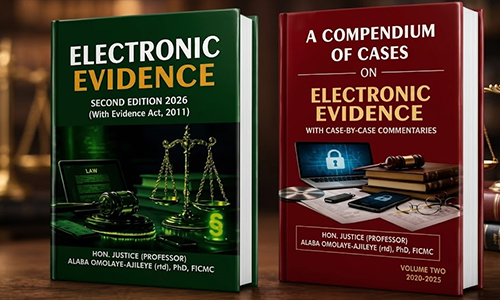
 Interested buyers are encouraged to place their orders and enquiries via:
0704 444 4777, 0704 444 4999, 0818 199 9888
Website: www.alexandernigeria.com
Interested buyers are encouraged to place their orders and enquiries via:
0704 444 4777, 0704 444 4999, 0818 199 9888
Website: www.alexandernigeria.com

 The book also examines Nigeria's legal ecosystem, focusing on the LPELR and NBA AI Guidelines. As a bonus, every purchase comes with a FREE eBook titled: How to Use the AI Features in LegalPedia and LawPavilion.
Ohio Books Ltd praises the publication, stating:
"....this is the only Nigerian book I know of on the topic."
How to Order:
📞 Call, Text, or WhatsApp: 08034917063 | 07055285878
📧 Email: benadigwe1@gmail.com
🌎 Website: www.benadigwe.com
Ebook Version: Access it directly online at https://selar.com/prv626
Authored by Ben Ijeoma Adigwe Esq., ACIarb (UK), LL.M, Dip. in Artificial Intelligence, Director at the Delta State Ministry of Justice, Asaba, Nigeria.
_______________________________________________________________________
The book also examines Nigeria's legal ecosystem, focusing on the LPELR and NBA AI Guidelines. As a bonus, every purchase comes with a FREE eBook titled: How to Use the AI Features in LegalPedia and LawPavilion.
Ohio Books Ltd praises the publication, stating:
"....this is the only Nigerian book I know of on the topic."
How to Order:
📞 Call, Text, or WhatsApp: 08034917063 | 07055285878
📧 Email: benadigwe1@gmail.com
🌎 Website: www.benadigwe.com
Ebook Version: Access it directly online at https://selar.com/prv626
Authored by Ben Ijeoma Adigwe Esq., ACIarb (UK), LL.M, Dip. in Artificial Intelligence, Director at the Delta State Ministry of Justice, Asaba, Nigeria.
_______________________________________________________________________
“Order Justice Omolaye-Ajileye’s Electronic Evidence Books Now” — Essential Guides On Evidence Act, Case Law And Digital Proof