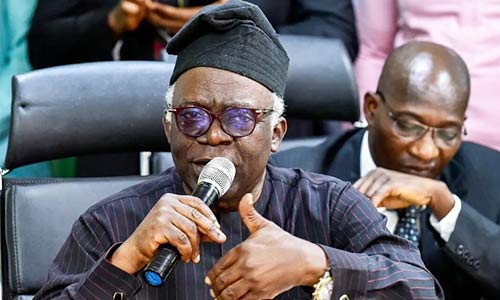
Human rights lawyer and Senior Advocate of Nigeria, Femi Falana, SAN, has said that the Economic and Financial Crimes Commission did not act illegally in restricting an account of the Osun State Government, and that the power of the Commission to freeze the account of any tier of government, subject to obtaining an order of court within 72 hours, has been settled by both the Court of Appeal and the Supreme Court.

Falana spoke on Channels Television’s Politics Today, where he also said that the intervention President Bola Tinubu made by public directive ought properly to have been made through the Attorney-General of the Federation under Section 174 of the Constitution, there being no legal nexus between the presidency and the office of the Commission’s chairman.
Asked whether the process the Commission followed was lawful and constitutional, the senior advocate answered without qualification.
“Well, as far as the law is concerned, the EFCC has not acted illegally,” he said. “As a matter of fact, that came out in the statement of the President, that whereas I am not questioning your mandate and the exercise of your power, however, I am embarrassed.”
He stated the extent of the power. “Under the law, the EFCC has the power to freeze the account of the federal government or of any state or local government in Nigeria.”
Falana traced the position to the litigation between the Attorney-General of Benue State and the Commission.
“This matter was settled in the case of Attorney-General of Benue State and EFCC in 2022. It arose in 2019. The Federal High Court in that state, in Benue State, held that the EFCC lacked the power to freeze the account of the state and awarded N50 million damages against the EFCC.”
He continued: “The EFCC went to court and in a judgment delivered, I think it is September 2022, the Court of Appeal held that the EFCC has the power to freeze the account of that state and place a PND of not more than 72 hours before obtaining a court order. That remains the law in Nigeria today.”
He then turned to the wider question of whether the anti-corruption agencies may probe state accounts at all.
“In 2024, the Kogi State government, joined by many state governments, challenged the investigation, the probing of state accounts, by EFCC, ICPC or NFIU. And in a historic judgment, the Supreme Court examined all the relevant laws and came to the conclusion that these agencies have the power to probe the accounts of any [government], be they federal or state. That remains the law.”
He recalled an earlier round of the same argument. “If you must know, when the ICPC was established in the year 2000, state governments challenged its legality: you have no business to arrest anybody in our state, you have no business to interfere or probe money we have received from Abuja. The Supreme Court said no. That was in the year 2002 when the case was decided. In this case, the Supreme Court in 2024 reviewed all the cases and rejected all the arguments of the state governments.”
Falana said the remedy for those dissatisfied with the current position is legislative rather than rhetorical.
“If Nigerians, those who are concerned, want the law changed, they can go to the National Assembly. But for now, as of today, the EFCC has the power to freeze the account of any state and in not more than 72 hours has to go to court.”
He noted that the Commission met that requirement in this case. “In this instance, the EFCC went to court, and the Federal High Court intervened based on information provided by the EFCC.”
He returned to the point later: “Anybody dissatisfied by the decisions of the court, [the course], the way it is done in all countries that proclaim to operate under the rule of law, is to ask for amendment of the law.”
The senior advocate drew a distinction between the ground of the President’s objection and the ground of the suit now filed.
“The President referred to the order obtained by the EFCC. And as it should be done, the state government has challenged the legality, the validity of the order, not the timing,” he said.
Falana warned against an emerging notion that enforcement must pause as polls approach.
“Because we must also be very careful that we don’t give a dangerous impression that when elections are 10 days away, 20 days away, 30 days away, the anti-graft agencies must turn the other eye. Don’t look at the state or the federal government. And so if funds are being moved to the tune of billions of naira, don’t look at them. I mean, don’t look at those funds because elections are coming. It is a very dangerous impression that is being created.”
On the President’s intervention, the senior advocate said the objective was legitimate but the route was wrong.
“In this particular instance, we engage in a lot of diversionary measures all over the place. It is a very simple and straightforward matter. The embarrassment alluded to by the President would have been handled by the Attorney-General of the Federation.”
He set out what the President’s position amounted to. “Because what the President said is that you have not exercised your power [illegally], you have a court order. However, I am being accused of manipulating federal agencies in a state. Therefore, go to court and see how you can have the order vacated. Again, that is the duty of the Attorney-General.”
He described the proper sequence. “In this case, the President of Nigeria would have advised the Attorney-General of the Federation: I am disturbed by the development in [Osun] State, please can you take over the case? And the Attorney-General would have exercised his powers under Section 174 of the Constitution of Nigeria by taking over the case.”
On what would follow, he said: “Upon taking over the case, the Attorney-General will either announce to the court, my lord, I have taken over this case, I want to withdraw this case; or, my lord, we have had a second look at this case based on representations made by Osun State Government, we want to withdraw this case; or, since the Osun State Government has challenged the order, my lord, we are conceding that this order should be vacated.”
He added a rider on the effect of such a step. “But again, the Attorney-General will tell the EFCC: what I have done is to vacate the order, but go on and ensure that you monitor and do your work. Because again the courts have held that neither the EFCC nor the ICPC nor the NFIU can be prevented from investigating allegations of corruption, money laundering and looting of the treasury in this country.”
Put to him that routing the instruction through the Attorney-General merely changes the channel of presidential intervention rather than removing it, and that Section 174 concerns criminal proceedings, Falana said the principle at stake is legality of form.
“The point I am making is this, and this is not the first time. In many instances the Attorney-General of the Federation has intervened, either to take over a case being prosecuted by the EFCC or the ICPC, and he has the last say. That is what the Constitution says.”
He continued: “What I am insisting on is that we must learn. Once you say your country operates under the rule of law, every action of government, every action of the President, or the EFCC chairman, or the ICPC chairman, a governor of a state, a chairman of a local government, must be in accordance with the rule of law. In every action, what does the law say? We are talking of the EFCC. Did you observe the provisions of the law? It didn’t go beyond 72 hours. The EFCC got a court order. Now the President wanted to intervene. All I am saying is that it has to be done legally.”
He identified the constitutional bridge. “And the only legal way known to the rule of law is through the office of the Attorney-General, because there is no legal nexus between the presidency and the office of the chairman of the EFCC. But there is one under Section 174 of the Constitution, whereby the Attorney-General can intervene in any case, whether it is a corruption case or not.”
He noted the limits of any challenge to that power. “It is now left for the public to challenge the Attorney-General: you have exercised your powers having regard to the circumstances of a case. It is very rare that the power of the Attorney-General to enter a nolle prosequi, to terminate a case, can be challenged. Only members of the public can do it. Not even the President.”
He emphasised his choice of words. “But the point I have made here, the President can advise. That is why I use the word advising. The President can advise the Attorney-General: an order has been obtained by the EFCC, can you work with the chairman of the EFCC to see what can be done, because I am embarrassed, people are alleging that I am using federal agencies to manipulate the election in Osun State. And that is the issue.”
Asked directly whether the President or those who advised him had committed a political error, Falana separated the political from the legal.
“I think the President is a politician. He acted politically. I am a lawyer and I am speaking legally. In other words, I would have preferred [that] the President ought to have advised the Attorney-General to do the needful in the circumstance, having regard to the embarrassment complained of by the President. And I think lessons are being drawn and learned on our side.”
The senior advocate said the issue that troubles him most as a human rights lawyer has been left out of the national conversation.
“For me, the most serious issue as a human rights person, that is not being addressed by Nigerians, and I have almost shouted myself [hoarse], is that in the last few weeks not less than 30 people, human beings, have been killed in Osun State, politically motivated killings.”
He added: “I am not aware that any of the criminal elements involved in killing people have been charged before the court. And if you don’t arrest them within the next few days and put them behind bars, they are going to be on the prowl to kill more people before or even during the election.”
Asked why the Commission moved against the source account rather than tracing the suspicious transfers, identifying the corporate recipients and seeking targeted orders against those destination accounts, Falana said no agency may paralyse the functions of a state, but noted the limited scope of what was done.
“Nobody can support any agency, whether of the federal government or of a state, [interfering with] the functions of any state government. But mind you, from the information at the disposal of the public, only one account was involved, not all the accounts of the state government.”
He framed the open question for the country. “Once the court has ruled that the EFCC has the power to stop the criminal diversion of public funds, whether elections are going to take place tomorrow or in 10 days’ time, that is what Nigerians may have to review: at what stage can the EFCC, the ICPC or even the police stop investigating allegations of criminal diversion of public funds? That is what has not been stated.”
Falana said the states have misconceived the character of the Commission, and he laid part of the blame at their door.
“This is where I blame state governments. The EFCC, according to the Supreme Court, is not an agency of the federal government. It is an agency of the federation. And according to the Supreme Court, in a situation where we operate cooperative federalism, these agencies are to be controlled by the federal, state and local governments.”
He drew a parallel with policing. “It is like the police powers. Instead of controlling police powers in line with the provisions of the Constitution, by the President, the governors and the Inspector-General, the governors have abdicated police powers to the President. They are now talking of state police.”
He set out the test he would apply. “So we must look at the powers of each agency of government under the Constitution. We must look at the power of every agency of government created outside the Constitution, and find out at all times, have they exceeded their powers? Once you come to the conclusion that the agency has not exceeded its power, if you then want to amend the law to take care of, oh, elections are 10 days away, [that] once elections are 10 days away this agency must not investigate allegations of criminal diversion of public funds, until you do that, it will be difficult to fault the EFCC in this instance.”
He added one qualification. “Unless it can be shown at the end of the day that there was no basis whatsoever for the EFCC to have approached the court in this instance, then I will join those who are blaming the EFCC for exceeding its powers. And I am happy the Osun State government has gone to court.”
Told that the Osun State Government’s suit relies on Section 162 of the Constitution and argues that the affected statutory allocation account is used to discharge government obligations including salaries and public services, Falana said those arguments have already been made and rejected.
“These arguments were adduced in the case of the Attorney-General of Kogi State and [others] against the Attorney-General of the Federation. In fact, the totality of the argument of the state governments was hinged on Section 162: money already distributed, no agency of the federal government can interfere in the management of it. The Supreme Court reviewed several cases and rejected all the arguments of the state governments.”
On the nature of the order in dispute, he said: “If you are saying the order obtained by the EFCC is likely to [affect] the activities of the government, you rush to court. And that is why it was an interim order. The court will never give a permanent order in such a circumstance. Let the state government come and show to the court why this order will be retained or why the order will not be required. And that is what is done in line with the rule of law.”
He said the litigation is to be welcomed. “So happily, Osun State government has gone to court asking for damages of two billion naira. I expect the EFCC to respond to the case. It is in the interest of the EFCC and Osun State government and other state governments in Nigeria to have that case determined one way or the other, so that the EFCC can go to court and say, this is the basis of our intervention. The court will then look at it and say, oh, you acted properly, you didn’t act properly, two billion should be awarded or should not be awarded, because the state government can in fact be penalised if there is no basis for the action.”
Asked about suspicions that no court order exists, and about the state’s complaint that it was never served, Falana said service is a duty on the Commission and a matter the state can pursue.
“When an order is made against you, you have the right, in fact the duty, to ensure that you get the order. The EFCC has a duty to serve a certified true copy of the order on the Attorney-General of Osun State.”
He continued: “Osun State Government has gone to court, and I also expect that the Osun State Government will find out which court issued the order and then file an application to vacate the order. But with the advice, or the directive, of the President, I expect that by now the EFCC is likely to have applied to the court to have the order vacated. That is my understanding.”
He added: “The court, [the Commission], ought to have served the processes on the Osun State Government. But if they have not been served, and having regard to the public nature of this matter, the Attorney-General of the state, I am sure, will also have taken steps to obtain the processes.”
While defending the legality of the action, the senior advocate acknowledged the force of the questions being asked about its timing and its optics.
He noted the concern that “every action taken by the EFCC now will be seen from the optics of politics,” and asked: “Why did the EFCC wait until 10 days before the election for an investigation that they said started in March? What were they looking at? Why did they wait this long?”
He then stated the Commission’s own answer and where it leaves the parties. “If they are claiming that between the 2nd of August and two days ago the movement of money in that particular account became suspicious, they rushed to court, the court intervened. The ball is now in the court of the state government to come to court and say, my lord, we withdrew these funds because of exigencies, we are fixing a road, we need to pay contractors, and we didn’t withdraw the money for elections, because you are not the [body] conducting the election. And so if there are logistics that will be involved in the election, you have to convince the court.”
Falana said the lasting remedy is institutional strength rather than presidential intervention, and he pointed to the United States by way of comparison.
“I think we need to look at our agencies and see how we can strengthen them so that they can discharge their duties in the interest of the country, and not to suit the interest of the government in power. And that is the essence of [a real] democracy, that institutions will act whether the President is happy or not.”
He continued: “We must perhaps look at what is going on in the United States of America. Every action of President Trump is challenged. Even today the Court of Appeal has just ruled that he has no business [modifying] the White House to suit his own prejudices. Without the intervention of the courts in America, President Trump would have turned that country into a banana republic.”
He put a figure to it. “President Trump, who believes he can do and undo, is being told by the court regularly, regularly, you have no powers, your executive [orders] are illegal. Not once, not twice. Over 150 court orders in the last three years or thereabout.”
He drew the conclusion for Nigeria. “So we must also get to that stage in our country where we strengthen the EFCC, the ICPC, the NFIU, the Nigeria Police Force and others, in a way that they will act always in the interest of the public, whether the elections are 24 hours away, or 36, or 10 days, or one month. We must ensure that nobody takes advantage of the circumstances in which a state might find itself, or even the federal government, to then say, oh, they have said we should not act 10 days to the election, therefore we will not do anything, we fold our arms, the ICPC will not do anything, the EFCC will not do anything, because elections are 10 days [away].”
He added the corresponding obligation. “Whereas the duty is also on state governments and the federal government that we do not toy with the funds of government meant for public service. I think this is the whole thing.”
Falana welcomed the fact that the Osun State Government has not discontinued its suit following the presidential directive.
“The government has gone to court, and it is good that the government is not saying, oh, because the President has intervened, therefore we are going to drop [it]. No. State government must be encouraged [to seek a judicial] conclusion.”
He offered a prediction on the likely outcome. “But I can assure you that the Federal High Court judge that will determine this case is likely to say, I am bound by the judgment of the Court of Appeal that [the EFCC] can freeze any account on its own and in not more than 72 hours obtain a court order to validate it, [and by] the Supreme Court judgment that says the EFCC, the NFIU and the ICPC are empowered to probe the accounts of all authorities in Nigeria. That is where we are.”
Invited to close the programme with the lessons and the way forward, the senior advocate said the matter must now be resolved judicially.
“I think the way forward is for the EFCC to join issues with the Osun State Government. The state government has gone to court, and this is the way it should be done in any civilised society. The ball is now in the court of the EFCC to react to the case and show the public and the court of law the basis of its intervention. And when that is done it will be clear to the court whether the EFCC acted properly or improperly. For me, I think that is the way it should go.”
He ended with the point he had pressed throughout. “And next time, as I said, the Attorney-General of [the Federation] should have advised the President to intervene in the matter.”
[A MUST HAVE] Evidence Act Demystified With Recent And Contemporary Cases And Materials

Available now for NGN 40,000 at ASC Publications, 10, Boyle Street, Onikan, Lagos. Beside High Court, TBS. Email publications@ayindesanni.com or WhatsApp +2347056667384. Purchase Link: https://paystack.com/buy/evidence-act-complete-annotation
______________________________________________________________________ “Enhance Legal Practice With Authoritative Reports” — Alexander Payne Offers Comprehensive Law Reports, Spanning Over A Century Of Nigerian Jurisprudence Interested buyers are encouraged to place their orders and enquiries via:
0704 444 4777, 0704 444 4999, 0818 199 9888
Website: www.alexandernigeria.com
Interested buyers are encouraged to place their orders and enquiries via:
0704 444 4777, 0704 444 4999, 0818 199 9888
Website: www.alexandernigeria.com