The Rule of Law and Accountability Advocacy Centre has instituted four fundamental-rights enforcement suits before the High Court of Imo State in Owerri over allegations of torture, arbitrary arrest, prolonged detention, forced labour, extortion, unlawful shooting and the disappearance of infants involving officers attached to the Anti-Kidnapping Unit of the Imo State Police Command, popularly known as Tiger Base.

The suits, filed on July 21, 2026, by RULAAC’s lead counsel, Chinedu Agu, were brought on behalf of eight applicants who are asking the court to examine alleged violations of their constitutionally guaranteed rights.
The four matters, numbered HOW/474/2026, HOW/475/2026, HOW/476/2026 and HOW/477/2026, were formally fixed for hearing before the court on Wednesday, August 5, 2026.
The respondents include the Nigeria Police Force, the Inspector-General of Police, the Police Service Commission, the Commissioner of Police in Imo State, the Commander of the Anti-Kidnapping Unit, ACP Oladimeji Odeyeyiwa, and other officers attached to the unit.
The allegations contained in the court processes have not been determined by the court, while the respondents are entitled to challenge the claims and present their defence.
In Suit No. HOW/475/2026, instituted on behalf of Onyebuchi Anyanwu, Chinenye Obi and Nkechinyere Ogu, the applicants alleged that women were arrested because of their relationships with men suspected of criminal activities and subsequently detained for extended periods.
According to the court documents, Onyebuchi was arrested in 2023 alongside her three children—Peculiar, aged five; Ihuoma, aged eight; and Onyinyechi, aged three—over allegations that her husband had links with the Indigenous People of Biafra and the Eastern Security Network.
She alleged that the children were taken away from her shortly after she arrived at the Tiger Base facility and that the police had failed to disclose their whereabouts, welfare or present custody by the time the suit was filed.
Chinenye also alleged that she was arrested alongside her son, who was one year and nine months old, but was separated from the child after arriving at the facility.
The applicants are asking the court to declare that the removal of the four children from their mothers and the alleged continuing failure to disclose their whereabouts constitute violations of the dignity and family rights of the women and their children.
They are also seeking ₦200 million in general, aggravated and exemplary damages over the alleged removal and disappearance of the children.
The applicants further alleged that the detained women were subjected to forced labour daily between 6 a.m. and 6 p.m.
The court processes alleged that they were compelled to wash officers’ clothes, carry stones and sand, undertake construction work, prepare meals for hundreds of detainees and clean or cover blood allegedly belonging to executed inmates.
They are asking the court to hold that compelling them to perform such duties amounted to forced labour, servitude and degrading treatment prohibited by Section 34 of the 1999 Constitution.
The women also claimed that they were held incommunicado from late 2023 until they were formally arraigned on December 16, 2025.
Suit No. HOW/474/2026 was filed on behalf of Chinaza Ifeanyi, Munachi Ifeanyi and Chidera Onyemuwa.
Chinaza alleged that she was arrested while nursing her two-month-old baby and was separated from the infant without any explanation from the officers involved.
She further claimed that she was physically assaulted, compelled to sign statements she did not prepare, deprived of her belongings and subjected to other forms of degrading treatment.
The applicant also alleged that officers used her seized Automated Teller Machine card to withdraw ₦30,000 from her bank account without her authorisation.
She and the other applicants in the suit maintained that they were arrested because of their relationships with persons the police were seeking rather than because they had committed any offence.
In Suit No. HOW/476/2026, Ngozi Ogbonna, a resident of Olokoro in Umuahia South Local Government Area of Abia State, alleged that she was unlawfully detained at the Tiger Base facility from December 12, 2024, until December 16, 2025.
Ogbonna claimed that she was struck with a walking stick, machete, belt and pistol, resulting in a bleeding head injury.
She further alleged that officers forced her to strip naked, threatened to apply pepper to her eyes and private parts and failed to provide appropriate medical attention when she suffered internal bleeding.
She is asking the court to declare that the alleged acts violated her right to dignity under Section 34 of the Constitution and Article 5 of the African Charter on Human and Peoples’ Rights.
Ogbonna is also seeking an order directing the Police Service Commission to investigate every officer allegedly implicated in her torture, sexual humiliation, denial of medical care, forced labour and prolonged detention.
She is demanding ₦100 million in general, aggravated, exemplary and public-law damages.
The fourth action, Suit No. HOW/477/2026, was filed on behalf of Kenneth Anyanwu, a trader and father of 11 children from Ihitte-Afoukwu in Ahiazu Mbaise Local Government Area of Imo State.
Anyanwu alleged that he was shot in the abdomen from behind on April 13, 2026, by an officer identified in the court processes as Chinedu Iwueke.
He claimed that he was unarmed and attempting to leave the scene of a police operation when the officer shot him, causing his intestines to protrude from his abdomen.
The applicant is asking the court to declare that the alleged shooting amounted to an unlawful use of force and an attempted deprivation of his constitutionally protected right to life.
He further alleged that officers chained his legs despite his life-threatening injury and denied him immediate access to medical treatment.
Anyanwu is seeking a declaration that the alleged treatment constituted torture and degrading treatment.
He is also asking the court to direct the police to refund ₦47,000 allegedly taken from him during his arrest and reimburse all medical expenses he incurred while treating the gunshot injury.
The trader is seeking ₦500 million in general, aggravated, exemplary and public-law damages for the alleged violation of his fundamental rights.
The known monetary claims contained in three of the four suits amount to at least ₦800 million, excluding the refund, medical expenses and any additional damages sought in the remaining action.
RULAAC said the suits are supported by sworn affidavits from the applicants, documentary materials and investigative reports concerning allegations previously made against the Tiger Base unit.
Commenting on the cases, RULAAC Executive Director, Okechukwu Nwanguma, said the proceedings presented an opportunity for the judiciary to examine longstanding allegations of police brutality and institutional impunity through sworn evidence.
“For years, the Tiger Base Unit has featured prominently in allegations by victims, families and human rights organisations of torture, prolonged detention without trial, enforced disappearances and other serious abuses,” Nwanguma said.
“These proceedings provide the first opportunity for many of those allegations to be rigorously examined through sworn evidence before a court of law.”
He maintained that independent judicial scrutiny was essential to rebuilding public confidence in policing and enforcing the constitutional principle that no public officer or institution is above the law.
“Justice for victims of torture and unlawful detention is indispensable to rebuilding public confidence in policing and reaffirming that no institution or public official is above the Constitution,” he added.
Nwanguma described the hearing of the four suits as a test of Nigeria’s commitment to justice, accountability and the rule of law.
 Interested buyers are encouraged to place their orders and enquiries via:
0704 444 4777, 0704 444 4999, 0818 199 9888
Website: www.alexandernigeria.com
Interested buyers are encouraged to place their orders and enquiries via:
0704 444 4777, 0704 444 4999, 0818 199 9888
Website: www.alexandernigeria.com

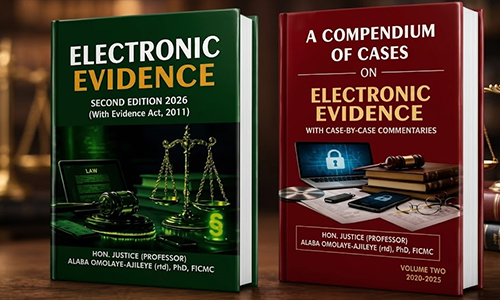
“Order Justice Omolaye-Ajileye’s Electronic Evidence Books Now” — Essential Guides On Evidence Act, Case Law And Digital Proof
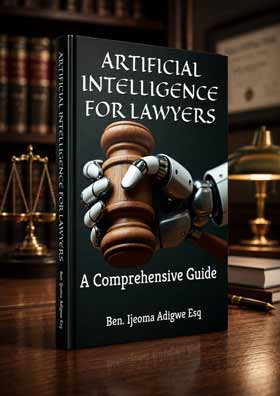 The book also examines Nigeria's legal ecosystem, focusing on the LPELR and NBA AI Guidelines. As a bonus, every purchase comes with a FREE eBook titled: How to Use the AI Features in LegalPedia and LawPavilion.
Ohio Books Ltd praises the publication, stating:
"....this is the only Nigerian book I know of on the topic."
How to Order:
📞 Call, Text, or WhatsApp: 08034917063 | 07055285878
📧 Email: benadigwe1@gmail.com
🌎 Website: www.benadigwe.com
Ebook Version: Access it directly online at https://selar.com/prv626
Authored by Ben Ijeoma Adigwe Esq., ACIarb (UK), LL.M, Dip. in Artificial Intelligence, Director at the Delta State Ministry of Justice, Asaba, Nigeria.
_______________________________________________________________________
The book also examines Nigeria's legal ecosystem, focusing on the LPELR and NBA AI Guidelines. As a bonus, every purchase comes with a FREE eBook titled: How to Use the AI Features in LegalPedia and LawPavilion.
Ohio Books Ltd praises the publication, stating:
"....this is the only Nigerian book I know of on the topic."
How to Order:
📞 Call, Text, or WhatsApp: 08034917063 | 07055285878
📧 Email: benadigwe1@gmail.com
🌎 Website: www.benadigwe.com
Ebook Version: Access it directly online at https://selar.com/prv626
Authored by Ben Ijeoma Adigwe Esq., ACIarb (UK), LL.M, Dip. in Artificial Intelligence, Director at the Delta State Ministry of Justice, Asaba, Nigeria.
_______________________________________________________________________