A coalition of 90 Nigerian, African and international civil society and human rights organisations has called on the National Assembly to immediately withdraw the proposed Foreign Aid (Regulation, Coordination, Transparency and Disclosure) Bill, 2026, and other pending legislative proposals it described as repressive.


The coalition warned that the passage of the bills could accelerate democratic decline, weaken civic participation and erode constitutional freedoms ahead of the 2027 general elections.
The Foreign Aid Bill, sponsored by Senator Ibrahim Hassan Dankwambo, seeks to establish a comprehensive legal framework for regulating foreign aid in Nigeria. It proposes the creation of a Foreign Aid Regulatory Commission to register, monitor, audit and oversee foreign grants, donations and technical assistance.
The bill also requires government agencies, NGOs, CSOs and relevant private entities to register foreign aid within a stipulated period, integrate donor-funded projects into national and state budgets, publicly disclose funding and project details, and comply with sanctions for fund diversion, false disclosure and unauthorised projects.
Speaking at a joint press conference in Abuja on Monday, the coalition, led by the Executive Director of the Civil Society Legislative Advocacy Centre, Musa Rafsanjani, accused the Federal Government of shrinking civic space through restrictive laws, arbitrary arrests, judicial harassment and politically motivated prosecutions since President Bola Tinubu assumed office in May 2023.
The organisations argued that the pending bills, particularly Senate Bill 1034 on foreign aid regulation and another proposal compelling social media companies to establish physical offices in Nigeria, would give the executive sweeping powers to monitor, regulate and potentially shut down civil society organisations, media organisations and digital platforms.
According to the coalition, the proposed laws would undermine the constitutional rights to freedom of expression, peaceful assembly, association, media freedom, access to information and democratic participation.
Rafsanjani said the proposals should not be treated as isolated bills, but as part of a broader pattern of authoritarian practices aimed at expanding executive control over civic life while weakening public scrutiny and democratic accountability.
“These legislative proposals are being considered at a time when civic space in Nigeria is experiencing one of its most serious periods of decline since the country’s return to democratic rule in 1999,” he said.
“The pending bills represent an increasingly coordinated legislative effort to expand executive control over civil society, independent media and digital spaces while curtailing civic participation, public scrutiny and democratic accountability.”
The coalition expressed concern that the timing of the bills, with the 2027 elections approaching, could create an atmosphere of fear and self-censorship capable of undermining electoral transparency and citizen participation.
It maintained that independent advocacy, investigative journalism and public scrutiny are not threats to democracy, but essential safeguards for constitutional governance and accountability.
The organisations cited what they described as recent instances of civic repression, including the continued prosecution of activist and publisher Omoyele Sowore, alleged reprisals against the Socio-Economic Rights and Accountability Project, and what they called the misuse of the Cybercrimes Act against journalists, bloggers and government critics.
They also referenced a May 2026 report by the Committee to Protect Journalists, which documented 91 cases of journalists allegedly arrested, attacked or harassed across 13 states and the Federal Capital Territory during the first three years of the current administration.
Rafsanjani criticised the proposed Foreign Aid Bill, saying although it claims to promote transparency and accountability, its provisions are overly broad and capable of turning legitimate financial oversight into state control over independent organisations.
He said the proposed Foreign Aid Regulatory Commission would have powers to register aid recipients, conduct inspections and audits, demand information, impose sanctions and enforce compliance with government policies.
According to him, such powers duplicate the responsibilities of existing agencies, including the Corporate Affairs Commission, the Economic and Financial Crimes Commission and the Special Control Unit against Money Laundering.
He further argued that the bill would criminalise failure to register with the proposed commission, impose extensive disclosure obligations, compel organisations to align donor-funded projects with government priorities and prescribe severe criminal and administrative sanctions, including imprisonment and withdrawal of operational licences.
The coalition also faulted the proposal requiring social media companies to establish physical offices in Nigeria, warning that the measure would increase government leverage over digital platforms that facilitate public debate and civic engagement.
It said making local establishment a condition for operating in Nigeria could encourage censorship, restrict access to information, discourage innovation and investment, and pressure technology companies to prioritise political demands over internationally recognised human rights standards.
The organisations insisted that the proposals violate Sections 39 and 40 of the 1999 Constitution, which guarantee freedom of expression, assembly and association, as well as Section 22, which assigns the media the responsibility of holding government accountable.
They also argued that the bills are inconsistent with Nigeria’s obligations under the African Charter on Human and Peoples’ Rights, the International Covenant on Civil and Political Rights, the International Covenant on Economic, Social and Cultural Rights and other international human rights instruments.
The coalition noted that international support remains critical to the work of many Nigerian civil society organisations involved in human rights monitoring, anti-corruption campaigns, humanitarian assistance, election observation, legal aid and public interest litigation.
It stressed that such support constitutes legitimate international cooperation and should not be treated as foreign interference.
The organisations called on the Senate President, the Speaker of the House of Representatives and members of both chambers to withdraw the controversial bills, ensure that future legislation affecting civic freedoms complies with constitutional and international human rights standards, and undertake broad consultations with stakeholders before introducing reforms affecting civil society and digital rights.
“The National Assembly now faces a defining constitutional choice. It can enact legislation that expands executive control, shrinks civic space and accelerates democratic decline, or it can uphold the Constitution and reaffirm Nigeria’s commitment to democratic governance, accountability and the rule of law,” Rafsanjani said.
The statement was endorsed by 90 organisations, including CISLAC, Amnesty International Nigeria, ActionAid Nigeria, SERAP, Yiaga Africa, BudgIT Foundation, Centre for Democracy and Development, Media Rights Agenda, International Press Centre, CLEEN Foundation, Transition Monitoring Group, Wole Soyinka Centre for Investigative Journalism and the Centre for Journalism Innovation and Development, among others.
 Interested buyers are encouraged to place their orders and enquiries via:
0704 444 4777, 0704 444 4999, 0818 199 9888
Website: www.alexandernigeria.com
Interested buyers are encouraged to place their orders and enquiries via:
0704 444 4777, 0704 444 4999, 0818 199 9888
Website: www.alexandernigeria.com

“Order Justice Omolaye-Ajileye’s Electronic Evidence Books Now” — Essential Guides On Evidence Act, Case Law And Digital Proof
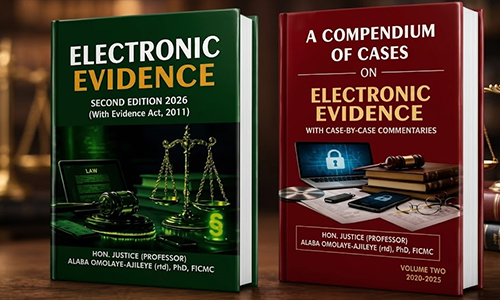
 The book also examines Nigeria's legal ecosystem, focusing on the LPELR and NBA AI Guidelines. As a bonus, every purchase comes with a FREE eBook titled: How to Use the AI Features in LegalPedia and LawPavilion.
Ohio Books Ltd praises the publication, stating:
"....this is the only Nigerian book I know of on the topic."
How to Order:
📞 Call, Text, or WhatsApp: 08034917063 | 07055285878
📧 Email: benadigwe1@gmail.com
🌎 Website: www.benadigwe.com
Ebook Version: Access it directly online at https://selar.com/prv626
Authored by Ben Ijeoma Adigwe Esq., ACIarb (UK), LL.M, Dip. in Artificial Intelligence, Director at the Delta State Ministry of Justice, Asaba, Nigeria.
_______________________________________________________________________
The book also examines Nigeria's legal ecosystem, focusing on the LPELR and NBA AI Guidelines. As a bonus, every purchase comes with a FREE eBook titled: How to Use the AI Features in LegalPedia and LawPavilion.
Ohio Books Ltd praises the publication, stating:
"....this is the only Nigerian book I know of on the topic."
How to Order:
📞 Call, Text, or WhatsApp: 08034917063 | 07055285878
📧 Email: benadigwe1@gmail.com
🌎 Website: www.benadigwe.com
Ebook Version: Access it directly online at https://selar.com/prv626
Authored by Ben Ijeoma Adigwe Esq., ACIarb (UK), LL.M, Dip. in Artificial Intelligence, Director at the Delta State Ministry of Justice, Asaba, Nigeria.
_______________________________________________________________________