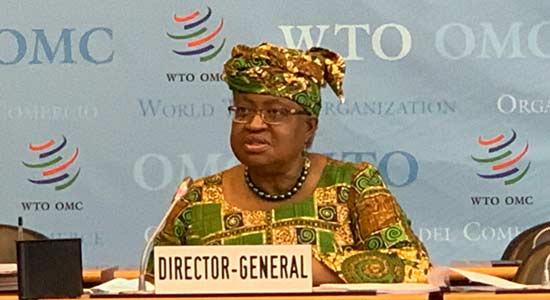
The Director-General of the World Trade Organisation, Dr Ngozi Okonjo-Iweala, has urged Nigeria and other African countries to deliberately process and add value to the continent’s vast mineral resources before exporting them.
Okonjo-Iweala made the call on Wednesday in Abuja while speaking at the 7th African Emerging Markets Forum hosted by the Central Bank of Nigeria.
She warned that Africa remained excessively dependent on other countries for essential commodities despite possessing about 30 per cent of the world’s mineral reserves.
According to her, the continent must abandon the traditional model of extracting and exporting raw materials, which she said had contributed to economic volatility, poor performance, corruption, conflict and banditry.
“Africa holds an estimated 30 per cent of the world’s mineral reserves. Instead of the extract-and-export model that has been the source of so much volatility, economic underperformance, corruption, conflict and banditry, the goal should be higher-value and higher-productivity growth,” she said.
She explained that such growth should be driven by the development of subregional value chains and Africa’s integration into global supply networks.
Okonjo-Iweala said current geopolitical developments had created an urgent opportunity for African countries to benefit from the growing demand for diversified critical-mineral supply chains.
“Quite frankly, the time to seize this opportunity is now, as geopolitics exerts some demand pressure for critical-mineral supply-chain diversification. If we miss this opportunity, I am afraid we would have missed a lot,” she said.
The WTO chief noted that some African countries had already begun taking steps to process their minerals locally.
She cited Morocco’s use of phosphate resources to manufacture electric-vehicle components for international markets, particularly Chinese automobile manufacturers.
She also identified Zambia, the Democratic Republic of Congo, Mozambique, Angola and Nigeria as countries making efforts to add value to critical minerals.
However, she warned that such initiatives needed to be systematised and harmonised through regional cooperation to prevent individual countries from being drawn into unfavourable bilateral agreements.
“These efforts need more systematisation and harmonisation, including a look at subregional approaches so that countries are not picked up one by one in suboptimal bilateral agreements,” she said.
Okonjo-Iweala added that Africa could develop a competitive advantage in the green economy by using its abundant renewable-energy resources to power mineral-processing industries.
She said efforts to reform the multilateral trading system and broaden the global economic base were complementary pathways to achieving greater resilience in international trade.
According to her, African and other developing countries seeking substantial investments must improve their business environments, strengthen physical and institutional infrastructure, and maintain stable macroeconomic conditions.
“To attract the kind of investments we have been talking about, developing countries will need to improve their business climate, upgrade hard and soft infrastructure and provide a stable macroeconomic environment,” she said.
Okonjo-Iweala also urged African countries to increase trade among themselves, observing that intra-African commerce remained too low.
She said the African Continental Free Trade Area offered the continent an opportunity to expand regional value chains, process its resources and increase economic integration.
In his address, the Governor of the Central Bank of Nigeria, Olayemi Cardoso, said intra-African trade still accounted for only about 16 per cent of the continent’s total trade.
Cardoso said African countries must develop stronger regional value chains, produce more of the goods they consume and increase commerce among themselves.
“With intra-African trade still accounting for only about 16 per cent of our total trade, we must build stronger regional value chains, produce more of what we consume and trade more with one another,” he said.
He described the African Continental Free Trade Area as a platform capable of turning current changes in the global economy to Africa’s advantage.
However, he said African governments must move beyond signing agreements and address practical barriers to trade by improving transport networks, harmonising customs standards and making cross-border payments faster and more affordable.
Cardoso also warned that international capital had become more selective and less tolerant of economic and political uncertainty.
According to him, the era in which abundant global liquidity pursued returns without adequate consideration of risks had ended, as investors now had more options and demanded greater certainty.
He said capital increasingly flowed to jurisdictions offering credibility, transparency, policy consistency, strong institutions and quality governance.
The CBN governor argued that Africa’s development ambitions could not depend solely on foreign capital and called for the mobilisation of domestic resources, including pension and insurance funds, savings and diaspora investments.
“We must mobilise more of our own resources, including pension and insurance funds, domestic savings and diaspora capital, and channel them towards productive domestic investment,” he said.
Cardoso said investors must be able to trust African policies, understand applicable rules and make long-term plans extending beyond political and economic cycles.
He described credibility as not merely a central banking concern but a national economic asset.
The CBN governor also highlighted the growing influence of artificial intelligence, saying the technology was reshaping production, service delivery and the skills required to compete in the global economy.
The Founding Director and Chief Executive of the Emerging Markets Forum, Harinder Kohli, similarly maintained that Africa would achieve faster economic growth by increasing trade among its countries.
The forum was attended by representatives of financial institutions, business leaders and other participants from around the world.
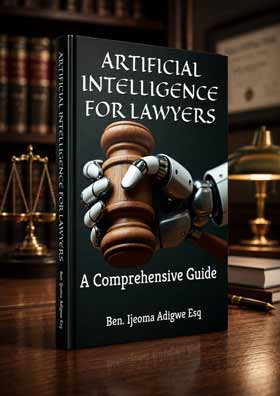 The book also examines Nigeria's legal ecosystem, focusing on the LPELR and NBA AI Guidelines. As a bonus, every purchase comes with a FREE eBook titled: How to Use the AI Features in LegalPedia and LawPavilion.
Ohio Books Ltd praises the publication, stating:
"....this is the only Nigerian book I know of on the topic."
How to Order:
📞 Call, Text, or WhatsApp: 08034917063 | 07055285878
📧 Email: benadigwe1@gmail.com
🌎 Website: www.benadigwe.com
Ebook Version: Access it directly online at https://selar.com/prv626
Authored by Ben Ijeoma Adigwe Esq., ACIarb (UK), LL.M, Dip. in Artificial Intelligence, Director at the Delta State Ministry of Justice, Asaba, Nigeria.
______________________________________________________________________
[A MUST HAVE] Evidence Act Demystified With Recent And Contemporary Cases And Materials
The book also examines Nigeria's legal ecosystem, focusing on the LPELR and NBA AI Guidelines. As a bonus, every purchase comes with a FREE eBook titled: How to Use the AI Features in LegalPedia and LawPavilion.
Ohio Books Ltd praises the publication, stating:
"....this is the only Nigerian book I know of on the topic."
How to Order:
📞 Call, Text, or WhatsApp: 08034917063 | 07055285878
📧 Email: benadigwe1@gmail.com
🌎 Website: www.benadigwe.com
Ebook Version: Access it directly online at https://selar.com/prv626
Authored by Ben Ijeoma Adigwe Esq., ACIarb (UK), LL.M, Dip. in Artificial Intelligence, Director at the Delta State Ministry of Justice, Asaba, Nigeria.
______________________________________________________________________
[A MUST HAVE] Evidence Act Demystified With Recent And Contemporary Cases And Materials

 Interested buyers are encouraged to place their orders and enquiries via:
0704 444 4777, 0704 444 4999, 0818 199 9888
Website: www.alexandernigeria.com
Interested buyers are encouraged to place their orders and enquiries via:
0704 444 4777, 0704 444 4999, 0818 199 9888
Website: www.alexandernigeria.com