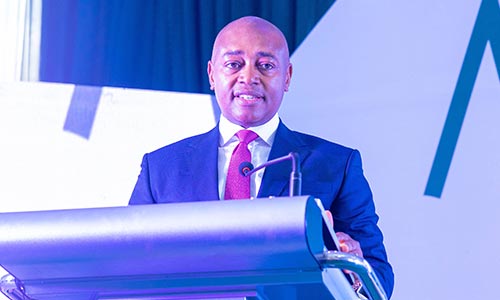
The Deputy Governor of Enugu State, Ifeanyi Ossai, Esq., through his lawyers led by Ikechukwu Onuoma, SAN, of Obra Legal LP, has issued a seven-day ultimatum to SaharaReporters demanding the immediate retraction, public apology, and disclosure of the identity of every individual responsible for a publication titled “Exclusive: Residents of Enugu Deputy Governor’s Community Lament Lack of Clean Water, Forced to Share Polluted Stream with Cattle,” threatening to pursue “all remedies available under the laws of the Federal Republic of Nigeria, including proceedings for appropriate declaratory, injunctive, compensatory, aggravated, exemplary, and any other reliefs the Court may deem just” if the demands are not met.

The demand letter, dated July 8, 2026, was addressed to the Editor-in-Chief of SaharaReporters at the publication’s office at No, 46b Adekunle Fajuyi Way Ikeja, Lagos., Ikeja, Lagos
The publication in question, dated July 7, 2026, reported that residents of Urukpa Ezimo Community in Udenu Local Government Area of Enugu State, described as the hometown of the Deputy Governor, have decried years of government neglect and continued dependence on a single contaminated stream for drinking water despite repeated promises of potable water projects.
SaharaReporters reported that residents of Urukpa Ezimo Community still depend on a single contaminated stream, Iyi Urukpa, which they said has served as the community’s only source of drinking water for generations. The publication stated that the situation has “deteriorated into a public health emergency as both humans and livestock now depend on the same water source.”
Photographic evidence obtained by the publication showed what was described as severe degradation of the water source: the surface of the primary water pool “visibly clouded, dynamic with floating organic debris, and completely discolored by heavy silt runoff,” and residents navigating “a steep, slippery dirt trail thoroughly churned into deep mud by foot traffic and erosion to access a rudimentary concrete containment basin holding a heavily stagnant, brown, and muddy mixture.”
Residents were quoted making several allegations. One stated: “The same water our children drink is the same water where cattle drink and defecate. The stream has become polluted, but we have no alternative because every government promise to provide potable water has ended in disappointment.”
Another resident stated: “They come with fanfare, cameras and promises. They tell us potable water is our right, but after the elections everything disappears and we are left to continue fetching water from the same stream.”
A community leader, who requested anonymity “for fear of victimisation,” alleged that the community suffers beyond the lack of potable water from poor road access, limited employment opportunities, and the absence of meaningful government empowerment programmes. The leader further alleged that “political thugs were deployed during the recent by-election to intimidate residents.”
An elderly resident questioned: “If the hometown of the Deputy Governor cannot get a functional borehole, what hope is there for other rural communities?” The elder alleged that the electricity currently enjoyed by the community “was not a government project but was funded through community self-help efforts” and that “government officials claim the credit.”
Residents also stated that the only borehole in the community, constructed under the Agricultural Transformation Agenda Support Program Phase 1 (ATASP-1), is not accessible to residents. “It is managed by cronies and political family. Always locked unless instruction is provided,” a resident told the publication.
SaharaReporters stated that efforts to obtain the reaction of the Enugu State Government were unsuccessful as of the time of filing the report.
Onuoma SAN stated that while the publication was “ostensibly presented as a report concerning the availability of potable water in Urukpa Ezimo Community, it repeatedly and deliberately so, associates our Client with the allegations contained therein through its headline, structure, and editorial framing.”
“The unmistakable effect is to portray our Client as having neglected his community, abused the privileges of public office, failed in his constitutional responsibilities, or otherwise being complicit in the alleged conditions described in the publication,” the demand letter stated.
“The publication is calculated to convey to the ordinary and reasonable reader that our Client is indifferent to the welfare of his people and has failed to utilize his office to address the developmental needs of his hometown. These insinuations are false, misleading, unfair, and unsupported by any credible factual basis,” Onuoma SAN stated.
The demand letter raised two specific journalistic concerns.
First, the publication “contains numerous serious allegations attributed to anonymous individuals whose identities are undisclosed and whose claims appear to have been published without any verification.” The allegations include assertions relating to “political intimidation, mismanagement of public resources, and the alleged control of public infrastructure by unnamed ‘cronies.'”
Second, “despite the gravity of these allegations and their obvious injurious effect on our client’s reputation, no opportunity was afforded to our Client to respond before publication.”
“The deliberate invocation of our Client’s office throughout the article serves no legitimate journalistic purpose beyond creating sensationalism and inviting public opprobrium against him,” Onuoma SAN stated.
The demand letter stated that the publication has “exposed our client to ridicule, public contempt, reputational injury, and unwarranted hostility both within and outside Nigeria.”
“This has gradually snowballed into our client being harassed or bullied online which has led to reputational damage. Recent political and business engagements have been lost upon reading your publication,” the letter stated.
The Deputy Governor’s legal team described the publication as “false to the knowledge of the publishers, malicious, reckless, highly prejudicial, gravely defamatory and sponsored to arouse political antagonism.”
The demand letter set out four specific demands to be complied with within seven days:
First, that SaharaReporters pull down the publication in its entirety from all platforms, digital or otherwise, archives, and social media accounts under its control.
Second, that SaharaReporters publish “a clear, unequivocal, and prominently displayed retraction acknowledging that the publication unjustifiably associated our Client with the allegations contained therein.”
Third, that SaharaReporters publish “an unreserved public apology to our Client on your website and on every social media platform through which the publication was disseminated, with prominence substantially equivalent to that of the original publication.”
Fourth, that SaharaReporters provide “the full identity, designation, and contact details of the source and every individual directly or constructively responsible for the defamatory article.”
The demand letter stated that failure to comply within the seven-day period would result in the Deputy Governor pursuing “all remedies available under the laws of the Federal Republic of Nigeria, including proceedings for appropriate declaratory, injunctive, compensatory, aggravated, exemplary, and any other reliefs the Court may deem just,” without further notice.
“Nothing contained in this correspondence shall be construed as a waiver of any of our Client’s rights or remedies, all of which are expressly reserved,” Onuoma SAN stated.
The dispute presents two starkly different narratives.
The residents’ narrative, as reported by SaharaReporters, is one of a community that has been neglected despite its association with the state’s second-highest ranking official, where families depend on a contaminated stream shared with cattle, where successive administrations have made promises during election periods without delivering, where the only borehole is locked and controlled by insiders, where the community funded its own electricity that government officials take credit for, and where political thugs were deployed during the recent by-election.
The Deputy Governor’s narrative, as articulated through his lawyers, is that the publication deliberately and maliciously associated him with conditions that are not his responsibility, used anonymous sources whose claims were not verified, denied him the opportunity to respond before publication, served no legitimate journalistic purpose, and was sponsored to arouse political antagonism against him.
The demand for disclosure of the sources’ identities raises a separate question about press freedom and source protection. Journalists routinely grant anonymity to sources who fear victimisation for speaking about powerful individuals or institutions. The community leader quoted in the publication specifically requested anonymity “for fear of victimisation.” A demand that the publication identify such sources could have a chilling effect on the willingness of community members to speak about conditions in their localities, particularly where powerful political figures are involved.
SaharaReporters has not publicly responded to the demand letter as of the time of this report.
The demand letter was signed by Ikechukwu Onuoma, SAN, Managing Partner, Obra Legal LP, on behalf of His Excellency Ifeanyi Ossai, Esq., Deputy Governor of Enugu State.
[A MUST HAVE] Evidence Act Demystified With Recent And Contemporary Cases And Materials

Available now for NGN 40,000 at ASC Publications, 10, Boyle Street, Onikan, Lagos. Beside High Court, TBS. Email publications@ayindesanni.com or WhatsApp +2347056667384. Purchase Link: https://paystack.com/buy/evidence-act-complete-annotation
______________________________________________________________________ “Enhance Legal Practice With Authoritative Reports” — Alexander Payne Offers Comprehensive Law Reports, Spanning Over A Century Of Nigerian Jurisprudence Interested buyers are encouraged to place their orders and enquiries via:
0704 444 4777, 0704 444 4999, 0818 199 9888
Website: www.alexandernigeria.com
Interested buyers are encouraged to place their orders and enquiries via:
0704 444 4777, 0704 444 4999, 0818 199 9888
Website: www.alexandernigeria.com