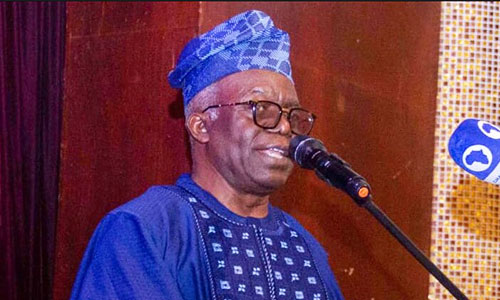
Human rights lawyer and Senior Advocate of Nigeria, Femi Falana, SAN, has said the 2027 general election must go beyond the emergence of new political leaders and mark a renewed commitment to security, good governance, human rights, accountability and human dignity.


Falana stated this in a paper titled, “2027: Building A Nation Where No Man Is Oppressed,” delivered at an event held in honour of the late Chief Alao Aka-Bashorun, one of Nigeria’s foremost defenders of constitutionalism and civil liberties.
He called on Nigerian authorities at all levels to uphold the human rights of citizens, respect the rule of law and ensure that democratic institutions genuinely serve the people.
According to Falana, Nigeria is approaching a defining constitutional and democratic moment, and the real challenge before the country is not merely the conduct of elections but whether the nation can build a democratic order founded on justice, accountability, credible institutions and respect for human rights.
“The protection of human rights also remains central to Nigeria’s democratic future. Civil liberties, socio-economic rights and meaningful access to justice are not peripheral democratic values but essential conditions for national development,” he said.
He noted that a nation’s progress should not be measured only by economic indicators, but also by the extent to which it protects the dignity, freedoms and rights of its people.
Falana said the problems confronting Nigeria are well known, stressing that what has been lacking is the political will to address them through institutional reforms and faithful implementation of the Constitution.
He said the 2027 elections should represent more than another electoral cycle, but the beginning of a new commitment to constitutional governance and democratic accountability.
“At the centre of this national renewal must be security,” he said.
“No democratic society can flourish while citizens continue to live under the constant threat of violence, kidnapping, terrorism, communal conflict and criminality. The protection of lives and property remains the foremost constitutional responsibility of government.”
Falana said political oppression occurs when public institutions established to serve the people are manipulated to serve narrow interests.
He warned that democracy is not only about elections but also about continuous citizen participation, transparency, accountability, inclusion and respect for the rule of law.
According to him, many Nigerians increasingly see political power as an avenue for personal enrichment rather than public service, while institutions that ought to be impartial are often subjected to political interference.
He identified abuse of state institutions, electoral manipulation, vote buying, abuse of incumbency and post-election litigation as factors weakening public confidence in democracy.
“A democracy in which citizens lose confidence in the electoral process creates fertile ground for oppression because political leaders become less accountable to the people and more accountable to the interests that facilitated their emergence,” he said.
Falana also decried what he described as democratic exclusion, noting that young people, women and persons living with disabilities remain underrepresented in governance.
He warned that the democratic space is shrinking, with citizens who criticise government or protest against unpopular policies being charged with offences such as terrorism, treasonable felony, cyberstalking or threats to public order.
The senior advocate said criticism of government should not be treated as a threat to national security, but as an essential part of accountable governance.
“The strength of a democracy is measured not by how it treats its supporters but by how it treats dissenting voices,” he said.
Falana also described economic oppression as one of the most widespread forms of oppression affecting Nigerians.
He said millions of citizens remain trapped in severe deprivation despite Nigeria’s natural and human resources, blaming governance failures, structural inequality and diversion of public resources from public purposes.
He cited rising food prices, transportation costs, unaffordable housing, poor access to healthcare and education, unemployment and widening inequality as major threats to social justice and democratic stability.
According to him, youth unemployment is a serious dimension of economic oppression, as millions of energetic and innovative young Nigerians remain unemployed or underemployed despite their potential.
Falana further noted that healthcare and education remain major challenges, adding that preventable illnesses have become death sentences for many citizens because of poverty and poor access to medical care.
He said about 18.5 million children remain outside the formal education system, a figure he said has worsened due to the abduction of schoolchildren and teachers.
“A nation that neglects education mortgages its future,” he said.
On housing, Falana said millions of Nigerians live in inadequate conditions without access to basic infrastructure, while rising accommodation costs have placed decent housing beyond the reach of many citizens.
He also called attention to the plight of persons living with disabilities and other vulnerable groups, saying a just society must dismantle barriers preventing full participation in economic, social and political life.
Falana described insecurity as one of the clearest manifestations of oppression in Nigeria, noting that many communities continue to suffer kidnapping, banditry, terrorism, communal violence and organised criminality.
He said insecurity has displaced communities, forced farmers to abandon their farms, shut businesses, disrupted schools and left families in fear.
Citing Section 14(2)(b) of the Constitution, he said the security and welfare of the people remain the primary purpose of government.
“A nation where citizens cannot travel safely, farm safely, learn safely or conduct business safely cannot be said to have fulfilled the minimum obligations of democratic governance,” he said.
Falana called for a comprehensive rethinking of Nigeria’s security architecture, stronger accountability mechanisms, improved intelligence gathering, greater community participation and renewed commitment to protecting human life.
He also said the objectives of the June 12 struggle have not been fully achieved, noting that although elections are regularly conducted, concerns about electoral credibility persist.
He warned that the slogan “one man, one vote” becomes meaningless in a country where votes are allegedly purchased by moneybags.
Falana maintained that political liberty without economic justice is incomplete, adding that democracy must translate into improved living standards for the people.
He also criticised what he described as an accountability deficit in public life, saying public office is increasingly treated as privilege rather than trust.
He urged Nigerians to use the Freedom of Information Act to demand accountability in public expenditure, legislative allowances, procurement processes and the management of public resources.
“Ultimately, oppression thrives where institutions fail. The challenge before Nigeria is not merely to condemn oppression but to dismantle the political, economic, social and security structures that sustain it,” he said.
“Only then can we begin the journey toward a society founded on justice, equality and human dignity for all.”
The paper was issued by Falana and Falana Chambers on June 28, 2026.
 The book also examines Nigeria's legal ecosystem, focusing on the LPELR and NBA AI Guidelines. As a bonus, every purchase comes with a FREE eBook titled: How to Use the AI Features in LegalPedia and LawPavilion.
Ohio Books Ltd praises the publication, stating:
"....this is the only Nigerian book I know of on the topic."
How to Order:
📞 Call, Text, or WhatsApp: 08034917063 | 07055285878
📧 Email: benadigwe1@gmail.com
🌎 Website: www.benadigwe.com
Ebook Version: Access it directly online at https://selar.com/prv626
Authored by Ben Ijeoma Adigwe Esq., ACIarb (UK), LL.M, Dip. in Artificial Intelligence, Director at the Delta State Ministry of Justice, Asaba, Nigeria.
_______________________________________________________________________
“Enhance Legal Practice With Authoritative Reports” — Alexander Payne Offers Comprehensive Law Reports, Spanning Over A Century Of Nigerian Jurisprudence
The book also examines Nigeria's legal ecosystem, focusing on the LPELR and NBA AI Guidelines. As a bonus, every purchase comes with a FREE eBook titled: How to Use the AI Features in LegalPedia and LawPavilion.
Ohio Books Ltd praises the publication, stating:
"....this is the only Nigerian book I know of on the topic."
How to Order:
📞 Call, Text, or WhatsApp: 08034917063 | 07055285878
📧 Email: benadigwe1@gmail.com
🌎 Website: www.benadigwe.com
Ebook Version: Access it directly online at https://selar.com/prv626
Authored by Ben Ijeoma Adigwe Esq., ACIarb (UK), LL.M, Dip. in Artificial Intelligence, Director at the Delta State Ministry of Justice, Asaba, Nigeria.
_______________________________________________________________________
“Enhance Legal Practice With Authoritative Reports” — Alexander Payne Offers Comprehensive Law Reports, Spanning Over A Century Of Nigerian Jurisprudence
 Interested buyers are encouraged to place their orders and enquiries via:
0704 444 4777, 0704 444 4999, 0818 199 9888
Website: www.alexandernigeria.com
Interested buyers are encouraged to place their orders and enquiries via:
0704 444 4777, 0704 444 4999, 0818 199 9888
Website: www.alexandernigeria.com